A Short Video on Building Personal Resilience The second video is a good cartoon introduction to the idea of Emotional Intelligence. It has some good examples and insights, but occasionally has some misses. Try it out first yourself and see if it might be helpful sharing with a student. Bookmark Please login to bookmark ClosePlease login to access.
Dyslexia and Stronger Emotional Responses [Premium]
Neuroscientists at the University of California San Francisco, just reported their finding that dyslexic children ages 7-12 showed stronger emotional responses as measured by a variety of measures than their non-dyslexic peers. From the study abstract: “..we examined whether right-hemisphere-based emotional reactivity may be elevated in dyslexia. We measured emotional reactivity (i.e., facial behavior, physiological activity, and subjective experience) in 54 children ages 7–12 with (n = 32) and without (n = 22) dyslexia while they viewed emotion-inducing film clips. Participants also underwent task-free functional magnetic resonance imaging. Parents of children with dyslexia completed the Behavior Assessment System for Children, which assesses real-world behavior. During film viewing, children with dyslexia exhibited significantly greater reactivity in emotional facial behavior, skin conductance level, and respiration rate […]
Tips From Hannah: College Junior with a 4.0 [Premium]
KNOW YOUR STRENGTHS – SELF-ADVOCATE – Early in group work, let your fellow students know that you’re dyslexic. Say, “I’m dyslexic, so I can’t read or write well, but I’m creative and can come up with ideas.” – Don’t be afraid of asking students to read things for you. You can help more if people read things aloud to you. – Research on RateMyProfessor ahead of time to find teachers that will work with you re: dyslexia. Are there any warning signs? I like choosing professors who like a lot of class participation. ASK FOR SUBSITUTIONS IF YOU NEED THEM When snow days upset the schedule at school, Hannah had to face learning material and putting together an assignment over Thanksgiving break without the help […]
Dyslexic MIND Strengths… for Kids!
Q: What can you tell me about MIND strengths and dyslexia? A: MIND-Strengths was a concept that we developed in our 2011 book, The Dyslexic Advantage. Both the book and the concept had their origin in our observations that dyslexic people not only shared certain kinds...
How to Avoid Delays in Identifying and Helping Students With Dyslexia Due to COVID-19
With news of the disruption in special education assessments across the country, I asked Brock to comment on the situation and share how the Neurolearning app could be helpful. The app is available for students ages 7 - 70. By Brock Eide MD: A recent article in...
STEM: Talent Development for Dyslexic Students [Premium]
Just from the strengths perspective, we might expect that many dyslexic students would excel in science and technology. STEM jobs often require strengths in real world problem solving that depend on powers of observation, analytical ability, pattern recognition, and synthesis, or putting different pieces of information together. The problem is, dyslexic students may get few opportunities to observe and dabble in “real science”, unless they go out looking for it. Recently, I had a chance to catch up with Dr. Doresa Jennings, an amazing homeschooling mom who we all can learn from in terms of how she designed educational plans that build on students strengths. Even if your kids aren’t yet strong in science or technology, Doresa’s advice is worth listening to. Here are three […]
Understanding Your Dyslexic Advantages Have Implications for Action and Leadership
As it turns out, the advantages that come with being dyslexic are not little skills that don't amount to something. In fact, just the opposite. The advantages and abilities that come with dyslexic thinking are "big hairy audacious" skills if you've heard about that...
Dyslexic Advantage in Translation
We received inquiries about Dysexic Advantage from India and Italy. Our book The Dyslexic Advantage is now translated into Spanish, Chinese (coming), Japanese (coming), Korean, Polish, and Dutch, but also our ENTIRE DyslexicAdvantage.org website can be...
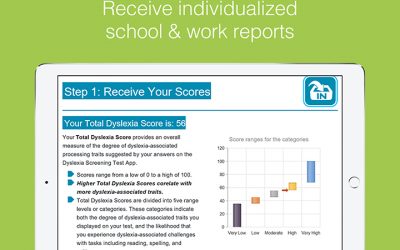
INTERVIEW: Dr. Brock Eide & the Neurolearning Dyslexia App
After writing The Dyslexic Advantage and co-founding this non-profit, why did you decide to create this innovative dyslexia screening app? After 20 years working in this field it's become clear that the biggest problem facing dyslexic people is access. That includes...
Unleash Dyslexic Writing with Dr. Nicole Swedberg [Premium]
In step-by-step fashion, learn how to unleash the dyslexic writing talent of students through Dr. Nicole Swedberg’s idea of Mini-Writes. In her talk, Dr. Swedberg talks about short writing assignments can help students master small achievable goals. She describes how she can take a student through the writing process in 1-3 sessions. Some strategies include using wordless picture books, a word bank, and afterwards a routine involving spellcheck and finally use of text-to-speech for each sentence. Other topics include strategies for overcoming a report meltdown and strategies for note taking using assistive technology. Dr. Nicole Swedberg has generously donated this 20-minute webinar on Teaching Writing to LD Kids as a fundraiser to support the programs here at Dyslexic Advantage and we are very grateful. […]
The Unappreciated Benefits of Dyslexia
This article can be read aloud or translated into over 70 languages by using the red ReciteMe button at top left. To close Reciteme, click the "X" at top right. This Q & A was originally published in Wired Magazine. Normally dyslexia is considered a handicap: a...
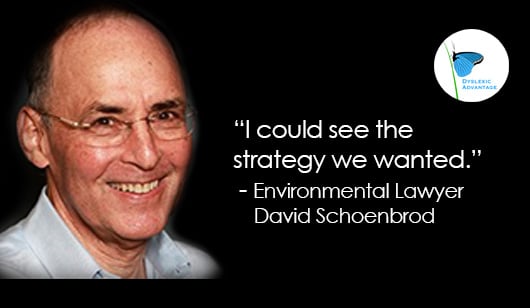
Dyslexia | Environmental Law Pioneer David Schoenbrod
David Schoenbrod is a pioneering environmental attorney on faculty at New York Law School. Since his start in doing anti-poverty community development under a program initiated by Bobbie Kennedy, he has used out-of-the-box dyslexic big picture thinking to trigger a...