A UK research group conducted a genome-wide association study of dyslexia, ADHD, autism, anorexia, anxiety, bipolar, major depression, obsessive compulsive disorder, Schizophrenia, and Tourettes Syndrome.


![Creativity and Its Connection Dyslexia, ADD / ADHD, and Low Working Memory [Premium]](https://www.dyslexicadvantage.org/wp-content/uploads/2018/03/Screen-Shot-2019-08-30-at-10.49.07-AM.jpg)
Creative companies and groups seem to have higher than average representation of people with dyslexia, ADD/ADHD, and low working memory. Dyslexia is associated with increased divergent and exploratory thinking, but what does ADD/ ADHD or low working memory have to do with creativity? A tech person might ask – is it a bug or a feature? We think it’s a feature, just like dyslexia.If dyslexia, ADD/ADHD and low working memory were all bad, you wouldn’t see an over-representation in creative industries. Attention and working memory have been suggested to be two sides of a neural coin. While attention is like a spotlight directed at certain parts of the outside world, working memory is like a spotlight directed at internal thoughts, information, or instructions. HIGH FUNCTIONING […]

This question came through our webinar last month and I thought we could respond to it in more detail in our newsletter. There can be a high degree of overlap between individuals diagnosed with ADHD and dyslexia. Both dyslexia and ADHD can run in families and both can be associated with creativity, giftedness, and lower working memory. Dyslexia is usually identified through a “clinical diagnosis” with a professional looking at gaps between certain measures of IQ – like verbal reasoning and comprehension, and lower than expected single word or pseudoword reading (fake words that need to be sounded out and so reflect phonological awareness), naming speed, oral reading accuracy and speed, spelling, and impaired automaticity with writing by hand. An entire book can be […]
![Strengthening Executive Function Skills [Premium]](https://www.dyslexicadvantage.org/wp-content/uploads/2023/02/Strengthening-Executive-Function-Skills-Premium-Dyslexic-Advantage-400x250.png)
“Reading isn’t the most challenging part of dyslexia. It’s the executive function…” Executive function consists of different sets of processes in the brain that act like executives in business. Executives supervise all the activities and resources – organizing and prioritizing activities, developing plans, and making sure actions are properly executed. CHALLENGES AMONG CHILDREN AND ADULTS Executive function challenges that are commonly reported among dyslexic children and adults include limitations in working memory, task monitoring, inhibitory control, set-shifting, and organization (read more here). What that pattern also often means is that learning and working efficiency is at its best when information and tasks can be processed in smaller bits, a system is developed for checking and double-checking work, non-distracting learning and work environments are essential, and […]

A nice family-friendly movie based on a true story is “Rescued by Ruby”. It’s a story of a high-spirited and difficult-to-train animal shelter dog who met up with a high-spirited and difficult-to-train state policeman (Daniel O’Neil). The two connected on multiple levels to make an against-the-odds rescue of a young boy who was lost for 36 hours after he took a bad fall and was knocked unconscious. Daniel, the policeman, is dyslexic with ADHD and what comes through in the movie is how important it is to have different learners of all types in difficult real world scenarios. By all accounts, Ruby, an Australian shepherd and border collie mix, was intelligent and also difficult to train using standard approaches. She was placed and returned the […]
![White Noise Improves Reading Skills and Memory in Reading Disabilities [Premium]](https://www.dyslexicadvantage.org/wp-content/uploads/2021/09/White-noise-2-400x250.jpg)
Some of you may remember research in the past that showed that individuals with dyslexia have more difficulty screening out background noise (discussed in the news HERE). Students or adults with this difficulty can usually request quiet area for work or test-taking under the ADA or Americans for Disabilities Act. Now another research group has tested the effect of “white noise” on reading skills and memory recall in children with a reading disability. From the paper: “The study was conducted with a group of 30 children with RD and phonological decoding difficulties and two comparison groups: one consisting of skilled readers (n = 22) and another of children with mild orthographic reading problems and age adequate phonological decoding (n = 30). White noise […]
![Learning with Dr. Sara Renzulli [Premium]](https://www.dyslexicadvantage.org/wp-content/uploads/2021/09/learning-with-dr-sara-1-400x250.png)
“I was identified as dyslexic and having ADHD in the fifth grade. I struggled quite a bit academically…” — Sara Renzulli, PhD, Visiting Professor, U Conn Recently I had the pleasure of talking to Dr. Sara Renzulli, a teacher in the Counselor Education department at the University of Connecticut, and daughter of illustrious educators, Drs. Joseph Renzulli and Sally Reis. I had discovered Sara’s interview at the 2E Newsletter and read some research publications of her work with college students. “My dyslexia made it extremely hard to learn how to read. I remember being so frustrated. If things were explained to me orally or read out loud to me, I understood what was going on. I just couldn’t decode words on my own […]
![The Writing Process From a University Tutor [Premium]](https://www.dyslexicadvantage.org/wp-content/uploads/2020/09/Screen-Shot-2020-06-16-at-8.54.47-PM-400x250.png)
I recently came across a helpful account from a university-based tutor who worked with a fellow college student at Reed. There are many points that are helpful to consider if you are working with a student in the area of writing. For some, writing is the most frustrating task they are likely to encounter in school. It is often the gateway to higher education and most common way their knowledge and ideas are assessed as they progress through education. The full article is HERE. She begins with a disclaimer, recognizing that she is “no expert,” but I think she is an expert of sorts, having worked through many difficult challenges with her student and helping him to reach a higher level of proficiency. “As my […]

Like it or not, when Fall rolls around, many of us may need to school from home whether it's our first choice or not. What if your student is dyslexic? Can it possibly work? There are a lot of people who can't see schooling from home working for their student, but...
![READING FLUENCY: Phrase Cueing [Premium]](https://www.dyslexicadvantage.org/wp-content/uploads/2020/01/phrase-craze-3-400x250.jpg)
Once students have made significant progress with single word decoding, reading fluency practice can be rolled into reading practice with phrase cueing. HERE is a nice review of reading fluency approaches that includes a discussion of phrased reading. Phrase scooping or cueing involved the drawing of scoops underneath groups of words that go together in parts of a phrase. Combining scooped words with choral reading or echo reading can help students get practice with both reading and listening for phrases. Intervention Central has a Phrase Cued Text Generator, but it’s so-so. It’s better to break sentences into 3-6 word phrases to increase the ease of reading. From Steve Peha, check out the example below: Of course these shorter phrases also help with reading on a […]
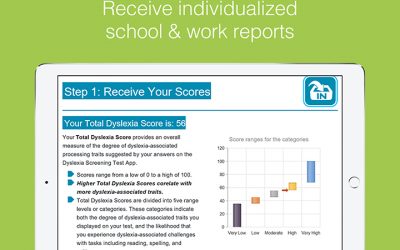
After writing The Dyslexic Advantage and co-founding this non-profit, why did you decide to create this innovative dyslexia screening app? After 20 years working in this field it's become clear that the biggest problem facing dyslexic people is access. That includes...

Resilience is a popular topic among today’s educational leaders, and for good reason. If you grow up with significant academic, social, or socio-economic stress, you’re more likely to still grow up as a happy, successful, and adaptive adult if you are resilient. Many external factors support resilience, like a supportive family or caregiver and stable home life, but individual factors are also important – and importantly there is substantial evidence that these can be learned. Studies of dyslexic children and adults almost universally show the significant degrees of stress that dyslexia can have in the school setting. In general, the period leading up to a formal ‘diagnosis’ or identification is especially stressful as individuals don’t know why school tasks are difficult or they are underperforming. […]