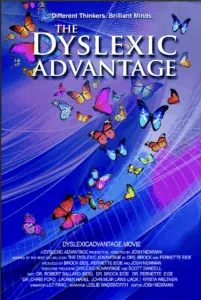
An inside look at how dyslexic strengths came alive on screen. This fall, the world will be invited to see dyslexia in a new light.
![Seeing Differently: Behind the Making of the Dyslexic Advantage Movie [Premium]](https://www.dyslexicadvantage.org/wp-content/uploads/2025/09/Behind-the-Making-of-Dyslexic-Movie-400x250.png.webp)

![The Why of Spelling [Premium]](https://www.dyslexicadvantage.org/wp-content/uploads/2025/03/why-of-spelling-3-400x250.png.webp)
![Strategies for Spelling [Premium]](https://www.dyslexicadvantage.org/wp-content/uploads/2025/03/Strategies-for-Spelling-D-400x250.png.webp)
![Dyslexia and Driver Assist or “Full Self-Driving Mode” [Premium]](https://www.dyslexicadvantage.org/wp-content/uploads/2025/03/Dyslexia-and-Driver-Assist-400x250.png.webp)
![Dyslexia in Everyday Life: Memory [Premium]](https://www.dyslexicadvantage.org/wp-content/uploads/2025/03/Dyslexia-in-Everyday-Life-C.png)
![Understanding Dyslexia as an Adult [Premium]](https://www.dyslexicadvantage.org/wp-content/uploads/2023/10/dyslexic-advantage-cambridge-400x250.png)
When I listened to music, I used to get really frustrated because I could never understand the words of a song that I had just heard for the first time… then I reread my report: “Isla struggles with auditory processing.” Now, I understand…that makes a lot of sense, something that I hadn’t thought about, which is why I think it’s so important.” – Isla McDade-Brown When Dr. Brock Eide was in England, he met up with young filmmaker Isla McDade-Brown from the University of York who was filming a documentary for her final Film and Television dissertation. Isla was identified with dyslexia at the age of eight, but now as a final year college student, she was reading her assessment as an adult and reflecting […]

It’s that time of year again when students have either started back or are beginning to start back to the school year and even old work routines. While some aspects of getting back to old routines are welcome, there are plenty of reasons why students, teachers, and parents will have mixed feelings getting into what things that may have been disrupted during the pandemic. THE POSITIVES First the positives. Students will enjoy seeing old friends again, sports, extracurriculars, and trying new things. Dyslexics may thrive in personal interactions – social perception, empathy, teamwork, leadership – and this pandemic has been tough. Students learn from first-hand experiences and people. So, it’s nice to have more direct contact again. Other students may be significantly behind if your […]

“…dyslexics sometimes seem unusually well suited to deal with major changes — to being able to see opportunities inside of adversity. They are known to be particularly good at rethinking situations in an original way. They are known to be able to see what others cannot see. They are good at not being stuck with conventional views and conventional solutions. They have trouble reading and memorizing old knowledge — but they are often really good at creating new knowledge and insights.” — Thomas G. West Tom West, author of Seeing What Others Do Not See, In the Mind’s Eye, and Thinking Like Einstein, has a wonderful article titled: Dyslexic Strengths in Times of Adversity. We thank the DAS, or Dyslexia Association of Singapore for letting […]
![Building Spatial Talents [Premium]](https://www.dyslexicadvantage.org/wp-content/uploads/2022/10/Building-Spatial-Talents.png)
“…Spatial reasoning has been key to numerous scientific advances, such as the discovery of the double-helix structure of DNA and the epidemiological research using maps to discover the true source of cholera outbreaks. It is also essential to many 21st-century careers, particularly in science and engineering… But are we able to see and support these particular kinds of talent in our classrooms?” — Lakin and Wai, Phi Delta Kappan What are spatial talents? In short, they are talents that involve visualizing objects and places in 3d and being able to manipulate them at will. These are talents that seem rich within the dyslexic community, but may be overlooked or neglected in conventional school activities. It’s an important strength set to recognize because it tends […]
![Dyslexic Super Learners [Premium]](https://www.dyslexicadvantage.org/wp-content/uploads/2022/10/Dyslexic-Super-Learners-C.png)
“This isn’t how I think either; this is how I have trained myself to think, because it works.” – Kevin Horsley, World Memory Champion and author of Unlimited Memory It seems surprisingly common that dyslexics are found among the world’s super-learners. It might be that all share a passion for understanding their memory strengths after suffering what may have been years in the school system, not realizing how to use their gifts. It also might be that dyslexics as a group have strengths in metacognition, especially when studied in selected groups like those found in universities. When Kirby and colleagues studied dyslexic and non dyslexic students in college, his study group of dyslexic students were more likely to use metacognition (i.e. thinking about their thinking), […]
![Actor Stephen Graham [Premium]](https://www.dyslexicadvantage.org/wp-content/uploads/2022/10/Stephen-Graham-1.png)
Actor Stephen Graham has been described as one of the most talented actors the United Kingdom has ever seen. Yet, he almost didn’t get a chance at his breakthrough role in Snatch when the director Guy Ritchie, asked whether he had come to read for the part. Stephen had just come along to support his friend who was trying to get the job, but when Guy found out that he was also an actor, he encouraged him to give it a try. Stephen told him that because he was dyslexic, he couldn’t do a cold read. I don’t know whether he knew that Guy Ritchie is also dyslexic – but fortunately for Stephen, Guy asked him to improvise the scene instead and he completely smashed […]