HOW THEY DO IT! University Students with Dyslexia [Premium]

Fortunately, there’s been growing interest from educational and scientific researchers for understanding how people can compensate for some of the academic challenges of dyslexia. POSITIVE FACTORS AMONG UNIVERSITY STUDENTS WITH DYSLEXIA A recent study by Drs. Rebecca Wiseheart and Lori Altmann (Int J Lang Comm Dis 2017) had a nice review of compensating factors as well as providing some new research data about oral fluency among college-attending dyslexic students. Background “In recent years, dyslexia has been reconceptualized as the combined sum of risk factors and protective factors. A number of protective factors have been investigated including verbal intelligence, vocabulary knowledge, morphological awareness, executive functions, and social-emotional resilience…Vocabulary knowledge has been implicated as a protective factor that allows some individuals to achieve good reading comprehension, despite […]

Bookmark

Please login to bookmark
Close
To access this post, you must be a Premium subscriber. log in

Bookmark
Please login to bookmark Close
read more

DYSLEXIA AT WORK: New Skills

Q: I’m working full-time and also am a mom. My employer recently told me that I need to learn new skills to earn a higher salary. My reading and writing aren’t the best.   A: Sounds like you’re carrying a full load! Without knowing the details of your occupation, a good general resources for the work place is https://askjan.org or the Job Accommodation Network. Their phone number is 1-800-526-7234. Title I of the ADA or Americans for Disabilities Act states that employers with 15 or more employees should consider providing reasonable accommodations for individuals who meet the criteria of having a disability. Here is a link to Ask Jan’s page of job coaches and accommodations. Job coaches can sometimes be paid for by the state’s […]

Bookmark

Please login to bookmark
Close
To access this post, you must be a Premium subscriber. log in

Bookmark
Please login to bookmark Close
read more

MATH: What Errors are Due to Dyslexia? [Premium]

Since Henry Winkler sat for a Geometry exam 8 TIMES before passing, one would hope that more progress has been made in understanding and anticipating what math difficulties arise with math problem solving, but few teachers (and perhaps fewer students!) receive explicit instruction in this area. Some of the math difficulties are due to language, but others are due to calculation errors, reversals, sequence, and direction, place value, as well as errors of verbal labeling and working memory which impact regrouping or carrying numbers. Miles and Miles have pointed out the confusion that results when dyslexic students are introduced to algebra. Math language is different from standard or conversational language. Ambiguous terms and symbols are best taught explicitly. For instance, Miles and Miles recommend explicitly […]

Bookmark

Please login to bookmark
Close
To access this post, you must be a Premium subscriber. log in

Bookmark
Please login to bookmark Close
read more

Motivation: The Batman Effect [Premium]

Researchers recently found that young children were more likely to persevere with tedious jobs that they were given to do if they pretended that they were Batman while doing it. There may be something to it. The researchers were studying self-regulation and perseverance in 180 kids ages 4 to 6 years old. The researchers compared 3 test situations: 1. First-person (“Am I working hard?”), 2. Third-person (“Is Billy working hard?”), and 3. Fictional Person (“Is Batman working hard?”). The effects were quite significant. This motivational effect was named after Batman because out of all the characters that were suggested to the children (Bob the Builder, Dora the Explorer, Rapunzel from Tangled, and Batman), children who chose Batman showed the greatest perseverance with the task! To […]

Bookmark

Please login to bookmark
Close
To access this post, you must be a Premium subscriber. log in

Bookmark
Please login to bookmark Close
read more

Dyslexic Innovation: GOOGLE (X) CAPTAIN Astro Teller [Premium]

Many of the world’s greatest innovators are dyslexic. These creators with a capital ‘C’, more often than not, arrive at their conclusions through wild leaps of their ideas rather than incremental, step-by-step invention. This pattern, which appears in so many accomplished people in every type of field and discipline, should be telling us what to look for in its raw form in young people, and what the end goal of the educational process should really be. A great case in point in Google’s X Lab Captain of Moonshots, Astro Teller.   Astro doesn’t talk a lot about his dyslexia, but he did relate this story about his dyslexia at an educational conference: “As a student in school, I fell into the habit of doing things […]

Bookmark

Please login to bookmark
Close
To access this post, you must be a Premium subscriber. log in

Bookmark
Please login to bookmark Close
read more

[PREMIUM] Realistic Confidence

We know that confidence can make a huge difference in course of people’s lives, but the question is how to avoid the extremes of underconfidence, which might lead to avoidance and underachievement, and overconfidence, which can also result in going off the rails. It was Albert Bandura, a founding father of scientific psychology who found that the best predictor of an individual person’s success is whether or not they believe they will succeed. But there’s an important caution here. There’s a difference between believing you will succeed and believing you will succeed easily…or to put it another way, there’s a difference between an unrealistic optimist and a realistic optimist. A realistic optimistic (or what some call a pessimistic optimist) anticipates that the path to success […]

Bookmark

Please login to bookmark
Close
To access this post, you must be a Premium subscriber. log in

Bookmark
Please login to bookmark Close
read more

[PREMIUM] Big Picture and Dyspraxia

The good news about dyspraxia is that there are many positive strategies that can significantly improve functioning. #1. SELF-AWARENESS – Self-awareness is the most important tool of children and adults with dyspraxia. There are many everyday classroom and real world tasks that can be extremely difficult or even impossible for a person with dyspraxia. Without being aware that something being asked of you is impossible, it’s easy to slide into negative thinking and self-deprecating behaviors which can pull you away from things that could actually help, like self-advocacy, technology, or training. #2. COORDINATION AND STRENGTH TRAINING – Coordination and motor strength are highly trainable, so it’s important to recognize that there’s a lot one can do to improve symptoms of dyspraxia. A common mistake is […]

Bookmark

Please login to bookmark
Close
To access this post, you must be a Premium subscriber. log in

Bookmark
Please login to bookmark Close
read more

Speak

To listen, select text and click sound button

WATCH NOW

OSPI STEM Course – STEM for Diverse Learners

Dyslexia and Gifted: Course for Psychologists

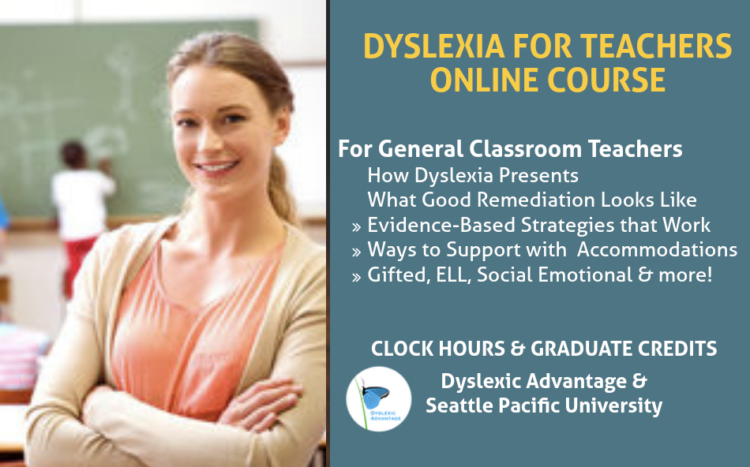
Dyslexia for Teachers Course

SPONSORS

    Discover Your Dyslexic MIND Strengths
                                    Free


Amazon Affiliate Notice

Dyslexic Advantage is an Amazon Affiliate. If you click on a link that takes you to the Amazon store, Dyslexic Advantage may earn money on qualifying purchases. Clicking HERE to enter Amazon and making a purchase may support Dyslexic Advantage. Thank you!