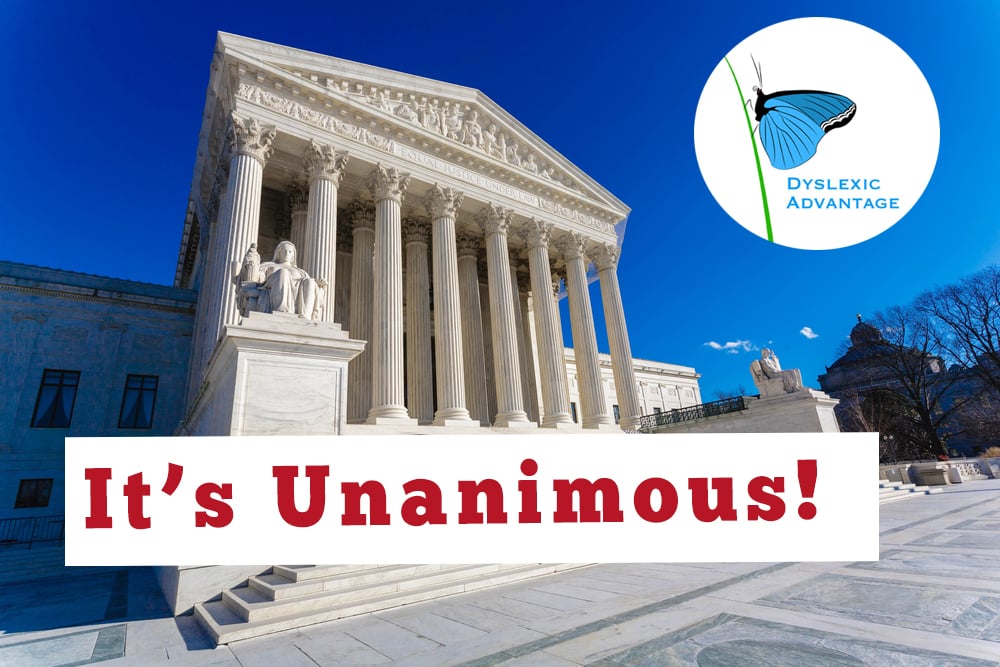
A GREAT Supreme Court Unanimous (8-0) was handed down that states that public schools must provide more than ‘de minimus’ or the bare minimum to benefit students with disabilities. The fact that some school systems (in this case, Douglas County) were fighting the case all the way to the Supreme Court tells you that there is a need to ensure that students are receiving an education that provides “appropriately ambitious progress.” The decision is very relevant to students with dyslexia because by definition, their intelligence is in the average or above average range. The case that was decided today was Endrew vs. Douglas County which involved a student with autism and attention deficit disorders whose parents removed him from public school in the fifth grade. He made […]
Improved College Board Guidelines for Test Accommodations
New from the College Board: "Beginning January 1, 2017, the vast majority of students who are approved for and using testing accommodations at their school through a current Individualized Education Program (IEP) or 504 Plan will have those same accommodations...
Q: How Can My Student Be Tested for Dyscalculia ? [Premium}
The last decade has seen a great advance in the biological understanding of dyscalculia, or math disability. The DSM V groups a specific learning disorder in math (315.1) under Specific Learning Disability along with impairment in reading (315.000) and impairment in written expression (315.2). The NIH defines dyscalculia as a condition contributes to “difficulty understanding arithmetic concepts and doing such tasks as addition, multiplication, and measuring.” It is important to identify dyscalculia, because an unrecognized LD can contribute to cycles of academic underachievement, secondary behavioral and emotional issues, and obstacles to further academic or workplace advancement. With the recent addition of high-stakes exams like the calculator-free section of the new SAT, it is even more critical that students with dyscalculia be identified. The DSM V definition includes the […]
Teaching Bilingual ELL Students with Dyslexia in the General Classroom [Premium]
Almost 1 out of every 10 students in public school classrooms are English Language Learners (ELLs). Because dyslexia is also common throughout the world (10-15%), some ELL students are dyslexic. For ELLs, identifying dyslexia can be a complicated process, sorting out the effects of language exposure, bilingualism (or multilingualism), and vocabulary in the 2nd language. Regardless, general education teachers can incorporate many ‘best practices’ that can support all of their students whether they ELL only ELL who are also dyslexic. The challenge for teachers of bilingual students is that they may not have an easy way of knowing how to factor in a student’s prior language instruction and exposure and how that impacts dyslexia per se. Whenever possible, students benefit by academic vocabulary and concept […]
ADHD / Gifted 2E Guidelines from Department of Education – Schools
In breaking news, the US Department of Education and Office for Civil Rights have released their a letter from Asst Secretary Catherine Lhamon and its Students with ADHD and Section 504 Resource Guide HERE. For your convenience, we also include them below -...