

Dyslexia is known for its high co-occurrence with other neurodevelopmental conditions.
Numerous studies have documented the high overlap (for review of the literature visit Brimo et al., 2021), but be aware that the literature is messy with different definitions of dyslexia and dyspraxia (sometimes referred to as developmental coordination disorder or DCD).
A large percentage – 25-40% – of dyslexic individuals also have a neurodevelopmental conditions such as dypraxia (motor difficulty), ADD, or dyscalculia. Interestingly, the presence of dyslexia is negatively correlated with autism spectrum-related inflexibility, a finding supportive of the hypothesis of Williams and Casanova (2010) which suggested that dyslexia and autism may have opposite features based on cortical structures.
The focus of this article is dyspraxia in the context of dyslexia. Even when dyslexia and dyspraxia co-occur, a particular person may have greater challenges with one than another.
The National Institutes of Health NIH defines dyspraxia like this:
“Developmental dyspraxia is a disorder characterized by an impairment in the ability to plan and carry out sensory and motor tasks. Generally, individuals with the disorder appear “out of sync” with their environment. Symptoms vary and may include poor balance and coordination, clumsiness, vision problems, perception difficulties, emotional and behavioral problems, difficulty with reading, writing, and speaking, poor social skills, poor posture, and poor short-term memory. Although individuals with the disorder may be of average or above average intelligence, they may behave immaturely.”
I confess this definition makes me cringe. I think there is dyspraxia that runs in my family and I have it, although probably to a mild degree.
There is something about this definition that seems like the kitchen sink thrown in. It’s likely that this definition needs to be updated in the context of neuroimaging; in a study from Canada, for instance, children had to work harder with motor sequencing and visual-motor tracking tasks.
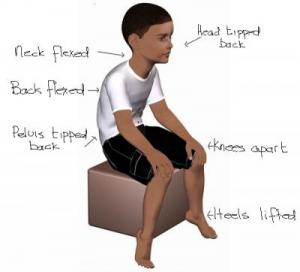
Individuals with dyspraxia tend to show floppy muscle tone, may have unexpected bumps and bruises (so-called “clumsy child”), and they may seem to have poor working memories and have trouble with multi-tasking.
Here is an example of what you may see with low postural tone (reference).
I think my dad had it, too. The definition bothers me because although some symptoms of the list ring true (I bump into things and will sometimes knock things off the counter), the description if you tally everything up sounds as if I’d be struggling terribly with everything, but I can’t think of much that I struggle with on a daily basis and I don’t feel as if I have a disorder – although I wasn’t ever in the first picks in playground sports in elementary school.
It didn’t keep me from doing well in school, becoming a doctor, etc. and I don’t think I have poor social skills or behave immaturely (!). Lists of symptoms are like potential side effects on medications. They may happen, and they can make you fearful if you believe all the symptoms will happen to you or your child, but they also by their nature are focused only on potential negatives, and they often miss the mark dramatically seeing the whole picture of any child or adult.
Daniel Radcliffe, the actor who played Harry Potter in all the movies, has dyspraxia. He admitted at the age of 19 that he still has trouble tying his shoelaces and his handwriting is difficult to read.
About his dyspraxia, Daniel said, “Do not let it stop you. It has never held me back, and some of the smartest people I know are people who have learning disabilities. The fact that some things are more of a struggle will only make you more determined, harder working, and more imaginative in finding the solution to problems.”
Dyspraxia is reportedly four times more common in men than in women.
WHEN DYSPRAXIA IS MORE OF A PROBLEM THAN DYSLEXIA
When dyspraxia is a significant challenge, students are especially late-blooming. They may be intelligent and creative, but seem to be somewhat distractible and to know more than they can easily show in pencil work.
Some accidents may occur – like falling out of chairs, unexplained bruises from bumping into things, and gross and fine motor issues that affect sports and writing by hand. I wanted to learn play piano when my older sister was learning to play, but my fingers seemed weak. My mother put little weights on each key and it probably ended up becoming perfect therapy because all I wanted to do was play the piano.
What is true is that secondary behaviors can occur with dyspraxia – for instance if children can lose their balance and fall, they may avoid busy playgrounds and avoid activities where they could hurt themselves. You may find them on the outskirts of the playground rather than in the thick of action and they may develop a persona of a quiet or studious child – but it may be due to avoidance rather than true temperament.
Dyspraxia can also affect speaking, so children can have hesitating speech and articulation problems and benefit from targeted work with a speech and language pathologist and dedicated time to practice speaking – whether it’s informal activities at home or work with a professional.
DYSPRAXIA CAN BE HIDDEN – PEOPLE WITH DYSPRAXIA SHOULD BE ENCOURAGED TO DO THINGS THAT ARE DIFFICULT
Dyspraxia is often referred to as a silent disability because it can be hidden and overlooked, yet over time – if people avoid activities that are challenging or they feel they are “bad” at, then the gap between them and their peers will grow.
Besides avoiding sports, dyspraxic children may avoid activities that require quick responses like video games – but doing these types of activities at the right level of challenge and with good support can really help them grow. Because dyspraxic children can get hurt with busy physical play, sometimes a professional is needed to support their activities, or thoughtful consideration given to the choosing of partners and activities.
Sometimes dyspraxic children gravitate to sports like swimming, martial arts, or running which require discipline and endurance, but not rapid back-and-forth play with other teammates.
Handwriting may be a challenge lifelong – but pediatric occupational therapy can help as well as extended time accommodations and options to type or dictate responses for younger students.
One wonders how a person can be functional with a definition like the NIH’s affecting almost all the senses as well as sensory and motor activities, but dyspraxia doesn’t result in complete dysfunction of any of these things – but rather the smooth ongoing coordination between senses and motor and emotional processing.
As an example, walking on a smooth predictable path may be a straightforward process for a person with dyspraxia, but add in some unpredictable elevations and depressions (a rocky path for instance with twist and turns and rocks) as well as a distraction like a person asking you questions at the same time and you trying to think of answers, then you have a conditions set up for a toe stub or accidentally walking into a low tree branch that comes in your way. Complex and challenging unpredictable situations are a setup for mishaps.
No wonder that many dyspraxic people – who have the same desire for belonging and connection with others – may nevertheless prefer to get work done in quieter situations or even working by themselves.
If a dyspraxic person has trouble keeping up with rapid back-and-forth conversations where many discussions may be going around them all at once, they may avoid after hours cocktail hours, and instead seek out social activities with quieter surrounds and more one-to-one or small group conversations.
Dyspraxia-related challenges may cause people of all ages to avoid activities where they are pretty certain they will fall short…but it may just be that these are the activities they would benefit from the most – so careful selection of makeable challenges – perhaps with a coach or thoughtful partner can help people to really grow.
Types of activities that may be challenging but growth-promoting are things like hand activities (arts, building) or activities that involve movement (dance, gymnastics, paired or solo sports).
Parents of young adults with dyspraxia should be aware that their children may be late bloomers in terms of leaving the nest or developing independence – but it will come.
Sometimes there will be activities that dyspraxic people may not be able to perform safely – because of the unpredictability of challenges. This might mean driving for some people or fast sports like hockey for others, but for the most part, dyspraxic people go about their lives like many others. They are creative and intelligent, and they will find ways to achieve their dreams.
WAYS DYSPRAXIA MAY AFFECT READING
Dyspraxia may affect eye movements, causing students to misread words, skip words, or skip lines. Speaking involves motor activity, so dyspraxia may also cause people to have trouble articulating words or mispronouncing them.
Dyspraxia can also affect endurance and difficult tasks, so sustained reading may be difficult and cause loss of focus.
WAYS DYSPRAXIA MAY AFFECT WRITING
Dyspraxia affects writing in many ways – in the retrieval of words, in the demands on working memory, and in all aspects of handwriting.
Schools typically underestimate the challenges that dyspraxic students have with writing. They will need a significant decrease in the amount of writing required (including writing for math and science).
Technology and accommodations should be brought in early and parents, teachers, and students should be aware that it may be years before many school tasks become less effortful.
DYSPRAXIA AND STRENGTHS
Recently, a dyspraxic social worker celebrated the strengths of dyspraxic people in her post.
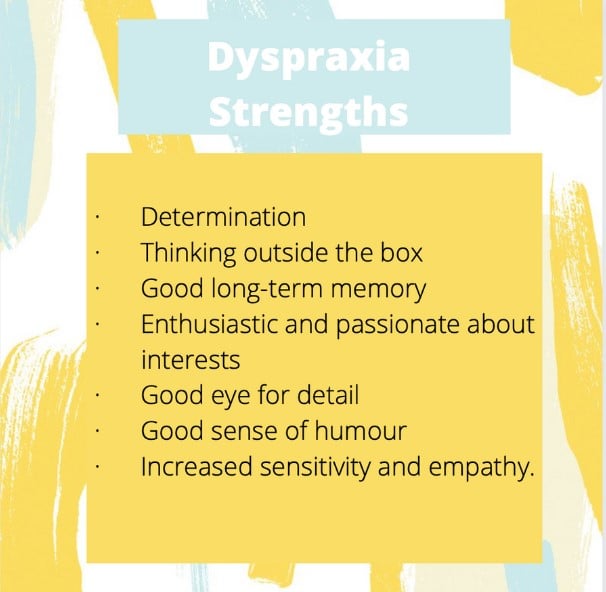
Think about them – determination, thinking out of the box, good long-term memory, passionate about interests, sense of humor, and sensitivity and empathy among others.
Career choices for people with significant dyspraxia can be difficult if they haven’t considered their particular interests and strengths and weaknesses. Afterschool jobs that may be routine for high school or college students (restaurant work, fast food, delivery) may be poor fits for people with dyspraxia.
Often strengths involve strategic thinking, problem solving, or creativity.
Although writing may be very difficult for dyspraxic students in their formal years of education, some write well as adults using computers and spell and grammar check.
Adults aware of their organizational challenges may “over-compensate” and actually manage their work and home life well by working hard to organize all their activities, even accounting for occasional lapses.
My hope is that researchers examine the strengths of dyspraxic people in the ways that some in the dyslexic community have begun to. The video below interviews a woman about her dyspraxia – but it’s still like the early days of dyslexia where people comment on their work ethic. Dyspraxia makes it hard to automate motor activities – but this lack of automaticity makes it more likely for people to do things out of routines. It may help one notice things that others miss and also develop new ways of interacting with people and the world.
Dyspraxia is much more common in males, but it’s much harder finding men talking about their dyspraxia.
Perhaps it’s because there is more of a perceived stigma, symptoms are generally greater in men, or other reasons!
Clearly more positive awareness and consciousness-raising about dyspraxia would be a good thing.