Additional Resources from Premium Issue 26 [Premium]

  Additional Premium Resources  February 2018 Issue 26. You must be logged into your account to access: False Memories, Verbatim vs. Gist Recall, Persistence and Transcience of Memory, and Visual Perceptual and Handwriting Skills of Student with Dyspraxia (DCD). False memory for orthographically vs semantically similar words in adolescents with dyslexia.     Verbatim and Gist Recall of Sentences by Dyslexia and Non-Dyslexic Adults The Persistence and Transience of Memory Visual perceptual and Handwriting Skills in Children with Developmental Coordination Disorder       Bookmark Please login to bookmark ClosePlease login to access.

Bookmark

Please login to bookmark
Close
To access this post, you must be a Premium subscriber. log in

Bookmark
Please login to bookmark Close
read more

Positive Strategies for College [PREMIUM]

In a recent research study (abstract only) of dyslexic students at college, the following strategies were mentioned: 1. Go to Lecture and Just Listen. It was common for students to be unable to listen and note-take at the same. Face-to-face lectures were preferred to recorded lectures because audio quality was sometimes bad, and some students need to see the teacher’s face and his or her gestures to fully comprehend what was being said. Request a Note-Taker Early. One student said at times a note-taker had to be requested several weeks in advance (!). Record Notes with the One Note or Audionote App. 2. Prepare for Lecture. For classes where teachers make Powerpoints available before lecture, download and print so notes can be written on them […]

Bookmark

Please login to bookmark
Close
To access this post, you must be a Premium subscriber. log in

Bookmark
Please login to bookmark Close
read more

[PREMIUM] Reading and Spelling: When Sights and Sounds Don’t Match

TRICKY WORDS: WHEN SIGHTS AND SOUNDS DON’T MATCH Spotlight: Inflectional Suffixes Because many dyslexic students don’t have a visual imprint of words, there are common spelling or pronunciation errors that occur when word endings seem to vary. In most cases, being explicitly taught the different patterns can reduce a great deal of distress later. The technical term “inflectional suffixes” refers to word endings that change a word to make it grammatically correct, but don’t fundamentally change the meaning or the class of words that they are. For example, in the following sentences, the suffixes are shown in red: The dog barks. The dog barked. The endings may reflect whether a noun is singular or plural (e.g. dog or dogs) or whether the action is happening […]

Bookmark

Please login to bookmark
Close
To access this post, you must be a Premium subscriber. log in

Bookmark
Please login to bookmark Close
read more

Dyslexic Master Montessori Teacher ALISON AWES [Premium]

I recently had a chance to talk with Master Montessori Teacher Alison Awes who is based at the Montessori Training Center of Minnesota. Alison is dyslexic herself and she has written about how Montessori instruction can support dyslexic students. Alison is also trained in Orton-Gillingham Level1. Like the Orton-Gillingham method, the Montessori approach was created by a physician working with special education students. I knew about Montessori because both our children attended Montessori preschools and we liked many aspects of the educational approach, including self-directed learning, multi-age classrooms, and well-designed hands-on materials. I was interested in hearing about Alison’s experiences because she attended a Montessori school herself until the age of 12 and then transitioned to a traditional middle school. She only discovered that she […]

Bookmark

Please login to bookmark
Close
To access this post, you must be a Premium subscriber. log in

Bookmark
Please login to bookmark Close
read more

Let Them Listen – Audiobooks and Dyslexia [Premium]

 Let Them Listen! “The objective of the present research study was to understand what benefits the use of audiobooks (both school-books and books of various genres, recorded on digital media) could bring to preadolescents and adolescents with developmental dyslexia. Two groups, each consisting of 20 adolescents, were compared. The experimental group used the audiobooks, while the control group continued to use normal books. After 5 months of experimental training, the experimental group showed a significant improvement in reading accuracy, with reduced unease and emotional–behavioural disorders, as well as an improvement in school performance and a greater motivation and involvement in school activities.” – Milani et al., Dyslexia (journal)  It’s surprising how often we continue to hear that dyslexic students are denied the use of audiobooks […]

Bookmark

Please login to bookmark
Close
To access this post, you must be a Premium subscriber. log in

Bookmark
Please login to bookmark Close
read more

Bridging the Gap to Reading Long Words [Premium]

 In our last post, we wrote about the 3rd grade gap or wall. Dyslexic students typically get through the hard slog of phonemic awareness and then parents and teachers breathe a sigh of relief. Many times, the extra work fades away and students are integrated back into their usual classroom routine. All seems well, but a problem may remain. Reading remains effortful and the complexity of the text goes up. Students may not be able to keep up. With little extra help and too little time to complete assignments, the “guess and go” approach may dominate the reading strategy so that the gap between peers increases. A large part of the problem may be that students have not effective strategy to read long words. These problems can come […]

Bookmark

Please login to bookmark
Close
To access this post, you must be a Premium subscriber. log in

Bookmark
Please login to bookmark Close
read more

Dyslexia and the Third Grade Wall [Premium]

If you’re not aware if the ‘3rd Grade Wall’, you can get blind-sided. A recurring theme that we hear about when we interview accomplished dyslexic men and women is the trouble and failure (often grade retention) that happens in the 3rd grade. Why?  What’s the big deal about the 3rd grade? From Time Magazine, “Take a guess: What is the single most important year of an individual’s academic career? The answer isn’t junior year of high school, or senior year of college. It’s third grade. What makes success in third grade so significant? It’s the year that students move from learning to read — decoding words using their knowledge of the alphabet — to reading to learn. The books children are expected to master are no […]

Bookmark

Please login to bookmark
Close
To access this post, you must be a Premium subscriber. log in

Bookmark
Please login to bookmark Close
read more

Dyslexic Advantage Premium – Issue 11 Organizing Creativity [Premium]

 Premium Issue 11 October 29, 2016 Organizing Creativity, Stealth Dyslexia, Dyslexia and Self Image, Memorizing for School, What Worked for 2E Gifted Dyslexics, Art Therapy for Dysgraphia, Hands-On Math for Fractions, More Interactive Reading Strategies, Mastering Foreign Languages and More This issue has memory strategies that seem to be helpful for a majority of dyslexic folk – whether it’s history facts, science vocabulary, or foreign languages. Subscriptions support Dyslexic Advantage.     [/wcm_restrict] Bookmark Please login to bookmark ClosePlease login to access.

Bookmark

Please login to bookmark
Close
To access this post, you must be a Premium subscriber. log in

Bookmark
Please login to bookmark Close
read more

How to Read to Kids with Dyslexia – Reading As a Conversation [Premium]

 There are many good ways to read to children with dyslexia. In this post, we wanted to talk share an approach that some have called “dialogic” or like a dialogue. A dialogue is a back and forth conversation, and that is exactly how this style of reading goes. Rather than having a parent or teacher read aloud with a child listening, in dialogic reading, the adult helps the child tell the story. The acronym for this method is PEER: 1. Prompt a child to say something about the book. 2. Evaluate her response. 3. Expand the response by rephrasing and adding more detail, and 4. Repeat the prompt to make sure the child learned. Except for the first reading of the book, PEER sequences should […]

Bookmark

Please login to bookmark
Close
To access this post, you must be a Premium subscriber. log in

Bookmark
Please login to bookmark Close
read more

Speak

To listen, select text and click sound button

WATCH NOW

OSPI STEM Course – STEM for Diverse Learners

Dyslexia and Gifted: Course for Psychologists

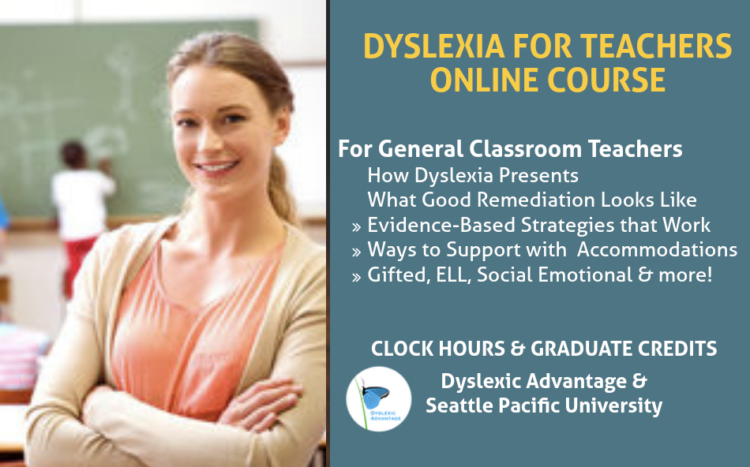
Dyslexia for Teachers Course

SPONSORS

    Discover Your Dyslexic MIND Strengths
                                    Free


Amazon Affiliate Notice

Dyslexic Advantage is an Amazon Affiliate. If you click on a link that takes you to the Amazon store, Dyslexic Advantage may earn money on qualifying purchases. Clicking HERE to enter Amazon and making a purchase may support Dyslexic Advantage. Thank you!