Dyslexia and Bilingualism [Premium]

There are many bilingual or multilingual families who are also navigating a path through dyslexia. Bilingual students with dyslexia usually have similar problems in both languages, but some languages are “easier” to learn if the phonology and spelling are more predictable. So functionally, it is possible for a student to appear dyslexic in one language, but not so dyslexic in another. The focus of this article, is not whether a student should elect to learn a second language, and if so, when, but rather what challenges and potential benefits that bilingual dyslexic students do have to look forward to if they ultimately master two languages and also have their dyslexia remediated. LATER BLOOMING If dyslexic students as a group are considered late blooming in general […]

Bookmark

Please login to bookmark
Close
To access this post, you must be a Premium subscriber. log in

Bookmark
Please login to bookmark Close
read more

How Not To Give Up On Learning A Second Language [Premium]

Learning second languages are difficult for many dyslexic students; foreign language waivers or substitutions are common, but in spite of this, many can learn other languages and even multiple languages if the goal is conversation. Writing and spelling second and third language can be more difficult, but also possible for many people. Students may be more successful if they able to study over a longer time and if they have learned more about the structure of language in their native tongue. In the video below, listen to 4 Hour Work Week guru Tim Ferriss (yes, he’s dyslexic) talk about how he learned to be able to converse in many foreign languages.     The type of learning described, won’t necessarily make you a master of […]

Bookmark

Please login to bookmark
Close
To access this post, you must be a Premium subscriber. log in

Bookmark
Please login to bookmark Close
read more

READING FLUENCY: Phrase Cueing [Premium]

Once students have made significant progress with single word decoding, reading fluency practice can be rolled into reading practice with phrase cueing. HERE is a nice review of reading fluency approaches that includes a discussion of phrased reading. Phrase scooping or cueing involved the drawing of scoops underneath groups of words that go together in parts of a phrase. Combining scooped words with choral reading or echo reading can help students get practice with both reading and listening for phrases. Intervention Central has a Phrase Cued Text Generator, but it’s so-so. It’s better to break sentences into 3-6 word phrases to increase the ease of reading. From Steve Peha, check out the example below: Of course these shorter phrases also help with reading on a […]

Bookmark

Please login to bookmark
Close
To access this post, you must be a Premium subscriber. log in

Bookmark
Please login to bookmark Close
read more

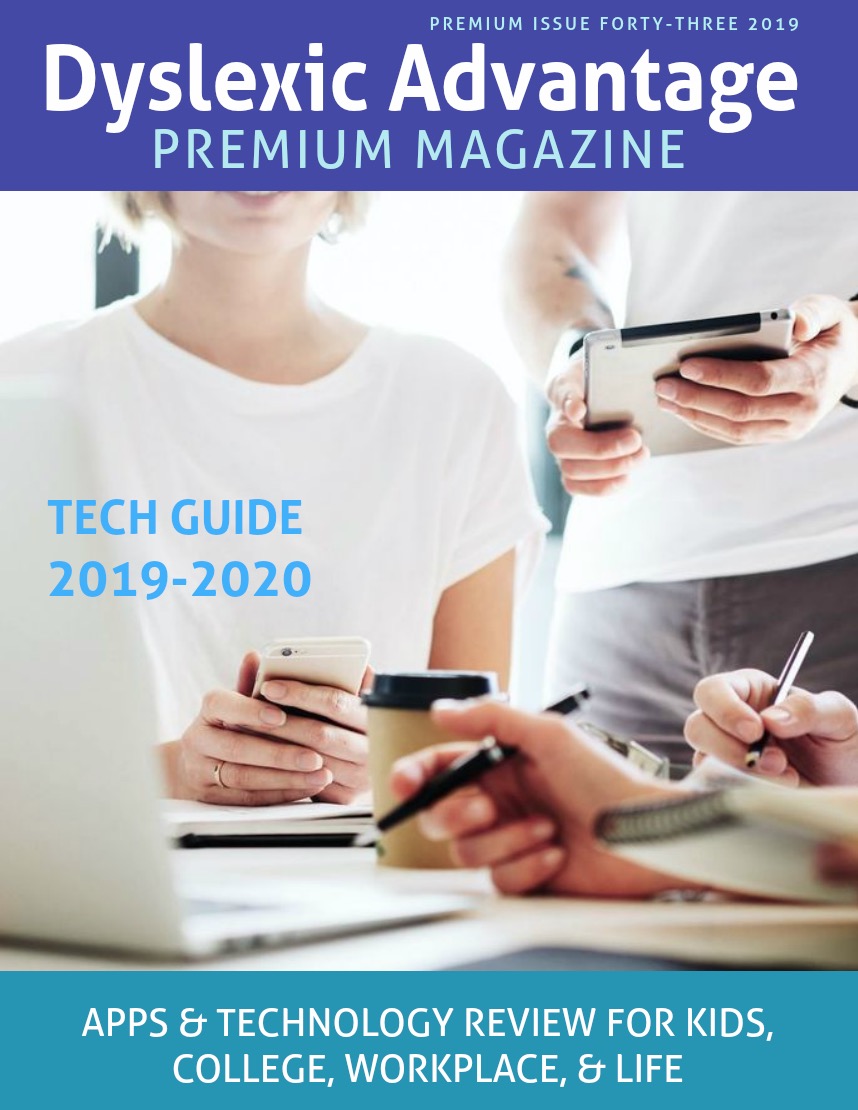
Dyslexic Advantage Premium TECH Guide 2019-2020

This issue features our largest Premium TECH Guide ever at 54 pages! Become a Premium subscriber at just $5 per month. Individual issues can also be purchased through Dyslexic Advantage apps in iTunes or Google Play. Dyslexic Advantage Premium Apps review includes the best dyslexia apps for iOS and Android in the areas of basic reading, phonological awareness and spelling, reading fluency, free and low cost resources for audiobooks and ebooks, ways to listen including podcasts, read to me books, scanning pens, best apps for writing, note-taking, scanning, and spelling for adult users, best apps for organization and productivity, math, and social and emotional health. Bookmark Please login to bookmark ClosePlease login to access.

Bookmark

Please login to bookmark
Close
To access this post, you must be a Premium subscriber. log in

Bookmark
Please login to bookmark Close
read more

[PREMIUM] Reading and Spelling: When Sights and Sounds Don’t Match

TRICKY WORDS: WHEN SIGHTS AND SOUNDS DON’T MATCH Spotlight: Inflectional Suffixes Because many dyslexic students don’t have a visual imprint of words, there are common spelling or pronunciation errors that occur when word endings seem to vary. In most cases, being explicitly taught the different patterns can reduce a great deal of distress later. The technical term “inflectional suffixes” refers to word endings that change a word to make it grammatically correct, but don’t fundamentally change the meaning or the class of words that they are. For example, in the following sentences, the suffixes are shown in red: The dog barks. The dog barked. The endings may reflect whether a noun is singular or plural (e.g. dog or dogs) or whether the action is happening […]

Bookmark

Please login to bookmark
Close
To access this post, you must be a Premium subscriber. log in

Bookmark
Please login to bookmark Close
read more

STRATEGIES FOR THE MOST COMMON SPELLING MISTAKES: THE SCHWA [Premium]

Once you learn how to recognize the ‘schwa’, you’ll start recognizing them everywhere! In linguistics, the schwa sound is represented by an upside-down ‘e’ and the mouth position is a lot like the ‘uh’ sound in ‘butter’. It contributes to lots of misspellings in dyslexic students (and actually non-dyslexic students too) so recognizing the patterns can significantly improve all-round spelling performance. STRATEGY 1: EXAGGERATE / MISPRONOUNCE THE SCHWA One surprisingly easy strategy is to exaggerate and deliberately mispronounce a word in order to remember the correct spelling. For instance, the-thee reminds you that the schwa is spelled with an ‘e’. Look at the following 3 objects: monitor, computer, and calendar. To remember -or, -er, and -ar, a student can pronounce monitor as mon-i-TOR, exaggerating the […]

Bookmark

Please login to bookmark
Close
To access this post, you must be a Premium subscriber. log in

Bookmark
Please login to bookmark Close
read more

DROPPING OUT BECAUSE OF FOREIGN LANGUAGE [Premium]

  At Harvard University in the 1970s, a clinical psychologist made a startling discovery. Intending to study the emotional problems that caused students at one of the world’s elite universities to drop out of school to drop out, he found out instead that the most common reason students dropped out of their degree programs was that they were unable to satisfy Harvard’s foreign language requirement. “Dinklage described three groups of students who were otherwise, bright, gifted, and highly motivated, but who remained unsuccessful in the foreign language classroom. He reported that these students were not helped by merely improving study habits or by adjusting to postsecondary demands.” The 1st group of students demonstrated problems in written language that were most apparent in “the student’s reading […]

Bookmark

Please login to bookmark
Close
To access this post, you must be a Premium subscriber. log in

Bookmark
Please login to bookmark Close
read more

Research: Classroom Culture Matters – Effects on Reading Performance [Premium]

In the latest issue of the Journal of Learning Disabilities, researchers from Harvard and Greece found that classroom culture, and in particular LD students’ perceptions of their classrooms motivational framework had sudden, significant, and unpredictable effects on reading performance and students’ emotional state. From the authors: “The purpose of the present study was to evaluate the proposition that a classroom’s motivation discourse exerts significant influences over students’ achievement in reading.” The two conditions that researchers compared were: #1. Mastery (internal standard) – “In our class trying hard is important” #2. Performance (external standard) – “In our class, getting good grades is the main goal.” Their brief conclusions: “…the results confirmed the research hypotheses concerning the role of mastery and performance goals. The form (mastery) had a […]

Bookmark

Please login to bookmark
Close
To access this post, you must be a Premium subscriber. log in

Bookmark
Please login to bookmark Close
read more

Bridging the Gap to Reading Long Words [Premium]

 In our last post, we wrote about the 3rd grade gap or wall. Dyslexic students typically get through the hard slog of phonemic awareness and then parents and teachers breathe a sigh of relief. Many times, the extra work fades away and students are integrated back into their usual classroom routine. All seems well, but a problem may remain. Reading remains effortful and the complexity of the text goes up. Students may not be able to keep up. With little extra help and too little time to complete assignments, the “guess and go” approach may dominate the reading strategy so that the gap between peers increases. A large part of the problem may be that students have not effective strategy to read long words. These problems can come […]

Bookmark

Please login to bookmark
Close
To access this post, you must be a Premium subscriber. log in

Bookmark
Please login to bookmark Close
read more

How to Read to Kids with Dyslexia – Reading As a Conversation [Premium]

 There are many good ways to read to children with dyslexia. In this post, we wanted to talk share an approach that some have called “dialogic” or like a dialogue. A dialogue is a back and forth conversation, and that is exactly how this style of reading goes. Rather than having a parent or teacher read aloud with a child listening, in dialogic reading, the adult helps the child tell the story. The acronym for this method is PEER: 1. Prompt a child to say something about the book. 2. Evaluate her response. 3. Expand the response by rephrasing and adding more detail, and 4. Repeat the prompt to make sure the child learned. Except for the first reading of the book, PEER sequences should […]

Bookmark

Please login to bookmark
Close
To access this post, you must be a Premium subscriber. log in

Bookmark
Please login to bookmark Close
read more

Choosing the Right Reading Level Books for Students with Dyslexia [Premium]

It’s often told to parents that a “Five Finger Rule” can help you choose whether a book is at the right reading level for a student. The rule states that if a student misses five or more words, it may be too hard, no words and it might be too easy, and three words and it’s  ‘just right’. The problem for dyslexic students is that the “Five Finger Rule” may prevent them accessing print information at their intellectual level and if reading aloud is the guide for the rule, then it’s possible they may never be granted access to higher level books even if they are university professors! In fact, pioneering work by Rosalie Fink (see research paper below for Premium members), showed that accomplished […]

Bookmark

Please login to bookmark
Close
To access this post, you must be a Premium subscriber. log in

Bookmark
Please login to bookmark Close
read more

Speak

To listen, select text and click sound button

WATCH NOW

OSPI STEM Course – STEM for Diverse Learners

Dyslexia and Gifted: Course for Psychologists

Dyslexia for Teachers Course

SPONSORS

    Discover Your Dyslexic MIND Strengths
                                    Free


Amazon Affiliate Notice

Dyslexic Advantage is an Amazon Affiliate. If you click on a link that takes you to the Amazon store, Dyslexic Advantage may earn money on qualifying purchases. Clicking HERE to enter Amazon and making a purchase may support Dyslexic Advantage. Thank you!