When many dyslexic students receive comprehensive testing in math, their math reasoning tends to be strong (equal to or higher than their peers), but their math facts retrieval is slow and sometimes inaccurate.
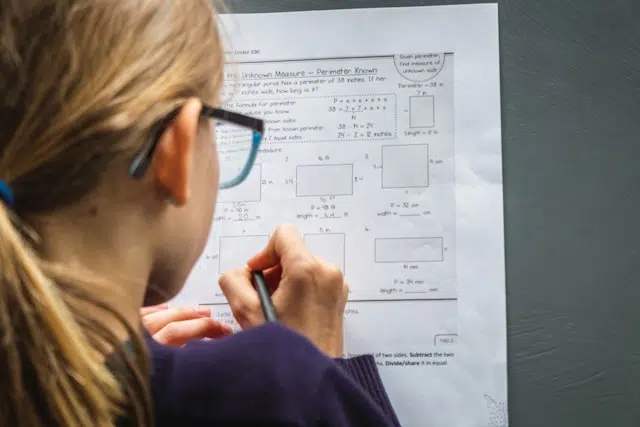
But rarely are students assessed for their understanding or misunderstanding of math vocabulary or syntax, and these problems can grow over the course of their schooling unless they work closely with a parent or tutor on homework and learn why mistakes happened on tests.
Math is a language-heavy subject. Even simple problems rely on specialized vocabulary that students must recognize, remember, and translate into actions. Words such as sum, total, altogether, difference, minus, take away, and subtract all refer to mathematical operations, yet they appear interchangeably across worksheets and textbooks. For a student who has learned only one phrasing, an unfamiliar synonym can create hesitation or confusion about what the problem is asking.
If you consistently review a student’s mistakes on tests, you may find that rather than not understanding concepts, the student misread or misinterpreted the question.
Explicit Instruction in Math Vocabulary
Explicit instruction in math vocabulary is important because mathematical understanding depends on accurately interpreting language, not just numbers. Many dyslexic students will not learn the specific meaning of words through exposure alone.
What that means is that math vocabulary should be taught explicitly – that means rather than modeling problems and how to solve them, lesson should address words used in problems and include sources of confusion as well as word differences. English Language
Learners will also benefit by math vocabulary instruction students are having to learn two vocabularies and sometimes words in one language will cause interference with learning a word in the other.
Math Picture Vocabulary Cards
Math picture vocabulary cards should be used to teach vocabulary whenever possible. Students should be allowed to use these picture cards as they work through problems, and teachers and tutors can model precise math vocabulary to help students learn concepts and problem-solving.
As an example, the number ¼ should be referred to as “one-fourth” and not “1 over 4”. Examples of math picture vocabulary cards can be found on sites like Pinterest or Teachers Pay Teachers.
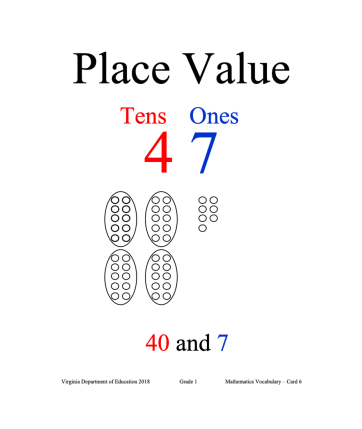
The Virginia Department of Education has free math picture vocabulary cards under “Word Wall Cards” for free here.
Some of them are helpful, like the visual explanation of place value, but some of the cards show unnecessary jargon for young students – for example, “transfer a repeating pattern” with visual confusing pictures of different colored hands, or “transfer a growing pattern.”
Simplicity and coordination of pictures with physical objects or manipulatives is the better way to help students grasp the mathematical ideas and put them into practice.
How many times do you need to hear a new word before it’s saved into long-term memory and retrieved easily? Research from the University of Cambridge suggests that an adult has to hear the word 160 times before it’s recognized like words that you have learned forever.
So if you find yourself repeating yourself when you’re helping a student with math, don’t despair, let students work ‘open book’ with picture vocabulary cards to work on problems. Growth is non-linear. Often students will be in a flat period where little progress seems to be made, but then all the little bits of information click into a big picture, and they have it!
Want to learn more about math strategies for dyslexic students? Our Math issue will be next for our Premium subscribers!