Working through Higher Math [Premium]

  “An algebra equation should have a physical meaning to it, and have good real world examples…” — Gary McGregor, PhD   Gary McGregor has a lot to say when it comes to math because he survived dropping out of high school, knowing only the basics of math calculation (adding and subtracting, but not fractions) before he enrolled in Junior College determined to learn all the math he would need to become a mechanical engineer. Not only did he succeed in that goal, but he also became an expert higher mathematician and now publishes papers involving complex math. So how did he get from A to Z?   MATH FROM MULTIPLE PERSPECTIVES Gary was fortunate to learn from a math teacher in junior college who […]

Bookmark

Please login to bookmark
Close
To access this post, you must be a Premium subscriber. log in

Bookmark
Please login to bookmark Close
read more

From High School Drop-Out to VP of Engineering [Premium]

There are some people who are so insightful into their cognitive processes that talking to them is pure gold. Gary MacGregor is one of those people – he’s a VP of an electronic device company and recent PhD recipient from the University of Texas at Austin. He has a remarkable story and has been very generous in sharing what he has learned. Gary: “I’m a high school dropout. My parents were high school dropouts. I’m the first male in the family to go to college.” When Gary dropped out of school, he took a job working an oil refinery – a lucrative career for a person without a high school diploma. While he was working 12 hour shifts 84 hours a week, he would exercise […]

Bookmark

Please login to bookmark
Close
To access this post, you must be a Premium subscriber. log in

Bookmark
Please login to bookmark Close
read more

How Families Help [Premium]

Families can really make a difference. Many times, they are the last place to find encouragement or to help find a connection to the next opportunity in life.   MARC’S UNCLE Marc shared with me that he grew up in a family that was poor with both parents working full-time to make ends meet. He had been an unexpected baby and an additional financial burden to the family. When he grew up, he recalled being a “clumsy kid” who wasn’t successful in sports like his older brother. His brother and his father connected through sports, but Marc had a harder time seeing ahead to his future because he wasn’t good in sports in addition to his problems in school. Fortunately, though there was an uncle […]

Bookmark

Please login to bookmark
Close
To access this post, you must be a Premium subscriber. log in

Bookmark
Please login to bookmark Close
read more

Math Strategies Instead of Drill [Premium]

In the many years Brock and I spent testing and listening to dyslexic students at every level of education, we often heard first hand accounts of how they learned how to tackle difficult subjects and bypass school-related challenges. As research studies bear out (for instance, see Kirby’s study of dyslexic university students), many dyslexic students in higher education have arrived at where they are because they are deep learners, savvy about how they learn best, and strategic in how they approach school.   Brain-Based Reasons Why Math Strategies Are Better for Dyslexics Than Drill But there is also neurobiological evidence that supports why strategies may be a superior route for dyslexic learning compared to drill or simple repetition. By now, anyone who knows about brain […]

Bookmark

Please login to bookmark
Close
To access this post, you must be a Premium subscriber. log in

Bookmark
Please login to bookmark Close
read more

How Not to Learn to Read aka Death by Worksheets [Premium]

Daniel Shanahan recently recounted his discussion with a principal about his school curriculum. His students were under-performing and he assured Daniel that students were receiving plenty of instruction in phonics and fluency.   When he looked at the teacher’s curricular plan, it looked as if plenty of reading instruction was given every day, but his impression changed once he began visiting classes. Daniel: “Much of the instructional time wasn’t used for instruction at all. The teachers spent a big chunk of time on “sustained silent reading” and they read to the children quite a bit, too. All the classrooms had multiple reading groups. That meant that the boys and girls did a lot of worksheets to keep them quiet while the others were reading with […]

Bookmark

Please login to bookmark
Close
To access this post, you must be a Premium subscriber. log in

Bookmark
Please login to bookmark Close
read more

Marlon Brando, Dyslexia, and Method Acting [Premium]

There’s a new book out this year on method acting, and it mentions Marlon Brando, his mercurial temperament, his dyslexia, and his method acting. Apparently he had ambivalent feelings about taking one of the leading roles in A Streetcar Named Desire, and he was told to show up at the playwright’s (Tennessee Williams’) house in order to clinch the deal. After hitchhiking to Provincetown, he found Williams and his friends in the dark, occasionally getting up to go to the bathroom in the woods. Apparently, a fuse had blown and a toilet was broken and neither Williams nor any of his artist friends knew how to fix either. Brando immediately made an impression, fixing both, then reading for the lead character, Stanley Kowalski. Needless to […]

Bookmark

Please login to bookmark
Close
To access this post, you must be a Premium subscriber. log in

Bookmark
Please login to bookmark Close
read more

Education During the Pandemic: Preparing for the Unpreparable [Premium]

As I am writing this, omicron cases have not reached their peak in the US, and calls for schools to close again because of the extreme contagiousness of this variant. How do parents, teachers, and tutors prepare for another unpredictable year?   ONE STUDENT AT A TIME If pandemic education has told us anything thus far, it’s that students will tell us what they need as much as any best laid plans. No matter what you decided for your students for the past year, reviewing what worked and what didn’t can be valuable going forward. If you have several children, you might have seen something work for one student, but not another. As before, the goals should be focusing on reasonable fits and not inflexible […]

Bookmark

Please login to bookmark
Close
To access this post, you must be a Premium subscriber. log in

Bookmark
Please login to bookmark Close
read more

Strength-based Thinking and Communication through Metaphor [Premium]

“Since dyslexics are visual learners and thinkers, I make sure to integrate that into how I work throughout the day. I always approach architecture decisions via white-boarding. I use metaphors when I explain things to other people or when I try to reason about the problem space in my head…” – Josh Brunner, from Embracing Dyslexia as a Software Engineer   An interesting thing happened when researchers (sorry free abstract only) set out to study figurative language in dyslexic and non-dyslexic people. Dyslexia is often referred to as a “language learning disability” and in the usually deficit-focused literature, there have been plenty of studies that might have suggested figurative language could be problematic – but Kasirer and Mashal also were aware of the creativity literature […]

Bookmark

Please login to bookmark
Close
To access this post, you must be a Premium subscriber. log in

Bookmark
Please login to bookmark Close
read more

Connecting the Dots with John Chambers of CISCO [Premium]

“A lot of leaders would say they’re curious. I can tell you from personal experience that most leaders are not. They don’t ask a lot of questions, rarely challenge conventional wisdom, stick with what they know, and often turn to sources that reinforce their existing point of view… my curiosity about things I don’t understand has been a critical factor in my success as a leader.” – John Chambers   I recently came across a book review of Chambers’ book by Emma Wallace, a fellow dyslexic who works in a very different industry, fashion. Despite these differences, Chambers’ description of strengths resonated.   “Not only has dyslexia meant that for John (and myself) it forced him to learn important skills early on: persistence, finding your […]

Bookmark

Please login to bookmark
Close
To access this post, you must be a Premium subscriber. log in

Bookmark
Please login to bookmark Close
read more

Multiple Choice Questions and Dyslexia [Premium]

One bane of higher education and professionals is the ubiquity of multiple choice questions and tests acting as gatekeepers for higher levels of credentialing, program admission, or pay.   This problem affects individuals seeking their GED, drivers licenses, college entrance exams, graduate school exams, professional licensing and credentialing exams, and formal performance reviews in company settings. Individuals with stellar educational and work achievements, may find their advance in schooling or job positions blocked because of trouble on multiple choice tests which may hold inappropriate sway on assessments and evaluation. Why?   WHY MULTIPLE CHOICE TESTING IS A COMMON CHOICE FOR ASSESSMENT One of the reasons that multiple choice questions are so pervasive is that once written, a database of questions can be used to automate […]

Bookmark

Please login to bookmark
Close
To access this post, you must be a Premium subscriber. log in

Bookmark
Please login to bookmark Close
read more

The Social-Emotional Side of Dyslexia [Premium]

“A lot of the time I take the parts of learning that are still hard for me as rejection — as someone telling me I can’t. I see points taken off for misspelled words on in-class English essays, and I start to see my future crumbling. I see the colleges that my dyslexia could prohibit me from going to. I see the kids with better scores, who don’t need tutors, or extra time, and I feel jealous. I feel worthless.” – Anna Kopelmann   The social emotional journey for dyslexic people can be complex and change over time depending on one’s life contexts, support, and environment. As few as 1 in 4 dyslexic students may be formally identified in public school systems, leaving the majority […]

Bookmark

Please login to bookmark
Close
To access this post, you must be a Premium subscriber. log in

Bookmark
Please login to bookmark Close
read more

Speak

To listen, select text and click sound button

WATCH NOW

OSPI STEM Course – STEM for Diverse Learners

Dyslexia and Gifted: Course for Psychologists

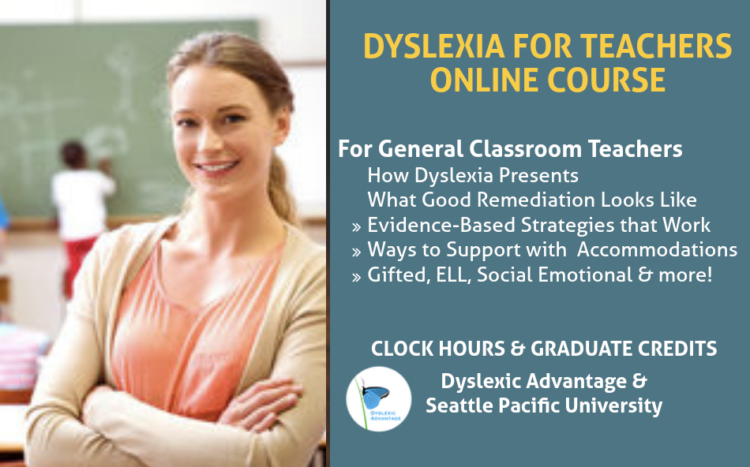
Dyslexia for Teachers Course

SPONSORS

    Discover Your Dyslexic MIND Strengths
                                    Free


Amazon Affiliate Notice

Dyslexic Advantage is an Amazon Affiliate. If you click on a link that takes you to the Amazon store, Dyslexic Advantage may earn money on qualifying purchases. Clicking HERE to enter Amazon and making a purchase may support Dyslexic Advantage. Thank you!