The last decade has seen a great advance in the biological understanding of dyscalculia, or math disability. The DSM V groups a specific learning disorder in math (315.1) under Specific Learning Disability along with impairment in reading (315.000) and impairment in written expression (315.2). The NIH defines dyscalculia as a condition contributes to “difficulty understanding arithmetic concepts and doing such tasks as addition, multiplication, and measuring.” It is important to identify dyscalculia, because an unrecognized LD can contribute to cycles of academic underachievement, secondary behavioral and emotional issues, and obstacles to further academic or workplace advancement. With the recent addition of high-stakes exams like the calculator-free section of the new SAT, it is even more critical that students with dyscalculia be identified. The DSM V definition includes the […]
Question: Does Note-Taking with Spellcheck Help or Hinder Students with Dyslexia ? [Premium]
It’s a question that arises commonly – does spellchecking for students help or hinder when it comes to students and spelling? The concern is that allowing students to use spellcheck on a regular basis in the long run may prevent them learning correct spellings. Should age matter or the presence of dyslexia? What about working memory overload or ADD/ ADHD? The issue is not a trivial one especially because of recent efforts to The issue is not a trivial one especially because of recent efforts to put laptops away in college during lectures based on computer-based vs. traditional note-taking by hand (N.B. this study did not specifically assess dyslexic students – see the NPR story also below). A recent paper by Hiscox and colleagues (see below) […]
[Premium] Sorting Out the Differences Between Dyslexia and ADD / ADHD
On one level, Dyslexia and ADD / ADHD would seem quite different, but in reality, we are only at the beginning of our understanding of how the two might overlap and be different. Both Dyslexia and ADD / ADHD were initially characterized by their negatives – Dyslexia by difficulty learning to read, and ADD / ADHD by difficulty paying attention. Today we know that for both, positive qualities like higher levels of creativity and ability can be associated as well as negatives, and researchers are only now beginning to take a more careful look at what these two designations imply. For those who don’t know, as a group, children with ADD / ADHD score lower on many tests of phonology and reading comprehension, theoretically because of their […]
[Premium] What to Do If a Reading Curriculum Doesn’t Work
It happens to everybody. You research a curriculum thoroughly or it gets through several levels of a review and then you put it into action and… it just doesn’t connect. What do you do? There are several common reasons why a curriculum doesn’t connect with a particular student – and so some trial and error and modification need to take place. The most common reasons that certain curricula fail for a particular student include: 1. Going Too Fast Because there can be difficulty registering information accurately (sounds, letters, words), a student may need to slow the pace down considerably if the lessons aren’t sinking in. It may seem counterintuitive if you feel a student is slipping farther behind, but reducing work and simplifying […]
Why It’s Important to Say Dyslexia But Also Support Its Strengths
What is Dyslexia? Dyslexia is a brain-based learning difference with a strong genetic basis. It characterized by unexpected difficulties in fluent reading and specific patterns of difficulty with writing, spelling, and sometimes math as well as strengths in...
Why It’s Hard to Proofread and Read Fluently [Premium]
It can be maddening. You look and look you just don’t see it. Later you pass your work along, you see all the thing you hadn’t seen the first time round. What’s going on ? You’ve experienced a ‘trick’ of perception. In our clinic, when trying to explain the phenomenon to children, we often use the analogy of optical illusions…when you see something that’s not there or you miss something – that later you can’t believe you could see at the start. These tricks of perception are what adds to the time needed for many dyslexic students on classroom and standardized exams. It accounts for why some teachers may be flabbergasted by a student’s need for extended time, when they seem so quick with problem solving […]
How They Did It: Dyslexia, Gifted Ed, and SAT and ACT Accommodations [Premium]
Today I had a chance to catch up with a member of our Dyslexic Advantage community who had just heard the great news that her 17 year old son had been granted accommodations for both the SAT and ACT, including the calculator-free section of the new SAT. This family navigated several difficult transitions: private school to public gifted school, middle to high school, and now college entrance exams. Accommodations granted this student included: Double time for reading, computer for essay, extra breaks between test sessions, reader, double time for math, double time for essay, record answers in test book, 4-function calculator on non-calculator active sections Hooray! Mom sent all the previous evaluations from All Kinds of Minds (Mel Levine’s old system), but also old speech […]
Understanding Processing Speed and Dyslexia [Premium]
When families come together to discuss test scores, no group of scores surprises them as much as “Processing Speed.” Processing Speed scores on psychometric exams might mean Coding and Symbol Search scores on the WISC intelligence exams or Visual Matching and Paired Cancellation on the Woodcock Johnson. Processing Speed scores on these subtests are typically lower for dyslexic students, but on other tasks like Decision Making and in real life, these students may be quite quick and even quicker than their peers at various tasks such as insight-based problem solving or situational awareness (helpful for athletics, for instance). Understanding the true significance of Processing Speed Difference in Dyslexia, then is important not only for recognizing when accommodations may be appropriate school, but also for identifying […]
[Premium] Examples of Dysgraphia and Dyslexia – What to Look For
After dyslexic students make progress in their ability to decode words, parents, teachers, and students themselves may begin to breathe a sigh of relief; however, another monster challenge may be looming on the horizon – the other D…. Dysgraphia. The National Institutes of Health definition of Dysgraphia includes the following: “Dysgraphia is a neurological disorder characterized by writing disabilities. Specifically, the disorder causes a person’s writing to be distorted or incorrect. In children, the disorder generally emerges when they are first introduced to writing. They make inappropriately sized and spaced letters, or write wrong or misspelled words, despite thorough instruction. Children with the disorder may have other learning disabilities; however, they usually have no social or other academic problems. Cases of dysgraphia in adults generally […]
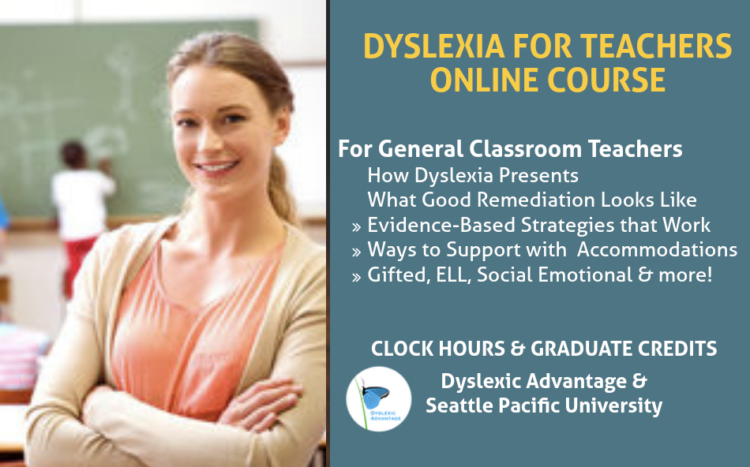
States Fall Short on First Professional Teacher Trainings for Dyslexia
So it's begun: states like South Carolina have begun making their first professional development for teachers explaining what dyslexia is and how teachers can meet their needs of the students in their classrooms. It's a start. However, if you look at the modules (see...
ADHD / Gifted 2E Guidelines from Department of Education – Schools
In breaking news, the US Department of Education and Office for Civil Rights have released their a letter from Asst Secretary Catherine Lhamon and its Students with ADHD and Section 504 Resource Guide HERE. For your convenience, we also include them below -...
Dyslexia and IQ: What You Must Know [Premium]
Here are 4 of the Most Important Things You Should Know About Dyslexia & IQ: #1. It Can Be Used to Identify Strengths and Talents. In our minds, one of the best reasons that dyslexic students benefit by IQ testing is that it can quickly establish their intelligence and strengths. There are many strengths that aren’t measured by IQ testing, of course, but also many that it can find – and it provides an objective standard with schools and other institutions wil accept. For dyslexic students in particular, it tends to trump traditional ‘achievement’ assessments because the best tests are given one-on-one (we do not like group IQ tests) and tests of higher order thinking are for the most part untimed (the verbal tests) involve […]