This category can only be viewed by members. To view this category, sign up by purchasing Premium, Premium Institutional 1 Year or STEM for Every Student - Dyslexia and More.

[PREMIUM] Latest Research: Dyslexia, Sequential Memory, and Seeing the Big Picture

“My mind doesn’t work like a train track. It’s more like a web page with lots of hyperlinks.” – dyslexic honors college student. It’s refreshing to see that more researchers take an interest on dyslexia beyond reading. In this recent paper from Belgium and Missouri, the challenges of remembering sequential information  for dyslexics and non-dyslexics was reviewed. Both working memory and sequencing were examined. Working memory is a type of short-term memory necessary for keeping information ‘in mind.’ Sequencing is remembering the order that things are said. It’s activities such as this that that can make something like following classroom instructions or remembering computer passwords easy or hard. Several interesting observations were made from their review of the research literature: – Dyslexic children and adults tend […]

Bookmark

Please login to bookmark
Close
To access this post, you must be a Premium subscriber. log in

Bookmark
Please login to bookmark Close
read more

[PREMIUM] Tips from a Dyslexic World Memory Champion

When people say they would like to ‘brain train’ or get smarter for school, they often mean they want to make their brains more efficient – so they learn more, but also work less. One of the most straightforward ways to do this is to boost memory – and for most dyslexic people, the way you train may be more important than how hard or how much. We talk about memory trade-offs a bit in our book, The Dyslexic Advantage, but briefly, in general, dyslexic people of all ages tend to show a preference for personally-experienced memories rather than dry facts that need to be memorized by rote. A trick for memorizing more efficiently is to take the dry stuff and transform it into something […]

Bookmark

Please login to bookmark
Close
To access this post, you must be a Premium subscriber. log in

Bookmark
Please login to bookmark Close
read more

Memory: Why Drill Can Kill – and What to Do Instead [Premium]

It would almost seem without question that repetition should be helpful for learning, but researchers have found that if  repetitions are too much and too long (longer than 10 seconds in one paradigm), further repetition caused poorer memory and word retrieval rather than better! From one of the papers below: “Both Experiments 1 and 2 demonstrated a striking and clear violation of the memory benefits typically associated with repetition. Specifically, increasing the rehearsal time of a word did not yield a straightforward monotonic increase in performance on a later free association test; rather, it led to a nonmonotonic effect, with performance initially increasing, but then declining with longer repetition durations.” The reason for this effect is currently being studied, but the researchers speculated that the increased forgetting […]

Bookmark

Please login to bookmark
Close
To access this post, you must be a Premium subscriber. log in

Bookmark
Please login to bookmark Close
read more

Research: Classroom Culture Matters – Effects on Reading Performance [Premium]

In the latest issue of the Journal of Learning Disabilities, researchers from Harvard and Greece found that classroom culture, and in particular LD students’ perceptions of their classrooms motivational framework had sudden, significant, and unpredictable effects on reading performance and students’ emotional state. From the authors: “The purpose of the present study was to evaluate the proposition that a classroom’s motivation discourse exerts significant influences over students’ achievement in reading.” The two conditions that researchers compared were: #1. Mastery (internal standard) – “In our class trying hard is important” #2. Performance (external standard) – “In our class, getting good grades is the main goal.” Their brief conclusions: “…the results confirmed the research hypotheses concerning the role of mastery and performance goals. The form (mastery) had a […]

Bookmark

Please login to bookmark
Close
To access this post, you must be a Premium subscriber. log in

Bookmark
Please login to bookmark Close
read more

Bridging the Gap to Reading Long Words [Premium]

 In our last post, we wrote about the 3rd grade gap or wall. Dyslexic students typically get through the hard slog of phonemic awareness and then parents and teachers breathe a sigh of relief. Many times, the extra work fades away and students are integrated back into their usual classroom routine. All seems well, but a problem may remain. Reading remains effortful and the complexity of the text goes up. Students may not be able to keep up. With little extra help and too little time to complete assignments, the “guess and go” approach may dominate the reading strategy so that the gap between peers increases. A large part of the problem may be that students have not effective strategy to read long words. These problems can come […]

Bookmark

Please login to bookmark
Close
To access this post, you must be a Premium subscriber. log in

Bookmark
Please login to bookmark Close
read more

Dyslexia and the Third Grade Wall [Premium]

If you’re not aware if the ‘3rd Grade Wall’, you can get blind-sided. A recurring theme that we hear about when we interview accomplished dyslexic men and women is the trouble and failure (often grade retention) that happens in the 3rd grade. Why?  What’s the big deal about the 3rd grade? From Time Magazine, “Take a guess: What is the single most important year of an individual’s academic career? The answer isn’t junior year of high school, or senior year of college. It’s third grade. What makes success in third grade so significant? It’s the year that students move from learning to read — decoding words using their knowledge of the alphabet — to reading to learn. The books children are expected to master are no […]

Bookmark

Please login to bookmark
Close
To access this post, you must be a Premium subscriber. log in

Bookmark
Please login to bookmark Close
read more

Dyslexia and Medical School – AMA Journal of Ethics [Premium]

In an important article published in the AMA Journal of Ethics, physicians call for mandatory dyslexia training for medical school faculty. The article presents the case of a 1st year dyslexic medical student who excelled in college and in clinical research, but who is conflicted about whether to disclose his dyslexia to faculty and fellow classmates because of his concerns that it would negatively impact his “education, performance, and reputation.” The writers comment: “Given the scientific progress in understanding the epidemiology, cognitive basis, and neurobiology of dyslexia, it is surprising that ignorance of the condition persists; such ignorance continues to result in faculty misperceptions of dyslexia. For example, the very common and physiologically based symptom of slow reading in dyslexia can be misinterpreted as slow […]

Bookmark

Please login to bookmark
Close
To access this post, you must be a Premium subscriber. log in

Bookmark
Please login to bookmark Close
read more

Surviving Parent Teacher Conferences [Premium]

Parent-Teaching Conferences can be stressful for both parents and teachers. Keep your eye on the big picture, think strategically, and work toward a positive year for your student in the classroom. Often the amount of time you have with the teacher is quite short because of the total number of students involved. As a result, plan on showing up to see how the beginning of the year is progressing and focus on finding solutions if your students is lagging behind or having difficulties. If you’ve purchase Dyslexia, Dysgraphia, or Dyscalculia Teacher cards, now is a good time to use them. Quick  Tips for Parent Teacher Conferences If Your Student is Dyslexic: Make a Positive First Impression – This may be the first time your meeting this teacher and she […]

Bookmark

Please login to bookmark
Close
To access this post, you must be a Premium subscriber. log in

Bookmark
Please login to bookmark Close
read more

Dyslexic Advantage Premium – Issue 11 Organizing Creativity [Premium]

 Premium Issue 11 October 29, 2016 Organizing Creativity, Stealth Dyslexia, Dyslexia and Self Image, Memorizing for School, What Worked for 2E Gifted Dyslexics, Art Therapy for Dysgraphia, Hands-On Math for Fractions, More Interactive Reading Strategies, Mastering Foreign Languages and More This issue has memory strategies that seem to be helpful for a majority of dyslexic folk – whether it’s history facts, science vocabulary, or foreign languages. Subscriptions support Dyslexic Advantage.     [/wcm_restrict] Bookmark Please login to bookmark ClosePlease login to access.

Bookmark

Please login to bookmark
Close
To access this post, you must be a Premium subscriber. log in

Bookmark
Please login to bookmark Close
read more

DEAN KAMEN INVENTOR [Premium]

“If you start to do things you’ve never done before, you’re probably going to fail at least some of the time…and I say that’s ok.” – Dean Kamen Dean Kamen is one of the world’s most prolific inventors with over 440 patents to his name – including the Segway, the Luke Arm (robotic prosthesis), a programmable insulin pump and portable water purifier for Third World Countries. He also created the FIRST LEGO league to encourage young people to build and engineer, and he considers that his most important accomplishment. Dean’s father was an illustrator for MAD magazine and Weird Science and his mother was a teacher. Precocious at a young age, he remembers inventing a way to make his bed without having to cross to […]

Bookmark

Please login to bookmark
Close
To access this post, you must be a Premium subscriber. log in

Bookmark
Please login to bookmark Close
read more

How To Become Invincible – Sort Of

Well, maybe not invincible, but you know what we mean. There’s a new idea circulating among business leaders and entrepreneurs. It’s not mindset or grit, but of course those are important. It’s rejection therapy. Some people think part of the reason for higher than average success of dyslexic people as CEOs and entrepreneurs is that they’re pretty much bullet-proof by the time they survive unrecognized dyslexia and the stressful bullying and teasing years of childhood. So what is the therapy in rejection therapy? It’s one of the oldest ideas in psychology – exposure. Increase resistance or tolerance to rejection by seeking it out. One popularizer of the idea is Jia Jiang, a startup CEO who realized that he hated being rejected when he pitched the […]

Bookmark

Please login to bookmark
Close
To access this post, you must be a Premium subscriber. log in

Bookmark
Please login to bookmark Close
read more

How to Read to Kids with Dyslexia – Reading As a Conversation [Premium]

 There are many good ways to read to children with dyslexia. In this post, we wanted to talk share an approach that some have called “dialogic” or like a dialogue. A dialogue is a back and forth conversation, and that is exactly how this style of reading goes. Rather than having a parent or teacher read aloud with a child listening, in dialogic reading, the adult helps the child tell the story. The acronym for this method is PEER: 1. Prompt a child to say something about the book. 2. Evaluate her response. 3. Expand the response by rephrasing and adding more detail, and 4. Repeat the prompt to make sure the child learned. Except for the first reading of the book, PEER sequences should […]

Bookmark

Please login to bookmark
Close
To access this post, you must be a Premium subscriber. log in

Bookmark
Please login to bookmark Close
read more

Speak

To listen, select text and click sound button

WATCH NOW

OSPI STEM Course – STEM for Diverse Learners

Dyslexia and Gifted: Course for Psychologists

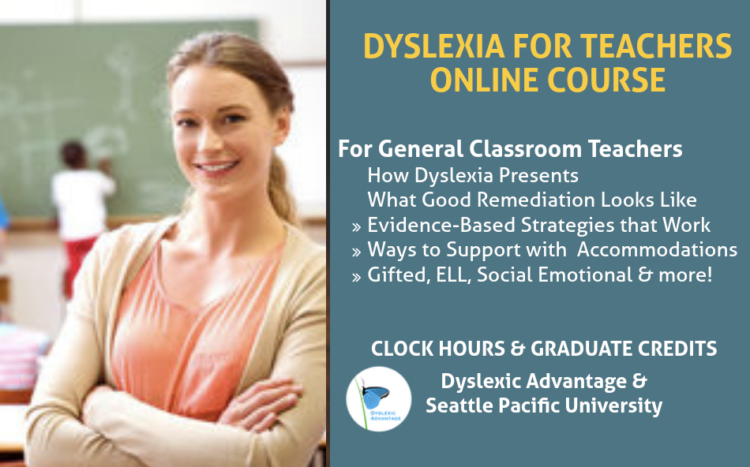
Dyslexia for Teachers Course

SPONSORS

    Discover Your Dyslexic MIND Strengths
                                    Free


Amazon Affiliate Notice

Dyslexic Advantage is an Amazon Affiliate. If you click on a link that takes you to the Amazon store, Dyslexic Advantage may earn money on qualifying purchases. Clicking HERE to enter Amazon and making a purchase may support Dyslexic Advantage. Thank you!