“Children with dyslexia often exhibit increased variability in sensory and cognitive aspects of hearing relative to typically developing peers.” – Hornickel et al., 2012 PNAS There is a long research history establishing auditory processing difficulties among children and adults who are dyslexic. What may be confusing to non-scientific people is that auditory processing is not simply “hearing”. It relates to the complex networks in the brain that interpret what sounds are heard.
Auditory processing difficulties in dyslexic people don’t present with abnormalities on simple screening hearing tests; instead, the difficulties present in tests that examine the effect of listening over background noise, for instance, or processing of rapid sounds. The reason it’s important to be aware of this is that auditory processing […]My Pandemic Hack for Classes

Shelley Wear, a long-time volunteer on our Dyslexic Advantage editorial team shared these pandemic hacks for her classroom. Thanks Shelley! “The struggle is real to make sure students understand what you are saying with a mask on. I purchased a personal amplifier (small box with microphone headset) and it has been a game changer for my classroom. Students are much more attentive and I believe it has really helped. I am also using a multisensory approach to decoding, teaching Visual Phonics. The paras have overheard students talking about how fun it is when kids are in the hallways and think no one is listening. I am relieved, because I have limited access to middle school materials to teach decoding and a large percentage of my […]
Dyslexia Advocacy: Say Dyslexia 2.0
From Chalkbeat’s story, “NYC plans to screen nearly 200,000 students in the early grades to uncover struggling readers. Then what?” “In a massive bid to gauge reading skills following COVID-related learning disruptions, New York City’s education department is introducing literacy screening for its nearly 200,000 children in kindergarten through second grade… While the education department’s screeners aren’t designed to identify students at risk of having dyslexia, which is the most common learning disability, they are able to identify learning gaps in skills that are often associated with dyslexia, literacy experts say. But many also note that screening alone will not address systemic issues that contribute to widespread literacy deficits across the city, such as uneven curriculum and inadequate teacher training. The success of the […]
I Never Thought I’d Be Homeschooling… [Premium]
We never thought we would be homeschooling when we started almost 2 decades ago. What our family can say today, is that looking back, we’re so grateful for our entire homeschooling journey – even though initially homeschooling chose us rather than the other way around. Today there are so many reasons to homeschool and ways that homeschooling can also be a good fit for dyslexic students, so take heart in the adventure ahead of you and may the coming year be one good surprise after another. WHY HOMESCHOOLING CAN BE A GOOD MATCH FOR MANY STUDENTS Schooling at an Individual Pace The first reason why homeschooling can be a good match for many students is that traditional schooling can be a […]
Math: Multiple Representations [Premium]
If you have a lot of ground to cover for the coming school year, consider the use of multiple representations to improve the efficiency of learning. First, as a person who is math-challenged herself and was tasked at one time with tutoring one of our kids with similar math difficulties, I am sympathetic to people who are tasked with teaching math. The truth is, I wasn’t good at it myself, so I found myself getting frustrated when my student didn’t understand. I had little flexibility between math representations – and as a result tended to teach math the way I was taught it…rote memory of sequenced steps – which I was to find was the last thing my student should have been trying […]
College Success: Strategies
“One half of all students who begin college fail to complete their degrees, resulting in wasted talents, time, and resources… Educating students on learning skills only solves part of the problem for students at risk for dropping out of college. According to this study, students need time to learn and effectively practice the strategies in their classes.” – Sara Renzulli, PhD It’s a striking statistic that half of all students who attend college fail to complete their degrees. Students with learning differences often comprise a significant percentage of those groups. Dr. Sara Renzulli has a practical and helpful research paper about how her intervention (a 2x per week class on learning strategies for a total of 6 sessions) had a positive effect on […]
Math Strategies Without Anxiety with Stanford Prof Jo Boaler
If you anticipate working with a student on math this coming year, what approach will you take? Dr. Jo Boaler has tips that can help create a positive atmosphere for learning. To read the entire handout with the excerpt above (including links), click HERE.
In the video below, see how Jo taught students how to become comfortable with consider multiple strategies when solving math problems. Bookmark Please login to bookmark ClosePlease login to access.Dyslexic Talents in STEM: Chemistry [Premium]
“Through most of high school, I hated math and science. It wasn’t until my senior year when I took AP statistics and AP chemistry that I discovered that I enjoyed solving challenging analytical problems. After I graduate in May, I plan to pursue a graduate degree in Electrical Engineering.” – Leah Harper Although chemistry may present dyslexic students with challenges, once the initial difficulty of notation and the periodic chart are mastered, the spatial and analytical aspects of chemistry can become life-long endeavors. In a video (that’s now unavailable on YouTube), Dr. Blake Charlton talked about how he discovered the narrative intelligence associated with dyslexia and how he used it to help him learn the periodic chart. Instead of memorizing columns of elements by […]
Managing Information with Concept Maps [Premium]
Although many people may use the terms “concept map” and “mind map” interchangeably, mind maps tend to be simpler, relating information to a central topic, whereas concept maps seek to cover more complex subjects, relating different parts to each other. Concept maps can be used to simplify material because different information can be grouped together and in the making of the map it can be easier to see how new knowledge builds on old. The process of making a concept map also transforms learning into an active process and students who are strong personal and experiential learners may remember the process better than reading through notes again and again. For students who say that they get lost in class, doing a concept map can help […]
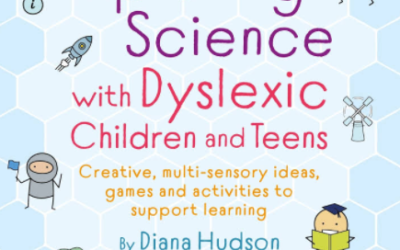
Exploring Science With Dyslexic Children & Teens
"The book begins by describing the strengths and weaknesses of creative thinkers who have dyslexia. It outlines the reasons that they may struggle in science and gives examples of specific areas of the school science curriculum that are often very challenging for...
Free Structured Literacy Resources [Premium]
Even if these are unprecedented frustrating times for instruction due to the pandemic, there are occasional upsides – like the increased availability of free resources about structured literacy now available on the web. In many respects, it’s never been easier to sample different curricula, look at how others introduce lessons, and take advantage of free resources posted online. As an example, for those using the Wilson system, here is a teletherapy site where teachers have uploaded lessons. Here is a board that can be used if you’d like to work with a student remotely or simply give your student digital manipulatives for lessons. https://sites.google.com/view/teletherapyforwilsonproviders/home Work directly online with a board HERE. Get a copy of the board HERE. […]
Surviving and Thriving in Hybrid Classrooms
With the rise in vaccinations, many schools have opened with a hybrid schedule which has some pros and cons for dyslexic students. ONLINE ASSIGNMENTS - GROUP PARTICIPATION and AUDIO The reduction in written assignments since of the start of the pandemic has...