Recently, I discovered the math activities of Ronit Bird. Ronit Bird is the author of several books about Dyscalculia. She has helpful tips for parents and teachers about concrete manipulatives and building up a sense of number through activities more than worksheets. I confess, I wish I had had this more when I was a kid. The tricky thing about math and activities even if you’re home schooling or home-enriching is that students who are weak in an area will often not want to do it, even if it’s something that would be beneficial for them to do. In our family, we had one child who was very, very good at all types of speed-based computer games, and another who was decidedly not good […]
Cognitive Overload [Premium]
Here is a nice overview of cognitive load theory – the only downside is due to some ads, but that’s YouTube for you. Everyone is susceptible to cognitive overload, but overload increases with stress (pandemic anyone?), younger age, and dyslexia. Some people have small working memory capacities which may make them more prone to cognitive overload. As a group, dyslexics tend to be more susceptible to cognitive overload, meaning that they are more dependent on how information is taught. If you’re dyslexic yourself, it’s good to periodically do a productivity check. If you’re a college student, chances are you already know what it means to have memory overload. Students can prepare for tough subjects by reviewing in advance (finding a relevant video […]
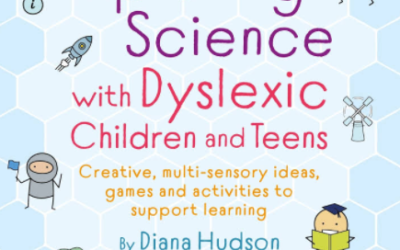
Exploring Science With Dyslexic Children & Teens
"The book begins by describing the strengths and weaknesses of creative thinkers who have dyslexia. It outlines the reasons that they may struggle in science and gives examples of specific areas of the school science curriculum that are often very challenging for...
The Double Whammy: Dyscalculia and Dysgraphia [Premium]
What happens when a student has both dyscalculia and dysgraphia? Be prepared for an educational path that has a timing of its own. Dysgraphia often accompanies dyslexia, but dyscalculia too. If you or your student has two or three out of these 3 “d’s” be prepared for a challenging course and a need for individualization for many years. The most typical presentation for dyscalculia relates to students who have trouble mastering the sequence of numbers and recall of basic math facts. When dysgraphia gets added to the mix, you can imagine how it may swamp working memory, causing students to lose track when they work through math problems. In a very real sense having both dyscalculia and dysgraphia also robs students of being able to […]
Quick or Slow Remediation? [Premium]
The learning challenges of dyslexia can be very mild or quite severe, but the severity of challenges are not the sole determination of whether remediation will be quick or slow. Once we visited an elite private school for dyslexia on the East Coast. Their aim to get students through their program in 2 years, in part, was successful. The school had solid training of its teachers and great resources, but the program was not unlike other structured literacy programs. Why was it that they could get students through so fast with their programs? Part of the answer was the strict criteria they had for student admission. With a long waitlist for spots, they had decided to accept to their program only students who had strong […]
Algebra: What Students See and What Mathematicians See [Premium]
Ben Orlin is the author of Math with Bad Drawings and Change is the only Constant: The Wisdom of Calculus in a Madcap World. Besides have a good sense of humor, Ben is good at recognizing the differences in the way students and mathematicians see math problems. Take for example, the math problem, What is 7 x 11 x 13. What goes through your mind when you see a problem like that? I reach for my calculator, or might try 7 x 11 first, then look for a pen a paper, but what Ben suggests is that mathematicians imagine this. The following examples Ben shared about Algebra had me laughing aloud: The mathematician’s simplification involves recognizing a pattern. But […]
Writing: Elaboration [Premium]
If you were to compare dyslexic and non-dyslexic university students in writing, it’s usually the case, that on average, dyslexic students write fewer words and fewer words that are polysyllabic. The reasons are several; slowness with word retrieval, writing, and spelling, organizational challenges, and working memory overload are likely contributors. Because multisyllabic words are more challenging phonemically, not only are they harder to recognize and remember while reading, but also they are harder to spell. THE BIG PICTURE OF ELABORATION The big picture of elaboration is that you want writers to fall in love with words, whether it’s a beautiful passage evoking imagery, or funny turn of phrase, or incisive argument. Students who are the easiest to cultivate as great writers are those who […]
How Not To Give Up On Learning A Second Language [Premium]
Learning second languages are difficult for many dyslexic students; foreign language waivers or substitutions are common, but in spite of this, many can learn other languages and even multiple languages if the goal is conversation. Writing and spelling second and third language can be more difficult, but also possible for many people. Students may be more successful if they able to study over a longer time and if they have learned more about the structure of language in their native tongue. In the video below, listen to 4 Hour Work Week guru Tim Ferriss (yes, he’s dyslexic) talk about how he learned to be able to converse in many foreign languages. The type of learning described, won’t necessarily make you a master of […]
Diagramming Math [Premium]
When we tested older students in our clinic who were in college on STEM tracks, I often asked students who were proficient in mathematics, what strategies were most helpful to them. Many of them found their own ways of solving problems – often using spatial and mental math strategies or diagrams. How did they learn these approaches? Most said they figured it out themselves. In my search for math curricula that emphasized deeper understanding and diagrammatic thinking, I came across two resources that may be valuable for you – Illustrative Mathematics and Japanese Math. Often, we may be reminded that mathematics has its own language. There are words and symbols that mean different things in every day speaking, reading, and writing vs. math. If […]
Free Structured Literacy Resources [Premium]
Even if these are unprecedented frustrating times for instruction due to the pandemic, there are occasional upsides – like the increased availability of free resources about structured literacy now available on the web. In many respects, it’s never been easier to sample different curricula, look at how others introduce lessons, and take advantage of free resources posted online. As an example, for those using the Wilson system, here is a teletherapy site where teachers have uploaded lessons. Here is a board that can be used if you’d like to work with a student remotely or simply give your student digital manipulatives for lessons. https://sites.google.com/view/teletherapyforwilsonproviders/home Work directly online with a board HERE. Get a copy of the board HERE. […]
Surviving and Thriving in Hybrid Classrooms
With the rise in vaccinations, many schools have opened with a hybrid schedule which has some pros and cons for dyslexic students. ONLINE ASSIGNMENTS - GROUP PARTICIPATION and AUDIO The reduction in written assignments since of the start of the pandemic has...
Homeschooling or Modified Schooling?
This is an older post from when students were heading back to school after the pandemic. We'll keep it up in case it's helpful for other families considering homeschooling or modified schooling First off, it's best to be aware that there is rarely a perfect...