Answer: Yes. Absolutely. There have been many famous physicians who were dyslexic, and many today that you might not know who are dyslexic because many don’t identify in the workplace and many more weren’t formally identified. The typical profile of a dyslexic physician is to have had early troubles in elementary school, then a jump in abilities in middle to high school, and then further jump up in college and medical school. There are probably several reasons why medicine can be a popular occupation for adult (often gifted) dyslexics. First, it is a complex domain to master that nevertheless also requires an ability to grasp the big picture, make decisions, and execute a plan. Medicine is based on science, which is a strong suit and […]
Breaking Research : Dyslexia in Adolescents and Adults [Premium]
An important paper was published this month from the University of Washington, entitled “Evidence-Based Reading and Writing Assessment for Dyslexia in Adolescents and Young Adults.” The paper is especially important guiding testing professionals who assess teens and adults for dyslexia or see gifted or twice-exceptional students. This paper also takes a more systematic look at the roles of individual factors like working memory and executive function on dyslexia and reading and spelling performance. The data will be helpful in targeting educational interventions and can also guide requests for testing accommodations. There are interesting observations too in that paper that will help with characterizing the strengths that occur among adolescent and adult dyslexics, with implications for twice-exceptional or gifted students with dyslexia. In several areas, adolescent / adult […]
Advice for Actors – Especially Dyslexic Ones
From accomplished actor Lloyd Everitt, the youngest actor to play Othello at Shakespeare's Globe Theatre in London https://www.thestage.co.uk/advice/2016/lloyd-everitt-5-tips-for-actors-especially-dyslexic-ones/ 1. Know yourself Observe your sound and reactions from...
HOW TO READ A WORDLESS PICTURE BOOK
With so much focus on reading for children with dyslexia, the choice of a wordless picture book might seem to be unusual, but it shouldn't be. Dyslexic children should be exposed to wordless picture books at an early age, and also be encouraged to continue read them...
Dyslexia: The Twenty-Something Years [PREMIUM]
“These are the years when it will be easiest to start the lives we want. And no matter what we do, the twenties are an inflection point- the great reorganization – a time when the experiences we have disproportionately influence the adult lives we will lead.” – Meg Jay, author of The Defining Decade “Life for emerging adults is vastly different today than it was for their counterparts even a generation ago. Young people are waiting longer to marry, to have children, and to choose a career direction. As a result, they enjoy more freedom, opportunities, and personal growth than ever before. But the transition to adulthood is also more complex, disjointed, and confusing. ” – Christian Smith, lead author of Lost in Transition Many ‘experts’ have […]
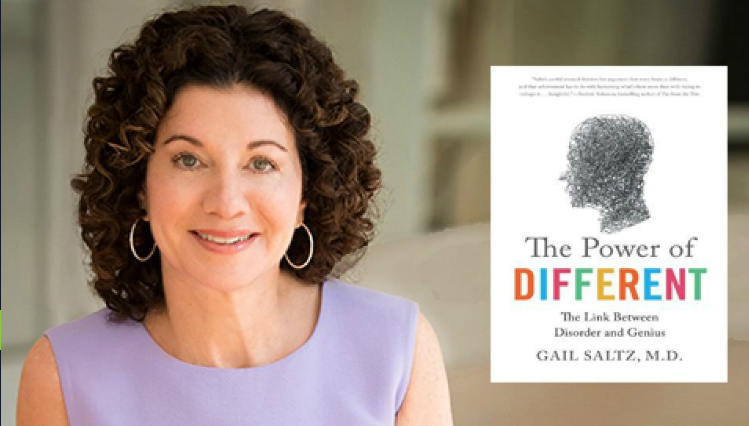
The Power of Different – Exclusive Interview
Dr. Gail Saltz has a hit book on her hands, and it's called The Power of Different. In addition to being a professor of psychiatry at Columbia University, she grew up with a brother who'd win a Nobel Prize. Gail was kind enough to talk to her about what she learned...
How a Dyslexic Author Wrote a NYTimes Bestseller about Joy
"...He explained that there is a Tibetan saying that it is the painful experiences that shine the light on the nature of happiness... The Archbishop added that that “nothing beautiful comes without some suffering,” and he mentioned how our muscles need resistance to...
DEAN KAMEN INVENTOR [Premium]
“If you start to do things you’ve never done before, you’re probably going to fail at least some of the time…and I say that’s ok.” – Dean Kamen Dean Kamen is one of the world’s most prolific inventors with over 440 patents to his name – including the Segway, the Luke Arm (robotic prosthesis), a programmable insulin pump and portable water purifier for Third World Countries. He also created the FIRST LEGO league to encourage young people to build and engineer, and he considers that his most important accomplishment. Dean’s father was an illustrator for MAD magazine and Weird Science and his mother was a teacher. Precocious at a young age, he remembers inventing a way to make his bed without having to cross to […]
How To Become Invincible – Sort Of
Well, maybe not invincible, but you know what we mean. There’s a new idea circulating among business leaders and entrepreneurs. It’s not mindset or grit, but of course those are important. It’s rejection therapy. Some people think part of the reason for higher than average success of dyslexic people as CEOs and entrepreneurs is that they’re pretty much bullet-proof by the time they survive unrecognized dyslexia and the stressful bullying and teasing years of childhood. So what is the therapy in rejection therapy? It’s one of the oldest ideas in psychology – exposure. Increase resistance or tolerance to rejection by seeking it out. One popularizer of the idea is Jia Jiang, a startup CEO who realized that he hated being rejected when he pitched the […]
How Dyslexic MIND Strengths Integrate with Multiple Intelligences [Premium]
In our book, The Dyslexic Advantage, we spoke about the 4 MIND strengths common in adult dyslexics: M for Material Reasoning, I for Interdisciplinary Reasoning, N for Narrative Reasoning, and D from Dynamic Reasoning. These skill clusters and talent sets had parallels in brain systems and processes as well as careers, domains of expertise, and areas of innovation. Multiple Intelligences is a concept that was introduced by Howard Gardner of Harvard to identify specific modalities that went beyond a single intelligence or general ability. The seven he initially characterized were: musical-rhythmic, visual-spatial, verbal-linguistic, logical mathematical, bodily, kinesthetic, interpersonal, and intrapersonal. The ones he considered adding later were naturalistic (able to classify natural forms, ecological ‘receptiveness’), existential or spiritual, and teaching -pedagogical in telligence. Somewhat related […]
Why It’s Important to Say Dyslexia But Also Support Its Strengths
What is Dyslexia? Dyslexia is a brain-based learning difference with a strong genetic basis. It characterized by unexpected difficulties in fluent reading and specific patterns of difficulty with writing, spelling, and sometimes math as well as strengths in...
Why Dyslexics Excel in Real Estate
"When I see a property I can instantly construct a new house on it. I can see exactly how that house is going to look, and I can walk through every room in that house, and out into the garden, and everywhere. I can turn my thoughts into reality...I can do a detailed...