WHEN A UNIVERSITY IS DYSLEXIA-UNFRIENDLY [Premium]

  Despite recent advances in dyslexia-friendly policies and statements in K-12 and higher education, reports of dyslexia-unfriendly and discriminatory practices are more common than anyone would like to mention. At the university level, rarely is there any education for faculty and staff about the needs of dyslexic and LD students on campus, so it should not be surprising that many professors will not understand why accommodations are necessary for dyslexic students. They may actively discourage students from obtaining such accommodations although it is against federal law. As we have recently reported, US Department of Justice regulations requires that private colleges give “Considerable weight to the documentation of past accommodations, modifications, or auxiliary aids or services received in similar situations” and not require additional burdensome re-testing. […]

Bookmark

Please login to bookmark
Close
To access this post, you must be a Premium subscriber. log in

Bookmark
Please login to bookmark Close
read more

Latest Research: Repetition As a Poor Way to Teach Dyslexics [Premium]

In groundbreaking research, researchers at MIT or the Massachusetts Institute of Technology reported that dyslexic children and adults have “a diminished ability to acclimate to a repeated input in their paper titled “Dysfunction of Rapid Neural Adaption in Dyslexia.” Like many research papers, dyslexia is seen through a negative lens (‘dysfunction’) and the take-home points through university press releases, similarly so, however the findings are interesting ones and fit with an evolving picture of dyslexia as a learning difference (rather than disease or disability) that extends beyond reading and has ramifications for many aspects of education. “It’s a difference in the brain that’s not about reading per se, but it’s a difference in perceptual learning that’s pretty broad,” says John Gabrieli, who is the study’s […]

Bookmark

Please login to bookmark
Close
To access this post, you must be a Premium subscriber. log in

Bookmark
Please login to bookmark Close
read more

[PREMIUM] Tips from a Dyslexic World Memory Champion

When people say they would like to ‘brain train’ or get smarter for school, they often mean they want to make their brains more efficient – so they learn more, but also work less. One of the most straightforward ways to do this is to boost memory – and for most dyslexic people, the way you train may be more important than how hard or how much. We talk about memory trade-offs a bit in our book, The Dyslexic Advantage, but briefly, in general, dyslexic people of all ages tend to show a preference for personally-experienced memories rather than dry facts that need to be memorized by rote. A trick for memorizing more efficiently is to take the dry stuff and transform it into something […]

Bookmark

Please login to bookmark
Close
To access this post, you must be a Premium subscriber. log in

Bookmark
Please login to bookmark Close
read more

Bridging the Gap to Reading Long Words [Premium]

 In our last post, we wrote about the 3rd grade gap or wall. Dyslexic students typically get through the hard slog of phonemic awareness and then parents and teachers breathe a sigh of relief. Many times, the extra work fades away and students are integrated back into their usual classroom routine. All seems well, but a problem may remain. Reading remains effortful and the complexity of the text goes up. Students may not be able to keep up. With little extra help and too little time to complete assignments, the “guess and go” approach may dominate the reading strategy so that the gap between peers increases. A large part of the problem may be that students have not effective strategy to read long words. These problems can come […]

Bookmark

Please login to bookmark
Close
To access this post, you must be a Premium subscriber. log in

Bookmark
Please login to bookmark Close
read more

Dyslexia and the Third Grade Wall [Premium]

If you’re not aware if the ‘3rd Grade Wall’, you can get blind-sided. A recurring theme that we hear about when we interview accomplished dyslexic men and women is the trouble and failure (often grade retention) that happens in the 3rd grade. Why?  What’s the big deal about the 3rd grade? From Time Magazine, “Take a guess: What is the single most important year of an individual’s academic career? The answer isn’t junior year of high school, or senior year of college. It’s third grade. What makes success in third grade so significant? It’s the year that students move from learning to read — decoding words using their knowledge of the alphabet — to reading to learn. The books children are expected to master are no […]

Bookmark

Please login to bookmark
Close
To access this post, you must be a Premium subscriber. log in

Bookmark
Please login to bookmark Close
read more

Surviving Parent Teacher Conferences [Premium]

Parent-Teaching Conferences can be stressful for both parents and teachers. Keep your eye on the big picture, think strategically, and work toward a positive year for your student in the classroom. Often the amount of time you have with the teacher is quite short because of the total number of students involved. As a result, plan on showing up to see how the beginning of the year is progressing and focus on finding solutions if your students is lagging behind or having difficulties. If you’ve purchase Dyslexia, Dysgraphia, or Dyscalculia Teacher cards, now is a good time to use them. Quick  Tips for Parent Teacher Conferences If Your Student is Dyslexic: Make a Positive First Impression – This may be the first time your meeting this teacher and she […]

Bookmark

Please login to bookmark
Close
To access this post, you must be a Premium subscriber. log in

Bookmark
Please login to bookmark Close
read more

How to Read to Kids with Dyslexia – Reading As a Conversation [Premium]

 There are many good ways to read to children with dyslexia. In this post, we wanted to talk share an approach that some have called “dialogic” or like a dialogue. A dialogue is a back and forth conversation, and that is exactly how this style of reading goes. Rather than having a parent or teacher read aloud with a child listening, in dialogic reading, the adult helps the child tell the story. The acronym for this method is PEER: 1. Prompt a child to say something about the book. 2. Evaluate her response. 3. Expand the response by rephrasing and adding more detail, and 4. Repeat the prompt to make sure the child learned. Except for the first reading of the book, PEER sequences should […]

Bookmark

Please login to bookmark
Close
To access this post, you must be a Premium subscriber. log in

Bookmark
Please login to bookmark Close
read more

Math Strategies for Arithmetic – Number Flexibility [Premium]

“Everybody could rock through their multiplication tables and I could do my ones and my twos and my zeros and my tens, and that was about it.” – Jack Laws, naturalist I’ve been enjoying a book, Mathematical Mindsets written by Stanford Professor Jo Boaler. It’s great stuff. She’ll help a lot of dyslexic students if they adopt her approaches to teaching math. The first concept is deceptively simple, but resonates with me after seeing over a decade of dyslexic students work math problems in our clinic. There is a high degree of overlap between dyscalculia and dyslexia although there is also a significant number of dyslexics who are solid or even outstanding mathematicians. The weak ones almost invariably struggle with basic math facts and require […]

Bookmark

Please login to bookmark
Close
To access this post, you must be a Premium subscriber. log in

Bookmark
Please login to bookmark Close
read more

Speak

To listen, select text and click sound button

WATCH NOW

OSPI STEM Course – STEM for Diverse Learners

Dyslexia and Gifted: Course for Psychologists

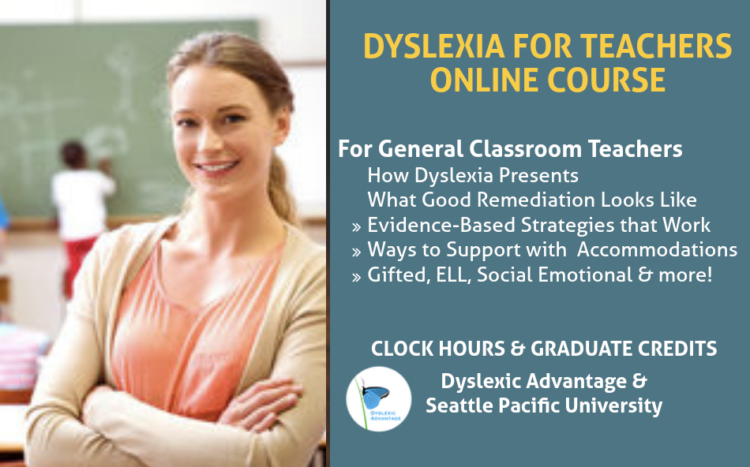
Dyslexia for Teachers Course

SPONSORS

    Discover Your Dyslexic MIND Strengths
                                    Free


Amazon Affiliate Notice

Dyslexic Advantage is an Amazon Affiliate. If you click on a link that takes you to the Amazon store, Dyslexic Advantage may earn money on qualifying purchases. Clicking HERE to enter Amazon and making a purchase may support Dyslexic Advantage. Thank you!