"My teachers loved me first and taught me second..." - Chad Beam 3x Teacher of the Year Chad Beam has won Burns High School's Teacher of the Year for the 3rd time in 2019. From the Shelby Star: "That floors me. I'm the dyslexic kid. I'm teaching what I...
Dyslexic National Geographic Photographer Michael Shainblum
Michael Shainblum is a photographer/filmmaker who specializes in a wide range of photography including night-cap, aerial, travel, adventure and more. Michael: "As a kid, a lot of people would succeed in certain ways that I couldn't. It took me a really long time to...
Great College Application Essay
Here is one of our favorite college application essays of all time (shared with permission): Please provide an answer below if you wish to provide details of circumstances or qualifications not reflected in the application. When I started the process of looking for...
Mark Ruffalo – The Hulk – “I am Dyslexic”
In a brief Twitter exchange, Mark Ruffalo, aka The Hulk / Bruce Banner from the Avengers shared that he was dyslexic after being asked about why he mentioned in an interview that he had difficulty reading. The multi-talented actor is an Oscar nominee, director,...
Test Accommodations for Students with Dyslexia Under the ADA – DOJ Statement
The Department of Justice has also released video clarification of key rights for students regarding testing accommodations under the ADA or Americans with Disabilities Act. The entire video is located at the bottom of this post, but we are highlighting a section...
Being Dyslexic – Actor John De Lancie
"I was not a good student, and the reason I was not a good student is that I didn’t know how to read… I was dyslexic, but at the time that was not really a word that was used. What was used was “mildly retarded” or “slow.” I ended up flunking out of a couple of...
Helping Severe Dyslexia – Part 2 Word Learning and Vocabulary [Premium]
In our previous post on Severe Dyslexia, we talked about 6 steps required to read: 1. Seeing 2. Visual Recognition of Words 3. Matching Letters and Words to Sounds – Phonemic Awareness 4. Matching Words to Word Meaning 5. Saying Words 6. Comprehending Text In that post, we talked about how different readers may have difficulty with the visual aspects of reading, whereas others have trouble with sound. Other areas where children or adults can have trouble are in the areas of learning and remembering word meaning, speech output, and finally reading comprehension in text form. It’s important to be able to target these areas because it helps prioritize needs and also could explain while more progress isn’t being made. One student may need intensive remediation in […]
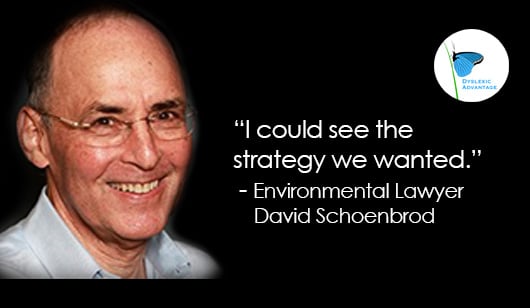
Dyslexia | Environmental Law Pioneer David Schoenbrod
David Schoenbrod is a pioneering environmental attorney on faculty at New York Law School. Since his start in doing anti-poverty community development under a program initiated by Bobbie Kennedy, he has used out-of-the-box dyslexic big picture thinking to trigger a...
Q & A: Can I be a Doctor if I am Dyslexic? [Premium]
Answer: Yes. Absolutely. There have been many famous physicians who were dyslexic, and many today that you might not know who are dyslexic because many don’t identify in the workplace and many more weren’t formally identified. The typical profile of a dyslexic physician is to have had early troubles in elementary school, then a jump in abilities in middle to high school, and then further jump up in college and medical school. There are probably several reasons why medicine can be a popular occupation for adult (often gifted) dyslexics. First, it is a complex domain to master that nevertheless also requires an ability to grasp the big picture, make decisions, and execute a plan. Medicine is based on science, which is a strong suit and […]
How Dyslexia Changes at Different Ages [Premium]
With all of the advances in our understanding of early intervention, dyslexia in older students and young adults often gets short shrift. The paper by Dr. Kathleen Niesen and colleagues has some interesting findings that have important points for identification, accommodations, and understanding of both the challenges and strengths of adolescents and young adults with dyslexia. Importantly, the authors made this point: “…if dyslexia was not diagnosed earlier in schooling, young adults do not qualify for accommodations even if as adolescents and adults they meet research criteria for dyslexia on evidence-based assessment. Such assessment practices do not seem fair or sensible or consistent with the spirit of the Americas for Disabilities legislation.” The point made was that dyslexia missed in the early grades usually meant dyslexia […]
The Moral Harm of Dyslexia Unawareness [Premium]
Primum non nocere. – Latin Saying (First, do no harm) The Latin Saying Primum non-nocere may not have originated with Hippocrates, however the advice is also like a laser beam focused on the greatest harm that comes from dyslexia unawareness.It’s a tragedy that so many negative ripples can affect and direct a young person’s life when dyslexia is not recognized, students are accused of not trying, scolded, shamed, and worse. The reality is that a student isn’t getting an appropriate education or the positive encouragement that they should.
The truth about being dyslexic is that it comes with many strengths and advantages. Dyslexic adults outperform non-dyslexics in spatial reasoning, divergent creativity and problem solving, and incidental learning. The dyslexia legacy includes some of the […]Breaking Research : Dyslexia in Adolescents and Adults [Premium]
An important paper was published this month from the University of Washington, entitled “Evidence-Based Reading and Writing Assessment for Dyslexia in Adolescents and Young Adults.” The paper is especially important guiding testing professionals who assess teens and adults for dyslexia or see gifted or twice-exceptional students. This paper also takes a more systematic look at the roles of individual factors like working memory and executive function on dyslexia and reading and spelling performance. The data will be helpful in targeting educational interventions and can also guide requests for testing accommodations. There are interesting observations too in that paper that will help with characterizing the strengths that occur among adolescent and adult dyslexics, with implications for twice-exceptional or gifted students with dyslexia. In several areas, adolescent / adult […]