“My mind is very visual: I can see anything in pictures, and I always visualize things. I can’t help it. It’s how I’m wired. So whatever you talk about, I’ll see pictures in my head. Very vivid, colorful, lifelike pictures. They aren’t still pictures. I can make them move. Reality, fiction, whatever. I really have to pull it back in to get focused. It was also a problem in the classroom because I’d sit there and imagine where I’d want to be, and what I’d want to do, and what I wanted to become, and I’d think happy thoughts, and I’d just be tuned out the whole time in class.” – Dyslexic CEO Glenn Bailey Does this sound like you or does this not […]

Dyslexic Talents in STEM: Chemistry [Premium]
“Through most of high school, I hated math and science. It wasn’t until my senior year when I took AP statistics and AP chemistry that I discovered that I enjoyed solving challenging analytical problems. After I graduate in May, I plan to pursue a graduate degree in Electrical Engineering.” – Leah Harper Although chemistry may present dyslexic students with challenges, once the initial difficulty of notation and the periodic chart are mastered, the spatial and analytical aspects of chemistry can become life-long endeavors. In a video (that’s now unavailable on YouTube), Dr. Blake Charlton talked about how he discovered the narrative intelligence associated with dyslexia and how he used it to help him learn the periodic chart. Instead of memorizing columns of elements by […]
Managing Information with Concept Maps [Premium]
Although many people may use the terms “concept map” and “mind map” interchangeably, mind maps tend to be simpler, relating information to a central topic, whereas concept maps seek to cover more complex subjects, relating different parts to each other. Concept maps can be used to simplify material because different information can be grouped together and in the making of the map it can be easier to see how new knowledge builds on old. The process of making a concept map also transforms learning into an active process and students who are strong personal and experiential learners may remember the process better than reading through notes again and again. For students who say that they get lost in class, doing a concept map can help […]
Hands-on Math and Games with Ronit Bird [Premium]
Recently, I discovered the math activities of Ronit Bird. Ronit Bird is the author of several books about Dyscalculia. She has helpful tips for parents and teachers about concrete manipulatives and building up a sense of number through activities more than worksheets. I confess, I wish I had had this more when I was a kid. The tricky thing about math and activities even if you’re home schooling or home-enriching is that students who are weak in an area will often not want to do it, even if it’s something that would be beneficial for them to do. In our family, we had one child who was very, very good at all types of speed-based computer games, and another who was decidedly not good […]
Cognitive Overload [Premium]
Here is a nice overview of cognitive load theory – the only downside is due to some ads, but that’s YouTube for you. Everyone is susceptible to cognitive overload, but overload increases with stress (pandemic anyone?), younger age, and dyslexia. Some people have small working memory capacities which may make them more prone to cognitive overload. As a group, dyslexics tend to be more susceptible to cognitive overload, meaning that they are more dependent on how information is taught. If you’re dyslexic yourself, it’s good to periodically do a productivity check. If you’re a college student, chances are you already know what it means to have memory overload. Students can prepare for tough subjects by reviewing in advance (finding a relevant video […]
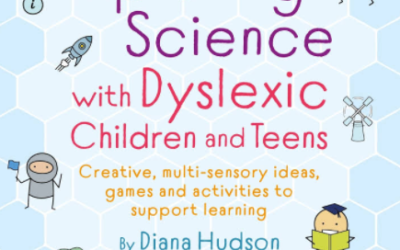
Exploring Science With Dyslexic Children & Teens
"The book begins by describing the strengths and weaknesses of creative thinkers who have dyslexia. It outlines the reasons that they may struggle in science and gives examples of specific areas of the school science curriculum that are often very challenging for...
Starting from the Positive Side of Dyslexia [Premium]
Last week I had a chance to talk with Aillie McKeever of the Schwab Learning Center at Stanford. In 2019, before COVID pandemic had fully taken hold here in the US, Stanford’s Schwab Center had decided to prioritize strengths in their approach to each and every student. They announced a “paradigm shift” to a strength’s based model of education. Every student would have a folder with a strengths section included in their assessment. Neurolearning shared its MIND Strengths Questionnaire with the center to examine the impact on students there. From Aillie: “In 2019, the MIND Strengths questions were included in this interview for every new student. Doing this seems to amplify students’ recognition of their strengths. As Learning Specialists leading the interviews, we noticed that […]
The Double Whammy: Dyscalculia and Dysgraphia [Premium]
What happens when a student has both dyscalculia and dysgraphia? Be prepared for an educational path that has a timing of its own. Dysgraphia often accompanies dyslexia, but dyscalculia too. If you or your student has two or three out of these 3 “d’s” be prepared for a challenging course and a need for individualization for many years. The most typical presentation for dyscalculia relates to students who have trouble mastering the sequence of numbers and recall of basic math facts. When dysgraphia gets added to the mix, you can imagine how it may swamp working memory, causing students to lose track when they work through math problems. In a very real sense having both dyscalculia and dysgraphia also robs students of being able to […]
Quick or Slow Remediation? [Premium]
The learning challenges of dyslexia can be very mild or quite severe, but the severity of challenges are not the sole determination of whether remediation will be quick or slow. Once we visited an elite private school for dyslexia on the East Coast. Their aim to get students through their program in 2 years, in part, was successful. The school had solid training of its teachers and great resources, but the program was not unlike other structured literacy programs. Why was it that they could get students through so fast with their programs? Part of the answer was the strict criteria they had for student admission. With a long waitlist for spots, they had decided to accept to their program only students who had strong […]
Algebra: What Students See and What Mathematicians See [Premium]
Ben Orlin is the author of Math with Bad Drawings and Change is the only Constant: The Wisdom of Calculus in a Madcap World. Besides have a good sense of humor, Ben is good at recognizing the differences in the way students and mathematicians see math problems. Take for example, the math problem, What is 7 x 11 x 13. What goes through your mind when you see a problem like that? I reach for my calculator, or might try 7 x 11 first, then look for a pen a paper, but what Ben suggests is that mathematicians imagine this. The following examples Ben shared about Algebra had me laughing aloud: The mathematician’s simplification involves recognizing a pattern. But […]
Writing: Elaboration [Premium]
If you were to compare dyslexic and non-dyslexic university students in writing, it’s usually the case, that on average, dyslexic students write fewer words and fewer words that are polysyllabic. The reasons are several; slowness with word retrieval, writing, and spelling, organizational challenges, and working memory overload are likely contributors. Because multisyllabic words are more challenging phonemically, not only are they harder to recognize and remember while reading, but also they are harder to spell. THE BIG PICTURE OF ELABORATION The big picture of elaboration is that you want writers to fall in love with words, whether it’s a beautiful passage evoking imagery, or funny turn of phrase, or incisive argument. Students who are the easiest to cultivate as great writers are those who […]
Clever Ways To Practice Repeated Reading [Premium]
It was in the late 1970’s that educational researchers began to question the practice of reading aloud different tasks as a way to make children more fluent readers. With this approach, every new day saw new challenges reading aloud for struggling readers so that they failed to gain proficiency, and if anything were more likely to develop a dislike or avoidance of reading. What actually showed greater success with reading fluency, was giving students repeated practice with the same passage. The general approach is to have a student or teacher pick a passage (a quote, poem, excerpt from a poem) that is 50-300 words long. The teacher or partner reads it aloud, then the student (echo reading). The goal is to have the student read […]