An important paper was published this month from the University of Washington, entitled “Evidence-Based Reading and Writing Assessment for Dyslexia in Adolescents and Young Adults.” The paper is especially important guiding testing professionals who assess teens and adults for dyslexia or see gifted or twice-exceptional students. This paper also takes a more systematic look at the roles of individual factors like working memory and executive function on dyslexia and reading and spelling performance. The data will be helpful in targeting educational interventions and can also guide requests for testing accommodations. There are interesting observations too in that paper that will help with characterizing the strengths that occur among adolescent and adult dyslexics, with implications for twice-exceptional or gifted students with dyslexia. In several areas, adolescent / adult […]
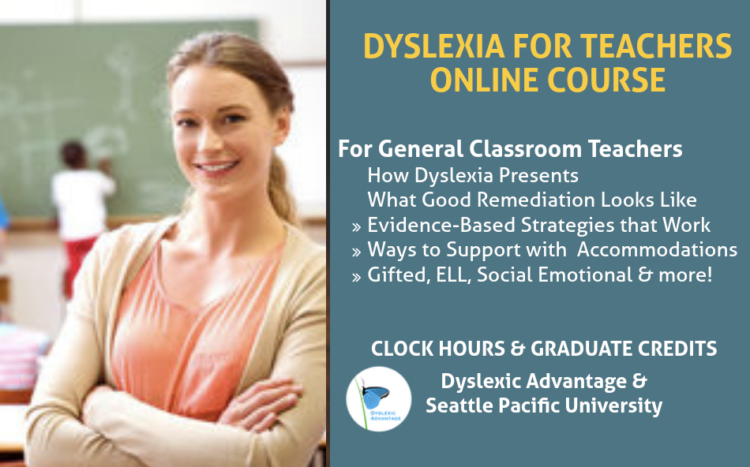
How to Help a Dyslexic Student in a General Education Classroom
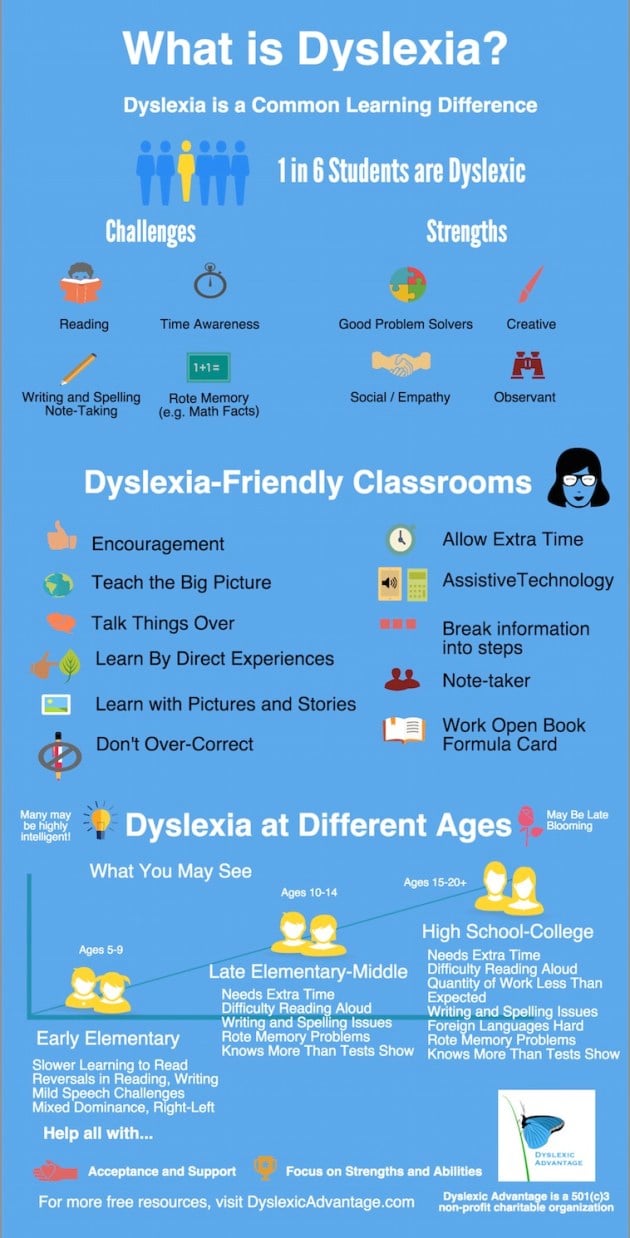
From the Connecticut Longitudinal Study, up to 1 in 6 students are dyslexic, but only a minority of these students will be found in special education classrooms. What does this mean for regular classroom teachers? 1. Get Basic Facts about Dyslexia - Dyslexic students...
Dyslexia Laws
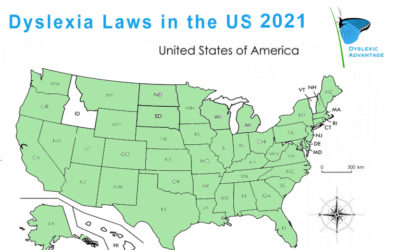
Here's our 2021 snapshot of Passed Dyslexia Laws in the US. This is a rapidly changing time for dyslexia legislation, so please update us with corrections, changes, or newly passed laws. Huge thanks to the Dyslexic Advantage community, Decoding Dyslexia, and other...
Doing Math : Inchworms vs. Grasshoppers [Premium]
‘If a child does not learn the way you teach then teach him the way he learns.’ Two American school teachers noticed that their students tended to prefer one of the two ways their teachers explained math. The inchworm style was part-to-whole, dutifully performing incremental step-by-step pencil work, following the solving of math problems more like a recipe than an intuitive leap. The grasshopper, on the other hand, was the big picture leaper, more likely to subtitute numbers (rounding up or down), use mental math strategies, working backwards from an example solved question. What strategy to most dyslexic students prefer? The answer seems to vary. In UK research (Chinn et al., 2001), dyslexic inchworms seemed to outnumber grasshoppers, but Miles and Miles (also in the […]
Your Brain on Math Anxiety [Premium]
This is your brain with math anxiety. In children as young as 7 years old, researchers found that activation in areas such as the amygdala and hippocampus were seen in children who had high math anxiety. The amydala and hippocampus are areas of the brain associated with fear condition and negative emotions. The children were given simple and complex arithmetic problems and asked to determine whether the answers given were right or wrong. The children in the high and low anxiety group were matched for IQ, working memory, reading and math performance, and general trait anxiety. As a double burden, the high math anxiety group (HMA) in the figure showed lower brain fMRI activation in areas associated with math processing. So anxiety could be acting […]
What is Dyscalculia? – Fast Facts [Premium]
“There is nothing in the IDEA that would prohibit the use of the terms dyslexia, dyscalculia, and dysgraphia in IDEA evaluation, eligibility determinations, or IEP documents.” – Michael Yudin, Department of Education “Dyscalculia is not assessed in our schools.” – school professional Fast Facts about Dyscalculia What Is Dyscalculia? Dyscalculia is usually defined as a difficulty with calculations or arithmetic skills that is not explained by low intelligence or inadequate schooling. How Common? 3-10% of people, 40% of dyslexics What Ages? Dyscalculia is lifelong, although many helpful strategies can improve math achievement. When adults with dyscalculia have calculator accommodations, they can perform at high levels in even mathematics-intense disciplines. From We Are Teachers How Do You Assess Dyscalculia? Typically dyscalculia is assessed by calculating the […]
[PREMIUM] Tips for Listening in Foreign Language Classrooms
Although for some dyslexic students the listening component of foreign language classes is an area of strength, many have significant challenges that teachers should be aware of in order to have a successful year. MULTISENSORY AND EXPLICIT INSTRUCTION TO HELP WITH AUDITORY DISCRIMINATION Dyslexic students can have significant challenges in the auditory discrimination of quick sounds, making the accurate learning of new words especially difficult. Teach sounds in a multisensory way, using pictures and actions and also exaggerating tricky or quick sounds and clapping out syllables so no parts of words will be skipped. Some students may need to have explicit instruction in how certain sounds are generated. Working with a mirror and receiving feedback about correct mouth and tongue positions while saying certain words […]
How to Not Hate and Dread High School
It's not easy. There are lots of reasons to hate or at least strongly dislike high school. What if you've done what you could to self-advocate and educate your teachers and classmates, but can't help but dread going back to school every day? Here are some tips from...
SELF-ADVOCACY: Common Accommodations and Modifications
KNOW! One of the first steps in advocacy is knowing which accommodations and or modifications you need. ASK! Here's a nice list from the state of CT. There's a reason this article is filed under "Self-Advocacy". Students should be aware that they...
HOW THEY DO IT! University Students with Dyslexia [Premium]
Fortunately, there’s been growing interest from educational and scientific researchers for understanding how people can compensate for some of the academic challenges of dyslexia. POSITIVE FACTORS AMONG UNIVERSITY STUDENTS WITH DYSLEXIA A recent study by Drs. Rebecca Wiseheart and Lori Altmann (Int J Lang Comm Dis 2017) had a nice review of compensating factors as well as providing some new research data about oral fluency among college-attending dyslexic students. Background “In recent years, dyslexia has been reconceptualized as the combined sum of risk factors and protective factors. A number of protective factors have been investigated including verbal intelligence, vocabulary knowledge, morphological awareness, executive functions, and social-emotional resilience…Vocabulary knowledge has been implicated as a protective factor that allows some individuals to achieve good reading comprehension, despite […]
How to Help With the Social and Emotional Side of Dyslexia
Dr. Michael Ryan is a Michigan Clinical Psychologist who developed one of the first clinical programs for LD students at Colorado State University and he spoke at our first Dyslexic Advantage conference. From his writing at LDOnline and the IDA: How can parents and...
Screen Children with Reading Problems for Hearing Difficulties
Children with dyslexia should be screened for hearing problems, says a UK researcher, after her research team found that 1 in 4 students had significant hearing problems that were not suspected by parents. Their study also found that 1 in 3 children with a hearing...