PTSD and Dyslexia

“This study identified that emotional trauma took place in all participants, and this resulted in many having Post-Traumatic Stress Disorder manifestations as a result of returning to school for their own children. Participants still noted anger and resentment as adults towards their childhood teachers…” — Neil Alexander-Passe   In Neil’s study of PTSD or post-traumatic stress disorder in dyslexic adults in the United Kingdom, he found that all experienced emotional trauma in their time in the public school system and over half (64%) experienced PTSD or school avoidance symptoms when re-entering schools as parents, resulting in anxiety with many stating that they felt powerless as a child. PTSD symptoms occurred in the same frequency whether or not adults had achieved advanced degrees.

From […]


Bookmark

Please login to bookmark
Close
To access this post, you must be a Premium subscriber. log in

Bookmark
Please login to bookmark Close
read more

Finding the Positive

Recently, I received an email from parents of a student that we tested almost ten years ago. They were celebrating their recent news of his acceptance into his college “dream” pick. Things had looked very different a decade ago, but since that time, I know he had flourished under homeschooling, tutors, and remote schooling. He won some Dyslexic Advantage student awards and another award at the national level. Almost the same time, a letter came in sharing a similar aged student’s struggle. He was coming to the end of his academic career and yet was frustrated, embittered, and exhausted. What would the future hold for him? EDUCATIONAL MISMATCHES ABOUND FOR DYSLEXIA – FIND THE POSITIVE The reality is that educational mismatches abound for dyslexic students; […]

Bookmark

Please login to bookmark
Close
To access this post, you must be a Premium subscriber. log in

Bookmark
Please login to bookmark Close
read more

The Social-Emotional Side of Dyslexia [Premium]

“A lot of the time I take the parts of learning that are still hard for me as rejection — as someone telling me I can’t. I see points taken off for misspelled words on in-class English essays, and I start to see my future crumbling. I see the colleges that my dyslexia could prohibit me from going to. I see the kids with better scores, who don’t need tutors, or extra time, and I feel jealous. I feel worthless.” – Anna Kopelmann   The social emotional journey for dyslexic people can be complex and change over time depending on one’s life contexts, support, and environment. As few as 1 in 4 dyslexic students may be formally identified in public school systems, leaving the majority […]

Bookmark

Please login to bookmark
Close
To access this post, you must be a Premium subscriber. log in

Bookmark
Please login to bookmark Close
read more

Eugene Matusov on Teaching and Motivation [Premium]

I recently discovered Eugene Matusov’s writings on motivation and agency. He is a professor at the University of Delaware and he is also dyslexic.   I found it interesting that he ended up choosing a career teaching other teachers and yet his early years seem to be fairly traumatic in school. He had some very bad learning experiences, but also good ones, and it’s clear that today, he remembers the good teachers that impacted his life and that the choices he made in his own career were influenced as much by the negative experiences as the positives. One negative experience that was shared involved a writing assignment that many of us are all-too-familiar with – “What I Did Over Summer Vacation.” Listen to Eugene tell […]

Bookmark

Please login to bookmark
Close
To access this post, you must be a Premium subscriber. log in

Bookmark
Please login to bookmark Close
read more

Dyslexia and Motivation [Premium]

“Self-esteem and motivation are important in a child with dyslexia. It is important that they not feel like a failure just because their mind thinks in a different way. It is important to understand what dyslexia is in order to be able to understand the importance of motivation in a dyslexic child… A personal note – This is a very personal topic for me because I am dyslexic…nobody recognized that I had dyslexia until I was in college… I had gone through school thinking I was dumb…” — Dr. Eugene Matusov   INTRINSIC AND EXTRINSIC MOTIVATION One popular way of looking at motivation is to consider that there are intrinsic and extrinsic rewards. An intrinsic reward tends to be internal – something that is rewarding for […]

Bookmark

Please login to bookmark
Close
To access this post, you must be a Premium subscriber. log in

Bookmark
Please login to bookmark Close
read more

Breaking the Cycle of Shame

“How do you not to feel stupid when everyone else is learning something that you can’t grasp at the same pace? The shame of not being able to read out loud without stuttering or misspelling something on the blackboard in front of the class was almost unbearable. The fear of being called on by the teacher was paralyzing and made me act out and have panic attacks. My math teacher berated me because she thought I was being careless when I accidentally reversed numbers. I spent countless hours with frustrated but well-meaning adults who wanted to help me but just thought I wasn’t trying hard enough. All of these experiences sent me the message that I was not good enough.” – Leana Greene   Shame […]

Bookmark

Please login to bookmark
Close
To access this post, you must be a Premium subscriber. log in

Bookmark
Please login to bookmark Close
read more

The Strength Switch [Premium]

Lea Waters is a psychologist and author from Australia who has developed a helpful strategy to reframe and help common childhood challenges. She suggests 5 Questions to overcome a natural tendency to be negative.   Here are the 5 questions. 1. Is It Strength Overuse? 2. Is It Strength Underuse? 3. Is it the Flipside of a Strength? 4. Could It Be a Blocked Strength? 5. Could It Be Forced Overuse of a Weakness or a Learned Behavior?   #1. Is It Strength Overuse? Lea gives the example of her husband’s playfulness and humor. He could make his classmates laugh, but his playfulness and humor could also get him in trouble with teachers and other authority figures. From Lea: “A strength-based parent taking a child […]

Bookmark

Please login to bookmark
Close
To access this post, you must be a Premium subscriber. log in

Bookmark
Please login to bookmark Close
read more

Dyslexia and Perfectionism [Premium]

For many, college is a “perfect storm” for personal stress. Reading and writing workloads may be astronomical, student and family expectations are high, and many students for the first time may be without personal and academic supports that allowed them to enter college in the first place. College is the time when students could find their organizational and time management abilities stretched beyond their ability to cope. There are surprisingly few studies looking at coping strategies for dyslexic students in college or universities. Recently, in the United Kingdom, researchers discovered that unhealthy patterns of perfectionism may negatively impact students’ well-being and the likelihood to reach out for help. Perfectionism is now thought to be a common personality disposition characterized by the making of high personal […]

Bookmark

Please login to bookmark
Close
To access this post, you must be a Premium subscriber. log in

Bookmark
Please login to bookmark Close
read more

Sneaky Ways to Help with the Dyslexia-Related Long Word Challenges [Premium]

It’s not your imagination – it’s much harder for most children and adults with dyslexia to learn long words – and it has nothing to do with intelligence. The sneaky reason is that for most dyslexic people, learning a random sequence of sounds puts more demands on those phonological processing pathways in the brain that once made it hard to learn to read. It’s good to be aware of this difficulty and also know that it has no relationship to things like creative insight or problem solving ability, which might be sky high. It does mean that for certain subjects – like science vocabulary, geography place names, long people and place names in literature, and foreign languages, extra care and time may be necessary to […]

Bookmark

Please login to bookmark
Close
To access this post, you must be a Premium subscriber. log in

Bookmark
Please login to bookmark Close
read more

Breaking Research : Dyslexia in Adolescents and Adults [Premium]

An important paper was published this month from the University of Washington, entitled “Evidence-Based Reading and Writing Assessment for Dyslexia in Adolescents and Young Adults.” The paper is especially important guiding testing professionals who assess teens and adults for dyslexia or see gifted or twice-exceptional students. This paper also takes a more systematic look at the roles of individual factors like working memory and executive function on dyslexia and reading and spelling performance. The data will be helpful in targeting educational interventions and can also guide requests for testing accommodations. There are interesting observations too in that paper that will help with characterizing the strengths that occur among adolescent and adult dyslexics, with implications for twice-exceptional or gifted students with dyslexia. In several areas, adolescent / adult […]

Bookmark

Please login to bookmark
Close
To access this post, you must be a Premium subscriber. log in

Bookmark
Please login to bookmark Close
read more

Speak

To listen, select text and click sound button

WATCH NOW

OSPI STEM Course – STEM for Diverse Learners

Dyslexia and Gifted: Course for Psychologists

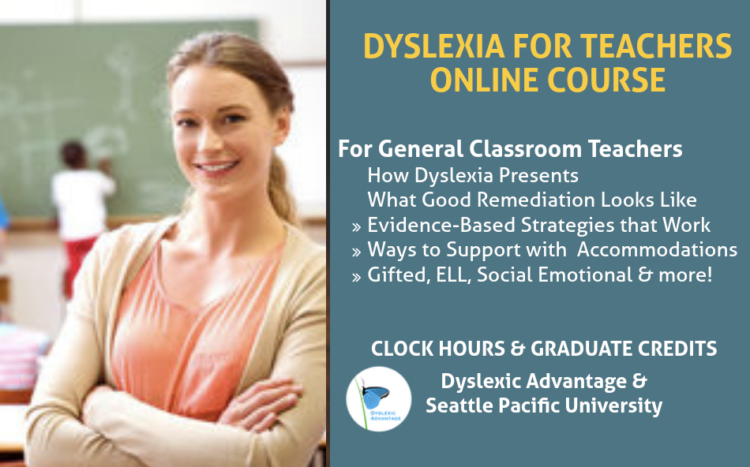
Dyslexia for Teachers Course

SPONSORS

    Discover Your Dyslexic MIND Strengths
                                    Free


Amazon Affiliate Notice

Dyslexic Advantage is an Amazon Affiliate. If you click on a link that takes you to the Amazon store, Dyslexic Advantage may earn money on qualifying purchases. Clicking HERE to enter Amazon and making a purchase may support Dyslexic Advantage. Thank you!