How Not To Give Up On Learning A Second Language [Premium]

Learning second languages are difficult for many dyslexic students; foreign language waivers or substitutions are common, but in spite of this, many can learn other languages and even multiple languages if the goal is conversation. Writing and spelling second and third language can be more difficult, but also possible for many people. Students may be more successful if they able to study over a longer time and if they have learned more about the structure of language in their native tongue. In the video below, listen to 4 Hour Work Week guru Tim Ferriss (yes, he’s dyslexic) talk about how he learned to be able to converse in many foreign languages.     The type of learning described, won’t necessarily make you a master of […]

Bookmark

Please login to bookmark
Close
To access this post, you must be a Premium subscriber. log in

Bookmark
Please login to bookmark Close
read more

Dyslexia at College: Chat With Xinru at Brown [Premium]

Recently I had the pleasure of talking to Xinru about dyslexia, college, and computer languages. Xinru’s currently studying both music and computer sciences at Brown University, an Ivy League university that is known for its “Open Curriculum” – that allows students to choose their personal course of study. But briefly, I found her when she posted her 10 Ways to Code with ADHD and Dyslexia (see below). She talks so fast, at times I had to listen to her on 1/2 speed; I think that means she’s a fast thinker too! Xinru first came to the US when she was just 8 years old; although she had trouble reading and writing in the early grades, she said she could “get away with” saying that she […]

Bookmark

Please login to bookmark
Close
To access this post, you must be a Premium subscriber. log in

Bookmark
Please login to bookmark Close
read more

Dyslexia-Friendly Technology: Customizing Your Web Reading And Listening [Premium]

With increased demands to read on phones and mobile devices, it’s more important than ever to optimize web reading for dyslexic students and adults.   There are 2 resources that you may want to check out. The first is an Unofficial Immersive Reader Chrome Extension that is free in the Google Extension store HERE. Here’s EdTech Teacher demonstrating some of it’s helpful features. The extension is unofficial because it doesn’t come directly from Microsoft. I was able to activate it quite quickly – I hope this extension is truly here to stay. The voice is quite good and there are also helpful functions like breaking down words into syllables to easier reading. It’s much better than Google’s tools. It can help with adjusting color, character […]

Bookmark

Please login to bookmark
Close
To access this post, you must be a Premium subscriber. log in

Bookmark
Please login to bookmark Close
read more

Diagramming Math [Premium]

When we tested older students in our clinic who were in college on STEM tracks, I often asked students who were proficient in mathematics, what strategies were most helpful to them. Many of them found their own ways of solving problems – often using spatial and mental math strategies or diagrams. How did they learn these approaches? Most said they figured it out themselves.   In my search for math curricula that emphasized deeper understanding and diagrammatic thinking, I came across two resources that may be valuable for you – Illustrative Mathematics and Japanese Math. Often, we may be reminded that mathematics has its own language. There are words and symbols that mean different things in every day speaking, reading, and writing vs. math. If […]

Bookmark

Please login to bookmark
Close
To access this post, you must be a Premium subscriber. log in

Bookmark
Please login to bookmark Close
read more

Resources For Reading Fluency [Premium]

Reading fluency is usually defined as an ability to read easily with little effort…with good accuracy, speed, expression, and comprehension. Reading fluency practice doesn’t take the place of decoding work, but it can be an important step that makes it likely that a person will become a lifelong reader. Strategies to improve reading fluency are many, including choral reading, echo reading, reading along with audiobooks, readers theater, sentence trees and more. As April Karl describes in the video below, reading books with repetitive text can also give student practice at reading words with a different tone.   The second video below is an example from McGraw Hill showing older students implementing practices like choral reading, Reader’s Theater, and paired reading in small groups. Some researchers […]

Bookmark

Please login to bookmark
Close
To access this post, you must be a Premium subscriber. log in

Bookmark
Please login to bookmark Close
read more

Free Structured Literacy Resources [Premium]

Even if these are unprecedented frustrating times for instruction due to the pandemic, there are occasional upsides – like the increased availability of free resources about structured literacy now available on the web. In many respects, it’s never been easier to sample different curricula, look at how others introduce lessons, and take advantage of free resources posted online. As an example, for those using the Wilson system, here is a teletherapy site where teachers have uploaded lessons.   Here is a board that can be used if you’d like to work with a student remotely or simply give your student digital manipulatives for lessons. https://sites.google.com/view/teletherapyforwilsonproviders/home           Work directly online with a board HERE. Get a copy of the board HERE.   […]

Bookmark

Please login to bookmark
Close
To access this post, you must be a Premium subscriber. log in

Bookmark
Please login to bookmark Close
read more

Surviving and Thriving in Hybrid Classrooms

With the rise in vaccinations, many schools have opened with a hybrid schedule which has some pros and cons for dyslexic students.   ONLINE ASSIGNMENTS - GROUP PARTICIPATION and AUDIO The reduction in written assignments since of the start of the pandemic has...

read more

Spatial Intelligence: Developing One of the Dyslexic Super Powers [Premium]

    Although spatial intelligence is often a “dyslexic super power” and associated with famous architects, filmmakers, inventors, and engineers, it gets surprising little education in K-12 education. What that might mean in a practical way is that many of the young members of this community might only stumble into their greatest talents by chance, or worse, not at all.   MOST CURRICULA ONLY SPECIFY NAMING AND SORTING SHAPES Math educator David Fielker noticed a surprising blind spot when it comes to math instruction with shapes: typically students are led to practice sorting and verbally classifying shapes, rather than working with them, building, adding, and taking away. It’s physically working with them, “composing and decomposing shapes, comparing and mentally manipulating two- and three-dimensional figures, and […]

Bookmark

Please login to bookmark
Close
To access this post, you must be a Premium subscriber. log in

Bookmark
Please login to bookmark Close
read more

Challenges of Pandemic Learning For Dyslexic Students

As education slowly drifts to a new normal, and parents take stock of where they are and what their priorities are in education, it is best to be aware of what to be on the lookout for because dyslexic students learn so differently. AUDITORY PROCESSING HURDLES Because...

read more

Tips From Hannah: College Junior with a 4.0 [Premium]

KNOW YOUR STRENGTHS – SELF-ADVOCATE – Early in group work, let your fellow students know that you’re dyslexic. Say, “I’m dyslexic, so I can’t read or write well, but I’m creative and can come up with ideas.” – Don’t be afraid of asking students to read things for you. You can help more if people read things aloud to you. – Research on RateMyProfessor ahead of time to find teachers that will work with you re: dyslexia. Are there any warning signs? I like choosing professors who like a lot of class participation. ASK FOR SUBSITUTIONS IF YOU NEED THEM When snow days upset the schedule at school, Hannah had to face learning material and putting together an assignment over Thanksgiving break without the help […]

Bookmark

Please login to bookmark
Close
To access this post, you must be a Premium subscriber. log in

Bookmark
Please login to bookmark Close
read more

Talking Through Math [Premium]

As the pandemic continues, more and more parents and tutors may find themselves supervising students’ math. For dyslexic students, the talking process can be especially valuable, but it may be difficult. If you are a parent or tutor helping explain a lesson or homework, it’s good to help your student talk through the steps of math; this may be especially difficult for some students. If a student has trouble finding words or has a limited working memory, talking through math may be difficult for a while until either or both of these functions develop. Such students may especially benefit when YOU talk through math, slowly and precisely. There are also ways to make the talking process easier – like having a list of math vocabulary […]

Bookmark

Please login to bookmark
Close
To access this post, you must be a Premium subscriber. log in

Bookmark
Please login to bookmark Close
read more

Speak

To listen, select text and click sound button

WATCH NOW

OSPI STEM Course – STEM for Diverse Learners

Dyslexia and Gifted: Course for Psychologists

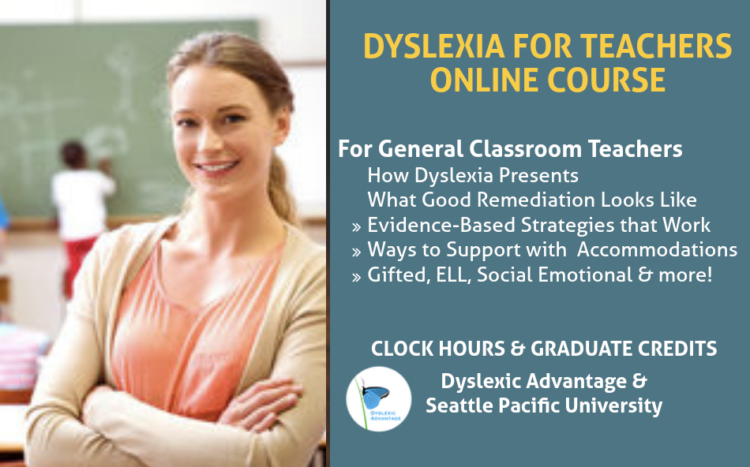
Dyslexia for Teachers Course

SPONSORS

    Discover Your Dyslexic MIND Strengths
                                    Free


Amazon Affiliate Notice

Dyslexic Advantage is an Amazon Affiliate. If you click on a link that takes you to the Amazon store, Dyslexic Advantage may earn money on qualifying purchases. Clicking HERE to enter Amazon and making a purchase may support Dyslexic Advantage. Thank you!