With the school year having come to a close, now is a good time to take stock of what worked or what didn’t for the past school year.


![Q: How Can I Modify Curricula for Dyslexic Students Without Compromising Standards? [Premium]](https://www.dyslexicadvantage.org/wp-content/uploads/2024/03/Modify-Curricula-for-Dyslexic-students-400x250.jpg.webp)
We were asked: How can I modify the curricula for dyslexic students without compromising standards? MODIFICATIONS VS. ACCOMODATIONS Usually, when 504s or IEPs are discussed, accommodations are mentioned more often than modifications. Accommodations refer to changes in the way students access content and demonstrate what they know. So for instance, an accommodation for dyslexic students might include extra time, the option to use text-to-speech, or a human reader for tests so that assessment more accurately reflect what students know. Modifications, on the other hand are changes in the content of the curriculum, homework, or what a student is expected to learn. Examples of modifications in a curriculum for dyslexic students might include fewer problems, an option to use spellcheck and a word processor for […]

There can be many hurdles facing students who have not been formally identified. Early in the school year, parents and students may be told to wait until a student has had time to adjust to class. But then when a student appears to fail without accommodations like...

This is an older post from when students were heading back to school after the pandemic. We'll keep it up in case it's helpful for other families considering homeschooling or modified schooling First off, it's best to be aware that there is rarely a perfect...

Across the United States, millions of K-12 school children take the NWEA MAP or Measures of Academic Progress tests. Using a computerized adaptive test it assesses math and reading in the early grades, and language usage and science for older students. By having...
![Dyslexia and the Illusion of Inclusion – Making Education Fit the Child [Premium]](https://www.dyslexicadvantage.org/wp-content/uploads/2016/01/illusion-inclusion.jpg)
There’s a viral post circulating on the Internet from a Texas special education professor: “It’s OK to say dyslexia!” U.S. Secretary of Education Arne Duncan tweeted shortly before his agency released guidance targeting the needs of the 2.5 million students with a learning disability. But while the government highlights the unique needs of students with learning disabilities, they are seemingly getting lost in misguided policies and practices in the name of educational equity.” What she protests (rightly) is the fact that reading and math scores for 4th and 8th graders have remained stagnant or declining since 2013. Also, in the name of inclusion, students with learning disabilities are being denied appropriate remediation because of a desire to keep them in general education classrooms. For dyslexic students, we respectfully put forth […]
![Too Much Homework for Dyslexic Students [Premium]](https://www.dyslexicadvantage.org/wp-content/uploads/2023/12/Should-I-help-with-homework-da-400x250.jpg)

"My daughter currently has an IEP. We asked that we keep her accommodations of the IEP in place but take a break from the support she is receiving from the resource teachers, with both pull out and push in. We were told that we need to revoke her IEP in order to do...
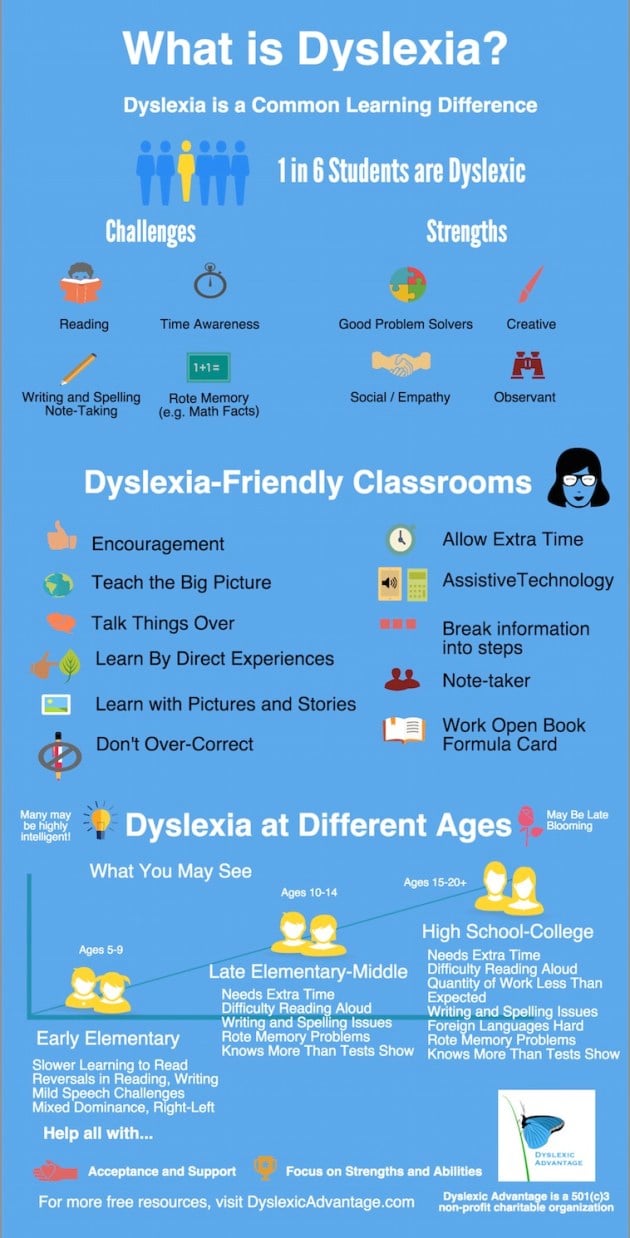
From the Connecticut Longitudinal Study, up to 1 in 6 students are dyslexic, but only a minority of these students will be found in special education classrooms. What does this mean for regular classroom teachers? 1. Get Basic Facts about Dyslexia - Dyslexic students...
![[PREMIUM] Letter for Teachers](https://www.dyslexicadvantage.org/wp-content/uploads/2018/12/Screen-Shot-2019-08-30-at-8.57.12-AM.jpg)
As the school year starts, it’s time to open up the word processing program and get to work on a letter for your student’s teachers. Letters should be customized for the particular class, subject, grade, and student’s needs. Here’s a nice example from Trish: “You have our son, *** in your second period AP Lang class. I wanted to give you a heads up that he has an IEP with accommodations. He has been professionally diagnosed by licensed psychologists as intellectually gifted, with dyslexia and dysgraphia. Dyslexia is often referred to as an invisible disability, and ____ has in the past had either his intelligence or his disabilities underestimated, as they can camouflage each other. He is an extremely hard worker, tries hard to overcome […]

The U.S. Department of Education has just released guidelines in light of the recent unanimous US Supreme Court Decision Endrew F. vs. Douglas County School District. That decision interpreted the scope of FAPE (free appropriate public education) to mean that a school’s educational program must provide “more than de minimus” educational benefit. “De minimus” is a latin term meaning trivial or minimal. According to the court, “every child should have the chance to meet challenging objectives.” The new guidelines from the government can be found here: https://www2.ed.gov/policy/speced/guid/idea/memosdcltrs/qa-endrewcase-12-07-2017.pdf
We will also post the document in pdf below so it can be read using Reciteme Text to Speech (click the red button upper left of this browser for text to speech). These guidelines are particularly important […]![Surviving IEP Season [Premium]](https://www.dyslexicadvantage.org/wp-content/uploads/2017/05/Screen-Shot-2017-05-30-at-9.53.04-AM.png)
IEP season usually runs from late March through early June, and it’s a time when parents and teachers meet with the IEP team to assess the past year’s progress and also plan for changes that should take place for the upcoming year. Be aware, too, that we have a new Supreme Court decision that is holding school districts accountable. Here is an important excerpt from the Endrew F. vs. Douglas County School District decision: “The IEP must aim to enable the child to make progress. After all, the essential function of an IEP is to set out a plan for pursuing academic and functional advancement… When all is said and done, a student offered an educational program providing ‘merely more than de minimis’ [trivial or […]