With the school year having come to a close, now is a good time to take stock of what worked or what didn’t for the past school year.


![Q: How Can I Modify Curricula for Dyslexic Students Without Compromising Standards? [Premium]](https://www.dyslexicadvantage.org/wp-content/uploads/2024/03/Modify-Curricula-for-Dyslexic-students-400x250.jpg.webp)
We were asked: How can I modify the curricula for dyslexic students without compromising standards? MODIFICATIONS VS. ACCOMODATIONS Usually, when 504s or IEPs are discussed, accommodations are mentioned more often than modifications. Accommodations refer to changes in the way students access content and demonstrate what they know. So for instance, an accommodation for dyslexic students might include extra time, the option to use text-to-speech, or a human reader for tests so that assessment more accurately reflect what students know. Modifications, on the other hand are changes in the content of the curriculum, homework, or what a student is expected to learn. Examples of modifications in a curriculum for dyslexic students might include fewer problems, an option to use spellcheck and a word processor for […]

There can be many hurdles facing students who have not been formally identified. Early in the school year, parents and students may be told to wait until a student has had time to adjust to class. But then when a student appears to fail without accommodations like...

Endrew F. vs. Douglas County School District decision: "The IEP must aim to enable the child to make progress. After all, the essential function of an IEP is to set out a plan for pursuing academic and functional advancement... When all is said and done, a student...
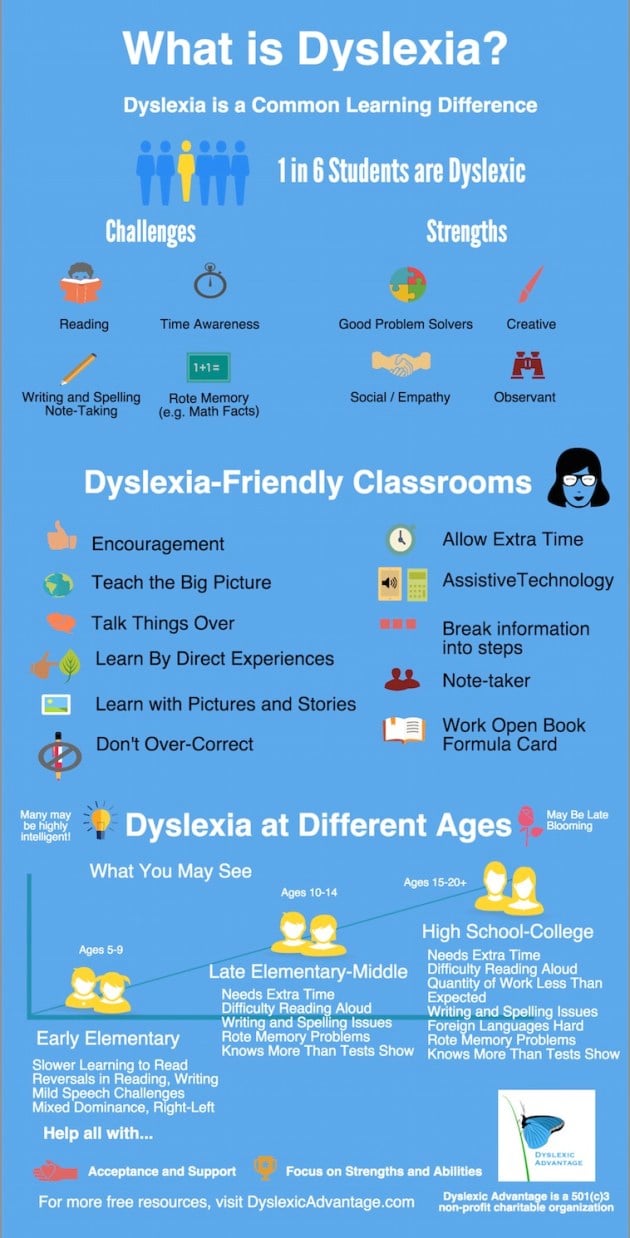
From the Connecticut Longitudinal Study, up to 1 in 6 students are dyslexic, but only a minority of these students will be found in special education classrooms. What does this mean for regular classroom teachers? 1. Get Basic Facts about Dyslexia - Dyslexic students...
![Surviving IEP Season [Premium]](https://www.dyslexicadvantage.org/wp-content/uploads/2017/05/Screen-Shot-2017-05-30-at-9.53.04-AM.png)
IEP season usually runs from late March through early June, and it’s a time when parents and teachers meet with the IEP team to assess the past year’s progress and also plan for changes that should take place for the upcoming year. Be aware, too, that we have a new Supreme Court decision that is holding school districts accountable. Here is an important excerpt from the Endrew F. vs. Douglas County School District decision: “The IEP must aim to enable the child to make progress. After all, the essential function of an IEP is to set out a plan for pursuing academic and functional advancement… When all is said and done, a student offered an educational program providing ‘merely more than de minimis’ [trivial or […]

A GREAT Supreme Court Unanimous (8-0) was handed down that states that public schools must provide more than ‘de minimus’ or the bare minimum to benefit students with disabilities. The fact that some school systems (in this case, Douglas County) were fighting the case all the way to the Supreme Court tells you that there is a need to ensure that students are receiving an education that provides “appropriately ambitious progress.” The decision is very relevant to students with dyslexia because by definition, their intelligence is in the average or above average range. The case that was decided today was Endrew vs. Douglas County which involved a student with autism and attention deficit disorders whose parents removed him from public school in the fifth grade. He made […]

New from the College Board: "Beginning January 1, 2017, the vast majority of students who are approved for and using testing accommodations at their school through a current Individualized Education Program (IEP) or 504 Plan will have those same accommodations...

The last decade has seen a great advance in the biological understanding of dyscalculia, or math disability. The DSM V groups a specific learning disorder in math (315.1) under Specific Learning Disability along with impairment in reading (315.000) and impairment in written expression (315.2). The NIH defines dyscalculia as a condition contributes to “difficulty understanding arithmetic concepts and doing such tasks as addition, multiplication, and measuring.” It is important to identify dyscalculia, because an unrecognized LD can contribute to cycles of academic underachievement, secondary behavioral and emotional issues, and obstacles to further academic or workplace advancement. With the recent addition of high-stakes exams like the calculator-free section of the new SAT, it is even more critical that students with dyscalculia be identified. The DSM V definition includes the […]
![How They Did It: Dyslexia, Gifted Ed, and SAT and ACT Accommodations [Premium]](https://www.dyslexicadvantage.org/wp-content/uploads/2016/09/Screen-Shot-2019-09-10-at-1.59.16-PM.jpg)
Today I had a chance to catch up with a member of our Dyslexic Advantage community who had just heard the great news that her 17 year old son had been granted accommodations for both the SAT and ACT, including the calculator-free section of the new SAT. This family navigated several difficult transitions: private school to public gifted school, middle to high school, and now college entrance exams. Accommodations granted this student included: Double time for reading, computer for essay, extra breaks between test sessions, reader, double time for math, double time for essay, record answers in test book, 4-function calculator on non-calculator active sections Hooray! Mom sent all the previous evaluations from All Kinds of Minds (Mel Levine’s old system), but also old speech […]

So it's begun: states like South Carolina have begun making their first professional development for teachers explaining what dyslexia is and how teachers can meet their needs of the students in their classrooms. It's a start. However, if you look at the modules (see...

In breaking news, the US Department of Education and Office for Civil Rights have released their a letter from Asst Secretary Catherine Lhamon and its Students with ADHD and Section 504 Resource Guide HERE. For your convenience, we also include them below -...