Q & A: Can I be a Doctor if I am Dyslexic? [Premium]

Answer: Yes. Absolutely. There have been many famous physicians who were dyslexic, and many today that you might not know who are dyslexic because many don’t identify in the workplace and many more weren’t formally identified. The typical profile of a dyslexic physician is to have had early troubles in elementary school, then a jump in abilities in middle to high school, and then further jump up in college and medical school. There are probably several reasons why medicine can be a popular occupation for adult (often gifted) dyslexics. First, it is a complex domain to master that nevertheless also requires an ability to grasp the big picture, make decisions, and execute a plan. Medicine is based on science, which is a strong suit and […]

Bookmark

Please login to bookmark
Close
To access this post, you must be a Premium subscriber. log in

Bookmark
Please login to bookmark Close
read more

Strategies for Addressing Math Mistakes [Premium]

Working memory mistakes in math include mistakes such as losing place in problems, errors due to missed steps or key information, calculation errors like near-misses or reversed digits, directional errors, or procedural errors like errors of grouping or carrying. In the video below, teacher Leah Alcala shares how she decided to change how she graded math mistakes in her class. Instead of putting a grade, she highlights mistakes and then gives examples of mistakes and the correct answers in class. Students have a chance to retake their test and better their final scores. This clever approach takes advantage of memory as well as intrinsic motivation and boosts what students learn in math by the time they complete her class. Working memory is such a common […]

Bookmark

Please login to bookmark
Close
To access this post, you must be a Premium subscriber. log in

Bookmark
Please login to bookmark Close
read more

MATH: The Problem with Word Problems [Premium]

For dyslexic students, the problem with word problems isn’t just the fact that they have to be read without error – but that there are many aspects of the language commonly found in word problems that will frustrate many dyslexic students if they aren’t explicitly taught where confusions arise. Here are just a few language-based sources of difficult that arise in the reading of math word problems: #1. PASSIVE VOICE Many students need to be explicitly taught about passive voice in grammar. Math problems frequently lapse into passive voice without any attention to the differences that may occur in meaning. For example, consider the differences in 8 divided by 2, 8 is divided into halves, and 8 is divided by half. In the first case, […]

Bookmark

Please login to bookmark
Close
To access this post, you must be a Premium subscriber. log in

Bookmark
Please login to bookmark Close
read more

STRENGTHS MATTER: Intelligence and Dyslexia [Premium]

Parents and dyslexia advocates should beware – there are vocal proponents arguing against the importance of intelligence and / IQ in determining the educational needs of students with dyslexia. As far as it seems we have come with dyslexia (more states with dyslexia-specific laws, mandatory teacher training), there are areas where the concept of specific learning disability and the definition of dyslexia is  coming under attack. SOME “EXPERTS” BELIEVE INTELLIGENCE IS IRRELEVANT FOR EDUCATING DYSLEXIC STUDENTS As surprising as it may seem, Past IDA Vice President Dr. Louisa Moats has argued through questionable selection of data there are “negligible cognitive differences between ‘LD’ and ‘Poor Reader’ ” groups. From her presentation online HERE, she states “Garden variety poor readers” are numerous and very much like […]

Bookmark

Please login to bookmark
Close
To access this post, you must be a Premium subscriber. log in

Bookmark
Please login to bookmark Close
read more

Connecting the Dots

"It’s refreshing to read about someone else so successful that thinks like me because of how their brain is wired, which has often only been seen as a learning disability. I’ve always known I had a different way of seeing the world which became more apparent when I...

read more

[PREMIUM] The Auditory Friendly Classroom

ENVIRONMENT – Reduce background noise as much as possible (carpeted, tennis balls on chair legs, closed doors) – Preferential seating for students – away from doors, windows, noisy heaters, overhead projectors, pencil sharpeners, noisy classmates – Allow students to wear musicians earplugs while doing quiet work. – FM Speaker or Headset   FOR STUDENTS – Sit at the front of the room with a good view of the teacher. – Request a classroom note-taker and or ask whether you can record classes. – Many students don’t realize how much they may miss by ear alone. – Choose seats away from noise sources like open doors, noisy classmates, heaters, or overhead projectors. – Use an FM speaker or headset which is known to improve classroom learning […]

Bookmark

Please login to bookmark
Close
To access this post, you must be a Premium subscriber. log in

Bookmark
Please login to bookmark Close
read more

Speak

To listen, select text and click sound button

WATCH NOW

OSPI STEM Course – STEM for Diverse Learners

Dyslexia and Gifted: Course for Psychologists

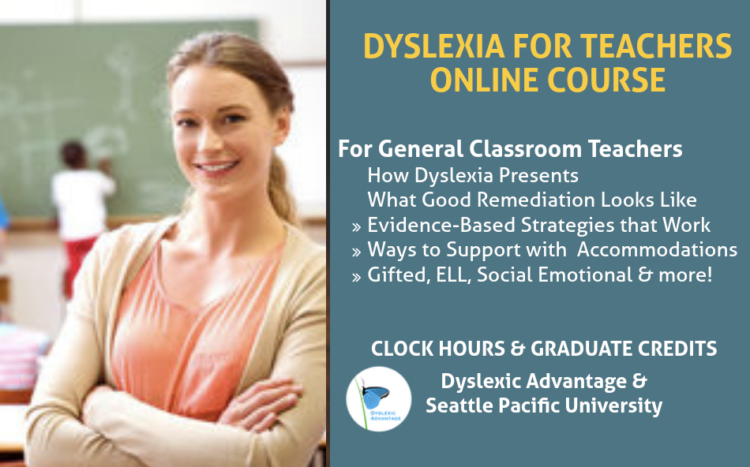
Dyslexia for Teachers Course

SPONSORS

    Discover Your Dyslexic MIND Strengths
                                    Free


Amazon Affiliate Notice

Dyslexic Advantage is an Amazon Affiliate. If you click on a link that takes you to the Amazon store, Dyslexic Advantage may earn money on qualifying purchases. Clicking HERE to enter Amazon and making a purchase may support Dyslexic Advantage. Thank you!