This category can only be viewed by members. To view this category, sign up by purchasing Premium, Premium Institutional 1 Year or STEM for Every Student - Dyslexia and More.

Common Irregular Words [Premium]

There are many common irregular words in the English language – and although some teachers and curricula may choose to postpone learning those tricky words until later, it is good, whether you’re a parent, tutor, or teacher, to have an approach to teach students how to distinguish similar words rather than simply saying that the spellings are “exceptions.” Some students are very logical – and may learn better if they are taught exceptions whenever these situations arise.   Here is an example of a tutor who uses picture associations – doodles and colors and boxes to make the different meanings and spellings of “wood” and “would” distinct:     The book series Words Their Way is one popular and fairly inexpensive approach to spelling that […]

Bookmark

Please login to bookmark
Close
To access this post, you must be a Premium subscriber. log in

Bookmark
Please login to bookmark Close
read more

A Day in the Life of a Creative Director: Guy Cornet

  “It was my dyslexia that made me who I am today.” — Guy Cornet, Creative DIrector Free Partners Creative director Guy Cornet recently reflected on his dyslexia in a recent post on Creative Bloq. It made me listen It made me relate It made me hungry It made me fair It made me think It made me understand people It made me passionate It made me have doctors handwriting It made me a creative From the interview: “A lot of neurodivergent individuals have found solace in the creative space. This is a place that has been built for people who think differently. And the industry needs fresh outlooks to stay ahead of the curve…

Being dyslexic, I found it extremely stressful working […]

Bookmark

Please login to bookmark
Close
To access this post, you must be a Premium subscriber. log in

Bookmark
Please login to bookmark Close
read more

Sensory Processing and Dyslexia [Premium]

What about Sensory Processing and Dyslexia? We recently received a question about this in regard to a young child who is dyslexic. Sensory Processing Disorder or Sensory Integration Disorder (an older term) is a term originally coined by a developmental psychologist and occupational therapist, Dr. Jean Ayres in the early 1960s. It described difficulties in sensory regulation that involved the five senses (seeing, hearing, smelling, tasting, and touch) as well as balance (proprioception – spatial orientation and movement).

Sensory Processing Disorder came to greater awareness after Carol Kranowitz published the book, The Out-of-Sync Child. Though not a formal medical diagnostic term, sensory processing disorder or SPD often presented in the toddler or early elementary school years when children were noted to be a […]

Bookmark

Please login to bookmark
Close
To access this post, you must be a Premium subscriber. log in

Bookmark
Please login to bookmark Close
read more

The Challenge of Word Problems [Premium]

Just as challenging text or long technical words can be difficult to decode without explicit instruction, so word problems in math can cause students to struggle without explicit instruction and highlight to the patterns that exist between problems. Many dyslexic students will struggle as they progress through higher levels of math without being able to grasp the big picture of what they are learning and trying to master. Teaching the different categories of word problems they are likely to encounter brings simplification and order to an otherwise chaotic accumulation of math problems.  

  One helpful free public resource for helping students with math is the math guide from the IES or Institute for Education Sciences here. Here are examples of how change […]

Bookmark

Please login to bookmark
Close
To access this post, you must be a Premium subscriber. log in

Bookmark
Please login to bookmark Close
read more

Managing Forgetfulness and Recognizing Its Benefits [Premium]

Can there be any benefits to forgetting? Not all types of memory are alike – and forgetting also takes on many different forms. STRANGE INSIGHTS INTO MEMORY FROM AI A funny thing happened when AI researchers tried to teach machines to learn many languages. Having a perfect memory – it seems, whether in machines or people – isn’t a good thing for flexible and generalizable learning. To really be super flexible learner, you have to forget. From Quanta Magazine’ How Selective Forgetting Can Help AI Learn Better: “A team of computer scientists has created a nimbler, more flexible type of machine learning model. The trick: It must periodically forget what it knows… A few years ago, Artetxe and others trained a neural network in one […]

Bookmark

Please login to bookmark
Close
To access this post, you must be a Premium subscriber. log in

Bookmark
Please login to bookmark Close
read more

MIND Strengths for Tutors: Material Reasoning [Premium]

What many tutors will have noticed is that many structured literacy strategies require frequent repetition because they focus remediation on tasks that are especially difficult for many dyslexic students – the automatic identification of the phonemes that make up words.

Bookmark

Please login to bookmark
Close
To access this post, you must be a Premium subscriber. log in

Bookmark
Please login to bookmark Close
read more

Not the Standard Track: Extracurriculars and Work Experience [Premium]

There are many ways of getting from A to Z and many of them don’t require a 4.0 GPA and elite school tracks. Dyslexics as a group may have trouble following the traditional route to their dream career because many of their academic strengths are late-blooming.

Bookmark

Please login to bookmark
Close
To access this post, you must be a Premium subscriber. log in

Bookmark
Please login to bookmark Close
read more

Fostering Creativity: The Early Life of Chuck Close [Premium]

Recently, I came across a paper, by Landmark College Professor Ken Gobbo, writing about the early life of artist Chuck Close – and this led me to an oral history recorded at the Smithsonian.

Bookmark

Please login to bookmark
Close
To access this post, you must be a Premium subscriber. log in

Bookmark
Please login to bookmark Close
read more

Dyslexia at Work: Dyslexia-Friendly Hiring? [Premium]

Research suggests that work teams that have at least one neurodiverse member are likely to be 30% more productive, but many companies have hiring practices that may exclude neurodiverse candidates before they are able to demonstrate their strengths.

Bookmark

Please login to bookmark
Close
To access this post, you must be a Premium subscriber. log in

Bookmark
Please login to bookmark Close
read more

Research Updates in Gifted Dyslexics [Premium]

Research into the Gifted Dyslexic population remains scarce, but there have been a few articles in the last years that may be helpful in identifying and supporting these students. One difficulty interpreting data from twice-exceptional research is that studies that focus solely on students with unevenness in scores may combine gifted dyslexic student scores with those who are gifted and on the autism spectrum. Because fluid reasoning scores may be very different between gifted and autistic populations, it’s difficult to draw conclusions for either group. As an example, Danika Maddocks in Gifted Child Quarterly undertook a review of 3891 K-12 school children, but failed to distinguish 2e-LD subpopulations. As a result, when she concluded that twice-exceptional LD students could outperform non twice exceptional students in […]

Bookmark

Please login to bookmark
Close
To access this post, you must be a Premium subscriber. log in

Bookmark
Please login to bookmark Close
read more

Speak

To listen, select text and click sound button

WATCH NOW

OSPI STEM Course – STEM for Diverse Learners

Dyslexia and Gifted: Course for Psychologists

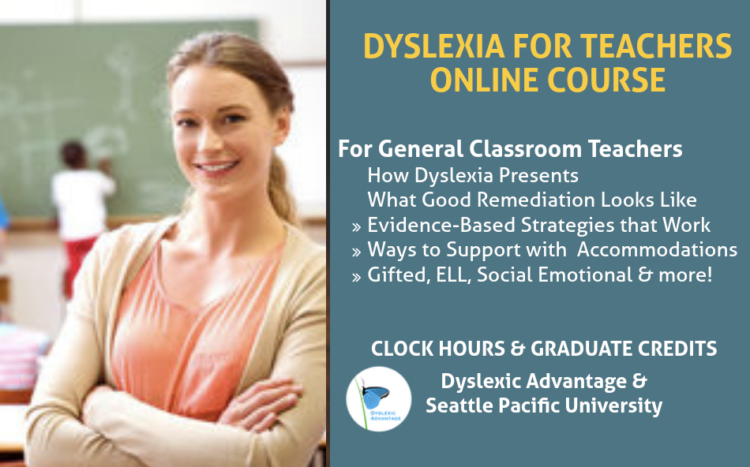
Dyslexia for Teachers Course

SPONSORS

    Discover Your Dyslexic MIND Strengths
                                    Free


Amazon Affiliate Notice

Dyslexic Advantage is an Amazon Affiliate. If you click on a link that takes you to the Amazon store, Dyslexic Advantage may earn money on qualifying purchases. Clicking HERE to enter Amazon and making a purchase may support Dyslexic Advantage. Thank you!