Research suggests that work teams that have at least one neurodiverse member are likely to be 30% more productive, but many companies have hiring practices that may exclude neurodiverse candidates before they are able to demonstrate their strengths.
![Dyslexia at Work: Dyslexia-Friendly Hiring? [Premium]](https://www.dyslexicadvantage.org/wp-content/uploads/2024/04/Dyslexia-at-Work-Dyslexia-Friendly-Hiring-Premium-1-400x250.jpg)

![Research Updates in Gifted Dyslexics [Premium]](https://www.dyslexicadvantage.org/wp-content/uploads/2024/03/Research-Updates-in-Gifted-Dyslexics-A-400x250.png)
Research into the Gifted Dyslexic population remains scarce, but there have been a few articles in the last years that may be helpful in identifying and supporting these students. One difficulty interpreting data from twice-exceptional research is that studies that focus solely on students with unevenness in scores may combine gifted dyslexic student scores with those who are gifted and on the autism spectrum. Because fluid reasoning scores may be very different between gifted and autistic populations, it’s difficult to draw conclusions for either group. As an example, Danika Maddocks in Gifted Child Quarterly undertook a review of 3891 K-12 school children, but failed to distinguish 2e-LD subpopulations. As a result, when she concluded that twice-exceptional LD students could outperform non twice exceptional students in […]
![Math and Sciences: Symbols and Dyslexia [Premium]](https://www.dyslexicadvantage.org/wp-content/uploads/2024/03/Math-and-Sciences-1-400x250.jpg.webp)
It’s important to be aware that although many dyslexics have natural strengths in math reasoning and scientific thinking, these strengths may not be evident during K-12 education because of challenges with symbol confusion and polysemous or multiple meaning words in math and science. As a result, even students with high potential in science and math may find themselves underperforming in these subjects. Few specialty teachers receive training in ways to support their dyslexic students, so students are left on their own to figure out lessons and homework. THE PROBLEM WITH SYMBOLS Symbols can be a great challenge to dyslexic students because of a common weakness in snapshot picture or eidetic memory. The same difficulty that makes it so hard to take a picture of spelling […]
![The Expansive Life of IBM’s Thomas Watson, Jr [Premium]](https://www.dyslexicadvantage.org/wp-content/uploads/2024/03/The-Expansive-LIfe-of-Tom-Watson-400x250.jpg.webp)
“Would you like me to give you a formula for success? It’s quite simple, really. Double your rate of failure.” — Thomas Watson, Jr. Recently, I had the chance to interview Tom Watson Jr’s grandson, Ralph Watson McElvenny and his co-author Marc Wortman. Tom Watson Jr. was one of those people who seemed to live larger than life. He struggled mightily as a child – and was sort of a black sheep of a talented family for years, but he found his niche – and later expanded that into multiple niches, There’s a lot to be gained from learning more about his life. From the book’s press release: “Nearly fifty years into IBM’s existence, Thomas Watson Jr. undertook the biggest gamble in business […]
![Q: How Can I Modify Curricula for Dyslexic Students Without Compromising Standards? [Premium]](https://www.dyslexicadvantage.org/wp-content/uploads/2024/03/Modify-Curricula-for-Dyslexic-students-400x250.jpg)
We were asked: How can I modify the curricula for dyslexic students without compromising standards? MODIFICATIONS VS. ACCOMODATIONS Usually, when 504s or IEPs are discussed, accommodations are mentioned more often than modifications. Accommodations refer to changes in the way students access content and demonstrate what they know. So for instance, an accommodation for dyslexic students might include extra time, the option to use text-to-speech, or a human reader for tests so that assessment more accurately reflect what students know. Modifications, on the other hand are changes in the content of the curriculum, homework, or what a student is expected to learn. Examples of modifications in a curriculum for dyslexic students might include fewer problems, an option to use spellcheck and a word processor for […]
![Organization with Automation using ChatGPT [Premium]](https://www.dyslexicadvantage.org/wp-content/uploads/2024/03/Organization-with-Automation-Using-ChatGPT-400x250.jpg)
ChatGPT is an AI or Artificial Intelligence-based program that can interact with you like a human in back-and-forth conversation. For dyslexic creatives, the potential to help with organization is immense. There are cautions about the technology, but also tremendous opportunities. FREE CHAT GPT vs PAID Currently using the free version of ChatGPT can give you a brief idea of how to communicate with the program, but information doesn’t stay long in the free version (for instance some guidelines you gave it yesterday may not be kept) and answers are also much simpler. The paid version for individuals is currently $20 per month if paid annually. The $20 per month rate allows you 40 messages in three hours. An Enterprise membership is more expensive, but […]
Nick Koshnick is a Stanford PhD and seasoned entrepreneur who raised money from companies like Google and Andreessen, and then sold the company.. He’s also dyslexic. Now, he’s co-founded StoriedWork.com with business partner Frank Corrigan. Storied has been nicknamed an “AI Co-Pilot for Non-Linear Thinkers.” Pretty quickly, Nick realized the potential of the app to empower fellow dyslexics.
NON-LINEAR THINKER? NO PROBLEM! For many dyslexic writers, one of the greatest challenges using speech to text is getting the explosion of ideas in your head into a straightforward linear text . The Storied app helps with that – you’re allowed to ramble – and in fact the app expects you to ramble. Talk about your ideas and let the app do its thing. It […]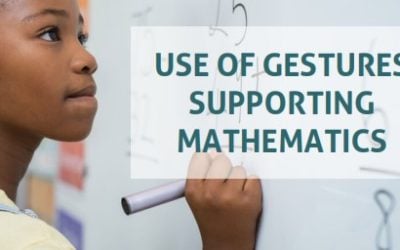
There’s an interesting paper by Hord and colleagues that showed how a secondary math teacher supported a student with LD and math anxiety using gestures. Gestures can sometimes be used to help remember and retrieve math actions and relationships in long-term memory. Gestures are like kinesthetic activities in Orton-Gillingham / structured literacy programs.. One example of a gesture is using a twisting motion in association with multiplying by a reciprocal.
Here’s another gesture that a teacher or tutor can use when multiplying equations: In the beginning, a student can work with color-coded arrows – but also air write over them before performing calculations; later when they encounter the problem on a test, having used such gestures can remind them of the spatial steps […]
Q: My 9 year old son is having trouble making progress in reading, writing, and Math because of working memory. What can help? Working memory is a type of memory that allows us to temporarily hold information ‘in mind’ to be used for other cognitive tasks. Some people refer to it as a ‘sticky note’ like remember a phone number when taking a message or directions when someone tells you where you need to go.
WORKING MEMORY LIMITATIONS AFFECT READING, WRITING, AND MATH Working memory limitations can affect reading, writing, math, and really all types of learning because if too much information is presented at once, students can lose their place, forget what’s been said, and experience what experts call “cognitive overload”. […]![Dyslexia and Music [Premium]](https://www.dyslexicadvantage.org/wp-content/uploads/2024/02/Dyslexia-and-Music-da-400x250.jpg)
“I’m dyslexic, so the notes just jump out at me. It’s the same with words too. That’s why the Key Editor in Cubase is the best thing for me as I see things in shapes and colors.” — Grammy Award-winning composer producer Lorne Balfe Here in the United States, it’s pretty uncommon to hear about dyslexia and music from the research community, but for some it’s a huge part of their lives and challenges (especially with music reading) have been noted by many. LOVING MUSIC BUT DIFFICULTY READING BY SIGHT Just as as some people love listening to stories, but avoid reading print books, many dyslexics love listening or playing music by ear but struggle with reading by sight; some may not be able to […]
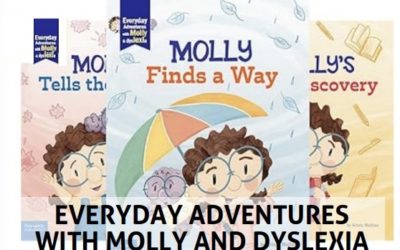
Krista’s 3-book series, Everyday Adventures with Molly and Dyslexia is now available in bookstores and online shops! These books are a wonderful way to talk to young children about dyslexia, the importance of self-advocacy, self-acceptance, and discovery of dyslexic strengths. REGISTER FOR KRISTA’S BOOK GIVEAWAY HERE These books can also be a wonderful addition to the classroom. Krista’s first book, Molly’s Great Discovery, follows Molly as she learns about her learning difference and trouble she is having with reading aloud or spelling tests and getting her ideas down on paper. At first, worried to ask for help, she gains confidence, then comes to understand her unique differences as well as that other children may have differences on the outside and inside as well. […]
![The Gift of Seeing People and Events from Multiple Perspectives [Premium]](https://www.dyslexicadvantage.org/wp-content/uploads/2024/02/The-Gift-of-Seeing-People-and-Events-from-Multiple-Perspectives-da-400x250.jpg)
There is a talent cluster that we’ve seen among dyslexics in diverse backgrounds, and it’s a gift of being able to see people and events from multiple perspectives. Within the MIND strengths framework, this could be in I for Interconnected Thinking, N for Narrative Thinking, or D for Dynamic Thinking. It is a gift to be able to visualize or or imagine a simulation of how people and events can be seen from different perspectives, and it allows empathy for people and situations that others might miss, or a connection of events that others see separately, and predictions that provide positive opportunities for bettering one’s situation or the world, or staving off problems. You might notice children who seem unusually empathetic or observant about the […]