Answer Apps and the Benefits of Learning in Reverse [Premium]

Conventional lecture courses for subjects with problem sets can be inefficient.   For dyslexic students if the information comes in too quickly, they can’t follow steps as a teacher works through problems in real time. A recurring scenario for many students (and not just the dyslexic ones) is that to truly understand, the students must work through the material themselves at home. The lucky ones have a parent, sibling, or someone else to be a tutor, while others may struggle looking at incomplete notes with only a hazy idea of what teachers did to arrive at their answers. Having teachers notes or having a flipped classroom (watch a video first, then see the problems worked by a teacher) can improve this situation, but inevitably there […]

Bookmark

Please login to bookmark
Close
To access this post, you must be a Premium subscriber. log in

Bookmark
Please login to bookmark Close
read more

Learning with Dr. Sara Renzulli [Premium]

“I was identified as dyslexic and having ADHD in the fifth grade. I struggled quite a bit academically…” — Sara Renzulli, PhD, Visiting Professor, U Conn     Recently I had the pleasure of talking to Dr. Sara Renzulli, a teacher in the Counselor Education department at the University of Connecticut, and daughter of illustrious educators, Drs. Joseph Renzulli and Sally Reis. I had discovered Sara’s interview at the 2E Newsletter and read some research publications of her work with college students. “My dyslexia made it extremely hard to learn how to read. I remember being so frustrated. If things were explained to me orally or read out loud to me, I understood what was going on. I just couldn’t decode words on my own […]

Bookmark

Please login to bookmark
Close
To access this post, you must be a Premium subscriber. log in

Bookmark
Please login to bookmark Close
read more

Finding the Word: Tip of the Tongue [Premium]

What is Tip of the Tongue? It’s trouble coming up with a word for something when you know what it is.     It’s common for people of any age to have occasional “tip of the tongue” moments, but it also gets more common as we age (mid 60’s and older especially) and more common if you’re dyslexic. As researchers increasingly probe why tip of the tongue word retrieval happens, it’s relationship to dyslexia becomes increasingly clear…it’s because that type of word retrieval is associated with phonological representations of a word. The brain does not just file the word in one file folder. There is a location for the meaning of words, the sound of words, and the visual structure of words. It’s the filing […]

Bookmark

Please login to bookmark
Close
To access this post, you must be a Premium subscriber. log in

Bookmark
Please login to bookmark Close
read more

Daydreaming While Reading [Premium]

“There are certain half-dreaming moods of mind in which we naturally steal away from noise and glare, and seek some quiet haunt where we may indulge our reveries and build our air castles undisturbed.” – Washington Irving   Daydreaming holds a curious position in the areas of science. On the one hand, daydreaming has been seen as a negative, associated with inattention and poor task persistence, but on the other, associated with creative behavior and personal inspiration. Neuroscientists have taken a renewed interest in daydreaming because daydream pathways activate the default mode network, a brain network that is now known to be important for reflecting on one’s self as well as others, remembering the past, and imagining the future. Studies of dyslexic and non-dyslexic people […]

Bookmark

Please login to bookmark
Close
To access this post, you must be a Premium subscriber. log in

Bookmark
Please login to bookmark Close
read more

Interconnected Multisensory Learning [Premium]

“My mind isn’t a train track. It’s like a web browser with lots of hyperlinks…” – Honors College Student with Dyslexia   What is interconnected multisensory learning?   INTERCONNECTED MULTISENSORY LEARNING Part of the educational challenges of growing up with dyslexia is learning how to harness the tremendous power that comes with interconnected and multisensory learning. On the advantage side, dyslexic learners are rich experiential and incidental learners. Remember that research study from Sweden and Georgetown University? “The Developmental Dyslexia group was not only not impaired at the task, but actually showed superior recognition memory (emphasis, ours), as compared to the control children. These findings complement previous reports of enhanced cognition in other domains (e.g., visuo-spatial processing) in DD. Possible underlying mechanisms for the observed […]

Bookmark

Please login to bookmark
Close
To access this post, you must be a Premium subscriber. log in

Bookmark
Please login to bookmark Close
read more

Preparing with Templates and Posters [Premium]

When interviewing accomplished people of all sorts who are also dyslexic, there are some recurring themes – and one is, “I learned how to do the ‘dyslexic thing,’ you know, overprepare.”     In some cases that means committing more hours to something – whether it was oral presentation or final project or job rotation. But often, it’s not just extra time spent; it’s also learning how to streamline certain repetitive features along the lines of “plan better” and not just “work more.” I was recently reminded of this when a social worker posted her work hacks for school and for work. One example is creating a template for her case notes:   The template streamlines repetitive information that needs to be covered and reduces […]

Bookmark

Please login to bookmark
Close
To access this post, you must be a Premium subscriber. log in

Bookmark
Please login to bookmark Close
read more

Sports and Getting Outdoors [Premium]

“He started swimming lessons when he was 3,” Terri says. “At the pool, his skills just grew and grew. By middle school he was one of the most valuable members of the swim team and the other kids looked up to him. Now in high school, Shawn still has to work hard at reading and writing, though he gets some extra help in these areas. His mom, who supports his progress in both academics and athletics, says that swimming gives him an outlet for school-related stress, and an identity he can be proud of…” – from Sports: Strengthening Self Confidence and School Skills, Yale Center Creativity & Dyslexia   For many, sports and outdoor recreation our powerful outlets sources of enjoyment, positive self-esteem, confidence, and […]

Bookmark

Please login to bookmark
Close
To access this post, you must be a Premium subscriber. log in

Bookmark
Please login to bookmark Close
read more

The Way of Resilient Readers: Vocabulary and Morphology [Premium]

There are many informal terms that have come into literature to describe “compensated” dyslexic readers. We coined the term stealth dyslexia to call attention to their pattern on psychometric tests; stealth dyslexics often had this compensated reading pattern where silent reading comprehension was much better than single word reading accuracy or oral fluency.     It’s common to see a pattern of resilient reading by dyslexic students in college or those who have been successfully remediated. Dr. Fumiko Hoeft has found that activity in the left prefrontal region seems to predict reading resilience in children (see below). Interestingly, a study by Farris et al. in the Annals of Dyslexia this year has found that strong vocabulary predicted reading resilience among college students with dyslexia. From […]

Bookmark

Please login to bookmark
Close
To access this post, you must be a Premium subscriber. log in

Bookmark
Please login to bookmark Close
read more

Creating An Environment That Works [Premium]

Sunlight, air, water, nutrients…we know these are the things that allow plants to grow and flourish, but what are the same essential factors for dyslexic students or employees?     FLEXIBILITY AND SOME CREATIVITY Good environments for dyslexics tend to be those that have some flexibility. Flexibility might take the form of how you may choose to do something vs. the standard way. In college, it might mean a reduced course load when taking difficult subjects, or at work, it might be focusing on project quality and program execution more than hours logged. The classic “bad job” for a dyslexic is work that is assembly-line, repetitive, and lock-step. Sometimes the dilemma is how to get to the good flexible jobs when you’re just starting out […]

Bookmark

Please login to bookmark
Close
To access this post, you must be a Premium subscriber. log in

Bookmark
Please login to bookmark Close
read more

College Success: Strategies

“One half of all students who begin college fail to complete their degrees, resulting in wasted talents, time, and resources… Educating students on learning skills only solves part of the problem for students at risk for dropping out of college. According to this study, students need time to learn and effectively practice the strategies in their classes.” – Sara Renzulli, PhD     It’s a striking statistic that half of all students who attend college fail to complete their degrees. Students with learning differences often comprise a significant percentage of those groups. Dr. Sara Renzulli has a practical and helpful research paper about how her intervention (a 2x per week class on learning strategies for a total of 6 sessions) had a positive effect on […]

Bookmark

Please login to bookmark
Close
To access this post, you must be a Premium subscriber. log in

Bookmark
Please login to bookmark Close
read more

Richard Branson’s Space Adventure

“Overcoming fear is the first step to success…” – Richard Branson       Richard Branson has pulled it off – the 70 year old made his own spaceport in New Mexico and hovered between the earth’s atmosphere and outer space for a few minutes, achieving weightlessness before landing back down on the spaceport’s runway. The goal, Richard said, was to make space travel “accessible to all”, of course, for most people, the cost is out of reach and not without risk. Virgin Galactic’s SpaceShip Two Rocket plane crashed in 2014, killing a test pilot.

For those of you who grew up with Apollo missions, this spacecraft looked very different. Besides ushering in a new era of space tourism, Virgin Galactic will allow […]

Bookmark

Please login to bookmark
Close
To access this post, you must be a Premium subscriber. log in

Bookmark
Please login to bookmark Close
read more

Math Strategies Without Anxiety with Stanford Prof Jo Boaler

If you anticipate working with a student on math this coming year, what approach will you take?   Dr. Jo Boaler has tips that can help create a positive atmosphere for learning.         To read the entire handout with the excerpt above (including links), click HERE.

In the video below, see how Jo taught students how to become comfortable with consider multiple strategies when solving math problems.         Bookmark Please login to bookmark ClosePlease login to access.

Bookmark

Please login to bookmark
Close
To access this post, you must be a Premium subscriber. log in

Bookmark
Please login to bookmark Close
read more

Speak

To listen, select text and click sound button

WATCH NOW

OSPI STEM Course – STEM for Diverse Learners

Dyslexia and Gifted: Course for Psychologists

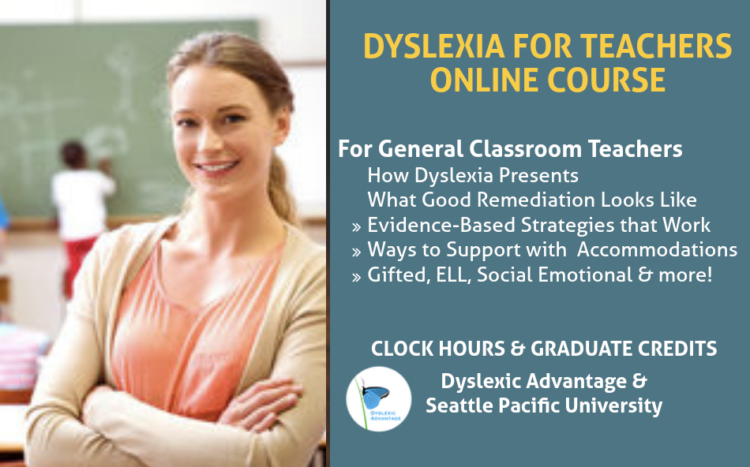
Dyslexia for Teachers Course

SPONSORS

    Discover Your Dyslexic MIND Strengths
                                    Free


Amazon Affiliate Notice

Dyslexic Advantage is an Amazon Affiliate. If you click on a link that takes you to the Amazon store, Dyslexic Advantage may earn money on qualifying purchases. Clicking HERE to enter Amazon and making a purchase may support Dyslexic Advantage. Thank you!