There are many common irregular words in the English language – and although some teachers and curricula may choose to postpone learning those tricky words until later, it is good, whether you’re a parent, tutor, or teacher, to have an approach to teach students how to distinguish similar words rather than simply saying that the spellings are “exceptions.” Some students are very logical – and may learn better if they are taught exceptions whenever these situations arise. Here is an example of a tutor who uses picture associations – doodles and colors and boxes to make the different meanings and spellings of “wood” and “would” distinct: The book series Words Their Way is one popular and fairly inexpensive approach to spelling that […]
What Can Help with Working Memory Limitations?
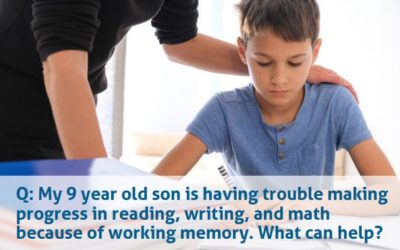
Q: My 9 year old son is having trouble making progress in reading, writing, and Math because of working memory. What can help? Working memory is a type of memory that allows us to temporarily hold information ‘in mind’ to be used for other cognitive tasks. Some people refer to it as a ‘sticky note’ like remember a phone number when taking a message or directions when someone tells you where you need to go.
WORKING MEMORY LIMITATIONS AFFECT READING, WRITING, AND MATH Working memory limitations can affect reading, writing, math, and really all types of learning because if too much information is presented at once, students can lose their place, forget what’s been said, and experience what experts call “cognitive overload”. […]Krista Weltner’s New Children’s Books: Everyday Adventure with Molly and Dyslexia
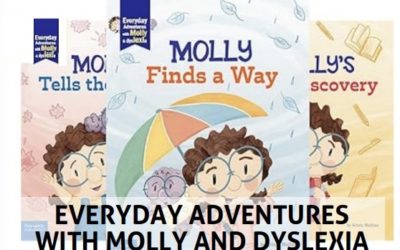
Krista’s 3-book series, Everyday Adventures with Molly and Dyslexia is now available in bookstores and online shops! These books are a wonderful way to talk to young children about dyslexia, the importance of self-advocacy, self-acceptance, and discovery of dyslexic strengths. REGISTER FOR KRISTA’S BOOK GIVEAWAY HERE These books can also be a wonderful addition to the classroom. Krista’s first book, Molly’s Great Discovery, follows Molly as she learns about her learning difference and trouble she is having with reading aloud or spelling tests and getting her ideas down on paper. At first, worried to ask for help, she gains confidence, then comes to understand her unique differences as well as that other children may have differences on the outside and inside as well. […]
Reading Hacks: How to Get the Most Out of Independent Reading
The more you read, the easier it is to read, but what if reading is still difficult? Is the best way to reading independently just toughing it out and persisting although you may be skipping words or reading at such a slow pace it’s difficult to know what you’re reading? For students, choosing the right level reading passage is important. It’s been suggested that if a reader wants to read a text independently, they should be able to decode 95-97% of the words. For older dyslexic students, this can mean texts that seem childish compared to their intellectual level. As Joanne Pierson points out, one solution to this difficulty is have dyslexic students read these texts to younger children. Another option is finding “hi-low” books […]
Dyslexia Wars: Attack on Dyslexia Definition
A brief note about about an article in Hechringer Report (also published in Scientific America). It is attacking the “unexpected” difficulty in reading (in the presence of average or above-average IQ) that has been a part of the dyslexia definition since its first clinical description in the late 1800’s as well as documented through scientific research since that time. I am opting not to share the link, because controversial articles such as these can attract “clicks” and that are credited in a positive way to the author and site, though contributing actual harm to students through misleading selective presentation of data use of emotionally-charged words. The title of the article is: “How a disgraced method of diagnosing learning disabilities persists in our nation’s schools.” […]
Severe Dyslexia Reading [Premium]
Q: My daughter is severely dyslexic and is having trouble making progress reading. She is homeschooled. How can I help? A: Ideally, the best person to provide specific information about your student’s dyslexia is the professional who performed a comprehensive assessment. The following information is not specific to your daughter, but more general information in the hopes some of it may be helpful to you. Many severely dyslexic children have trouble perceiving or remembering sounds, sound-letter associations, or the letters that comprise the different spellings of words. If a student has significant working memory limitations, she or he may also have to learn in little bits which may add to the time words are mastered. RE-LEARNING AGAIN AND AGAIN If the problem is that a […]
AI Voices Make Listening Easy
With AI, artificial voices for book reading are getting better. People who struggled with electronic voices in the past, may find themselves pleasantly surprised as AI-voices develop more natural voice pauses and even emotional tones that make listening more enjoyable and easier to keep in mind. The latest addition to free AI-read audiobooks include thousands of books in Project Gutenberg’s Open Audiobook Collection thanks to Project Gutenberg, Microsoft, and MIT. You can listen to the books on Spotify, Apple Podcasts, and Google Podcasts. If you’re new to electronic voices, check these out – they’re quite good. One of the benefits of getting used to these voices is that they’re very predictable once you get used to them (compared to human readers) and then it […]
The Importance of Guided Repeated Oral Reading in Training of Skilled Readers
By Brock Eide, MD MA, co-founder of Dyslexic Advantage and Neurolearning SPC In recent years, research on reading development has revealed that truly skilled reading requires two kinds of skills: the ability to quickly and accurately decode or “sound...
What About Audiobooks? Interview with Dyslexia Kit’s Yvonna Graham
“Audio books, turned out to be the most powerful tool I had in my toolkit.” – Yvonna Graham, MEd., author Dyslexia Toolkit Despite the widespread availability of text-to-speech and audiobooks, it’s only a small percentage of people who discover and use these tools. Parents and teachers may feel ambivalent about the use of audiobooks, especially if they believe that students need to practice reading, but the downside of withholding audiobooks or assistive technology in general is that they may deny individuals a tool that could really accelerate their reading progress. Recently, I sat down with author and dyslexia tutor Yvonna Graham to learn how she uses audiobooks and how they can accelerate reading progress rather than hamper it. Audiobooks are not a replacement for […]
The ‘Why’ of Accommodations: Motor, Language, Speed [Premium]
Although dyslexia is typically defined in terms of its effect on reading, research studies have established much broader effects on motor systems, language, and speed of processing. If professionals are not aware of these differences, they won’t request accommodations for the students who they test, and as a result, these students will miss out on supports that help them in higher education and beyond. MOTOR AND LANGUAGE – WRITING There are motor difficulties associated with dyslexia that are unrelated to reading (Turesky et al., 2023), but rather than being a difficulty affecting speed or coordination, it is more subtle – affecting automatic learning. If you are able to sign your name without thinking about all the twists and turns your fingers make for […]
Great Reading and Audiobook Apps for Summer
If you or your student haven’t tried audiobooks or e-books, summer is a great time. You can get a public library card for free, and have access to thousands of e-books, audiobooks, comics and graphic novels, and movies and magazines from the convenience of your desktop or digital device. Many libraries may even have free 1:1 tutoring and language lab for foreign or English Language Learners. Some schools also have institutional subscriptions for online book services that families can use for free. Contact your teacher or tech support at school to see what additional goodies you may qualify for before school dismisses for the summer. Remember, too, that students with dyslexia or other print disability qualify for free e-books from Bookshare. First, I want […]
Reading Mode: How to Make Web Pages Easier to Read
Do you find it easier to read webpages that aren’t cluttered? If so, you’re not alone. Popups and even photos can be distracting. Many browser reading modes offer customizations like font size, color, and sometimes character and line spacing. Typically, many dyslexic children and adults prefer slight increases in default font size, slight increases in character spacing, and double line spacing between paragraphs. After having their Reader Mode hidden for years, Google launched it officially in March, making it available on Google Chrome and Chromebooks. Here is how it works: Lifehacker has a helpful article on How to use Reader View for how to access Reader View on Safari, Firefox, and Microsoft’s Immersive Reader. For example, on Safari, there is a tiny page […]