Fostering Creativity: The Early Life of Chuck Close [Premium]

Recently, I came across a paper, by Landmark College Professor Ken Gobbo, writing about the early life of artist Chuck Close – and this led me to an oral history recorded at the Smithsonian.

Bookmark

Please login to bookmark
Close
To access this post, you must be a Premium subscriber. log in

Bookmark
Please login to bookmark Close
read more

Organization with Automation using ChatGPT [Premium]

  ChatGPT is an AI or Artificial Intelligence-based program that can interact with you like a human in back-and-forth conversation. For dyslexic creatives, the potential to help with organization is immense. There are cautions about the technology, but also tremendous opportunities. FREE CHAT GPT vs PAID Currently using the free version of ChatGPT can give you a brief idea of how to communicate with the program, but information doesn’t stay long in the free version (for instance some guidelines you gave it yesterday may not be kept) and answers are also much simpler. The paid version for individuals is currently $20 per month if paid annually. The $20 per month rate allows you 40 messages in three hours. An Enterprise membership is more expensive, but […]

Bookmark

Please login to bookmark
Close
To access this post, you must be a Premium subscriber. log in

Bookmark
Please login to bookmark Close
read more

Nick Koshnick: StoriedWork.com An AI Co-Pilot for Non-Linear Thinkers

Nick Koshnick is a Stanford PhD and seasoned entrepreneur who raised money from companies like Google and Andreessen, and then sold the company.. He’s also dyslexic. Now, he’s co-founded StoriedWork.com with business partner Frank Corrigan. Storied has been nicknamed an “AI Co-Pilot for Non-Linear Thinkers.” Pretty quickly, Nick realized the potential of the app to empower fellow dyslexics.

NON-LINEAR THINKER? NO PROBLEM! For many dyslexic writers, one of the greatest challenges using speech to text is getting the explosion of ideas in your head into a straightforward linear text . The Storied app helps with that – you’re allowed to ramble – and in fact the app expects you to ramble. Talk about your ideas and let the app do its thing. It […]

Bookmark

Please login to bookmark
Close
To access this post, you must be a Premium subscriber. log in

Bookmark
Please login to bookmark Close
read more
Is There Anything I Shouldn’t Do? [Premium]

Is There Anything I Shouldn’t Do? [Premium]

We’re often asked to give suggestions of activities or jobs that might be bad matches for people who are dyslexic, but the best answer is almost always, “It depends.” Dyslexic people tend to excel in creative activities that may include some or all of the MIND strengths (Material Reasoning, Interconnected Reasoning, Narrative Reasoning, Dynamic Reasoning). Difficult activities for dyslexics tend to include secretarial work because of its demands on proofreading and transcription, and rote repetitive jobs that require that tasks be done the same way every time. However, there are few absolute prohibitions when it comes to different activities or fields. In many fields or careers, challenges may arise, but in most cases these can be overcome with workarounds, technology, partnering with someone else, or […]

Bookmark

Please login to bookmark
Close
To access this post, you must be a Premium subscriber. log in

Bookmark
Please login to bookmark Close
read more

Don’t Do This: Dyslexia in The General Classroom [Premium]

With all the demands that teachers face regarding classroom management, and the pressures getting students up to speed in reading and math, dyslexic students may find themselves experiencing additional stress from common classroom practices. We now know that as a group, dyslexic children are more emotionally reactive than their classroom peers (UCSF research). In addition, we know that over half of dyslexic adults experience symptoms of post-traumatic stress disorder when returning to school settings as parents.     In the the Dyslexia at School study from Dyslexic Advantage, 43% of parents surveyed reported that their student was punished because of dyslexia-related challenges. What were some the punishments recorded? – given extra homework – physical seclusion (work in hallway or closet) – singled out in classroom […]

Bookmark

Please login to bookmark
Close
To access this post, you must be a Premium subscriber. log in

Bookmark
Please login to bookmark Close
read more

Question: My 5th Grader is Refusing Structured Literacy What Should I do? [Premium]

My 5th Grader is refusing structured literacy, what should I do? The following is general and not specific advice. The best advice comes from someone who knows your student and also knows in more detail what your student has been experiencing. REFUSING STRUCTURED LITERACY It’s generally accepted that structured literacy is the remediation of choice for students who are struggling significantly with reading and individual word decoding. There are many reasons why students may struggle with and ultimately give up on structured literacy. They may be depressed and worn out or mismatched with a curriculum, teacher or tutor. Sometimes what worked for a student in the past won’t work for them now because the progress is slow, or they decode sufficiently that they prefer to […]

Bookmark

Please login to bookmark
Close
To access this post, you must be a Premium subscriber. log in

Bookmark
Please login to bookmark Close
read more

Dyslexic Toymakers and Gamemakers : Howard Wexler

  Many dyslexic kids and adults are great at games – all sorts of games. Not surprisingly, some decide to make games themselves and then some choose careers in some aspect of the game industry. There may be an ability to see game play from multiple perspectives including different points of view, while those who win these games are often good at strategy, role play, and pattern recognition. Among game creators, strengths in humor, and divergent and playful thinking are very well-suited to inventing new games. Some years ago, legendary toy inventor Howard Wexler gave our community a webinar about his life inventing toys. As a kid, he played with Tinkertoys and enjoyed taking things apart. His toys and games were very different from each […]

Bookmark

Please login to bookmark
Close
To access this post, you must be a Premium subscriber. log in

Bookmark
Please login to bookmark Close
read more

Redefining Dyslexia [Premium]

In the past year, there have been some remarkable papers published in the field of dyslexia. By and large, the changes seem to be good news and more inclusive of the diverse ways that dyslexia presents – including gifted individuals with dyslexia. But change is likely to be messy – and schools and educational and research groups are likely to different and present different information to students and their families. THE PENDULUM SWINGS AGAIN ON DISCREPANCY Although the earliest professional accounts about dyslexia recognized the unexpected connection of high intelligence with difficulties in reading, writing, and spelling, the dyslexia field has been involved in many warring opinions about whether cognitive tests are worthwhile. Without pointing fingers, many researchers and educational leaders over the years questioned […]

Bookmark

Please login to bookmark
Close
To access this post, you must be a Premium subscriber. log in

Bookmark
Please login to bookmark Close
read more

What About Audiobooks? Interview with Dyslexia Kit’s Yvonna Graham

  “Audio books, turned out to be the most powerful tool I had in my toolkit.” – Yvonna Graham, MEd., author Dyslexia Toolkit Despite the widespread availability of text-to-speech and audiobooks, it’s only a small percentage of people who discover and use these tools. Parents and teachers may feel ambivalent about the use of audiobooks, especially if they believe that students need to practice reading, but the downside of withholding audiobooks or assistive technology in general is that they may deny individuals a tool that could really accelerate their reading progress. Recently, I sat down with author and dyslexia tutor Yvonna Graham to learn how she uses audiobooks and how they can accelerate reading progress rather than hamper it. Audiobooks are not a replacement for […]

Bookmark

Please login to bookmark
Close
To access this post, you must be a Premium subscriber. log in

Bookmark
Please login to bookmark Close
read more

Speak

To listen, select text and click sound button

WATCH NOW

OSPI STEM Course – STEM for Diverse Learners

Dyslexia and Gifted: Course for Psychologists

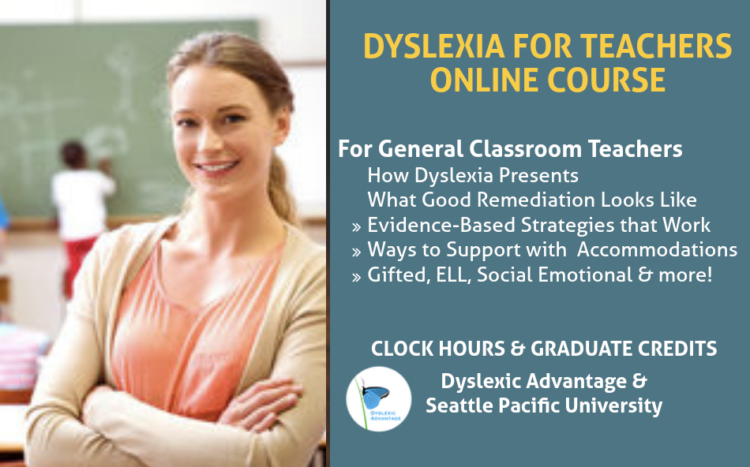
Dyslexia for Teachers Course

SPONSORS

    Discover Your Dyslexic MIND Strengths
                                    Free


Amazon Affiliate Notice

Dyslexic Advantage is an Amazon Affiliate. If you click on a link that takes you to the Amazon store, Dyslexic Advantage may earn money on qualifying purchases. Clicking HERE to enter Amazon and making a purchase may support Dyslexic Advantage. Thank you!