Learning Irregular Words [Premium]

Question: Why does dyslexia intervention focus so much on phonics and phonological awareness when so much of English doesn’t follow rules? Every comprehensive structured literacy program includes lessons and intensive practice with sight words and orthographic mapping as well as morphology (the study of words from the perspective of small meaning parts like prefixes, roots, and suffixes). So students undergoing remediation are actually becoming deep scholars of language. It can be pretty intense. Regular phonological patterns are learned first, then irregular words that don’t fall into classic phonics rules. For example, an open syllable is a syllable that ends in a vowel (the word “she”, for instance). The rule for open syllables is that the vowel is long. Closed syllables are syllables that are closed […]

Bookmark

Please login to bookmark
Close
To access this post, you must be a Premium subscriber. log in

Bookmark
Please login to bookmark Close
read more

Navigating the Non-Dyslexic World [Premium]

For almost every subject and career, there will be challenges that arise because rules and programs were designed without dyslexic people in mind. The only way things can change for the better is to have more members of the community speak up and advocate for change. Sometimes the process of self-advocacy can be exhausting, but if you stay with it day-in and day-out, educating rather than doing battle, you are usually surprised to see improvement over time. ADVANCED AND SPECIALTY CLASSES OR ACTIVITIES As individuals progress through their education and life, they master the basics of reading and writing, and other problems are encountered in spotty fashion as they enter advanced or specialty activities and classes. For example, I’ve often heard from dyslexic IT specialists […]

Bookmark

Please login to bookmark
Close
To access this post, you must be a Premium subscriber. log in

Bookmark
Please login to bookmark Close
read more

Can Artificial Intelligence (AI) Help Dyslexics? [Free Registration]

  It’s very clear that AI or Artificial Intelligence-informed software can be extremely useful in many ways for dyslexic students as well as adults. If you haven’t tried any of these programs before, you’re in for a surprise. There are also downsides to the technology (see our article, The Fight Against Robots) but AI is already embedded in many programs including Apple’s Siri, Amazon’s Alexa, and Google Assistant, and also programs like Grammarly and WordTune. Many of the best text-to-speech programs are using AI. So it’s here and the applications are immense. STUDENTS A student in New Zealand recently spoke anonymously about their use of AI for written assignments in college. They rationalized that it was like writing with Grammarly, which in the paid version […]

Bookmark

Please login to bookmark
Close
To access this post, you must have a free registration or be a Premium subscriber.

Bookmark
Please login to bookmark Close
read more

Multiplication [Premium]

Multiplication has always been my nemesis. When I was testing a student and Brock heard me hesitate when a student was answering a math fact, he took that job away from me. I know I’ve spoken about the stories and mnemonics at Multiplication.com before, but if this approach is not a match for your student, consider multiplication chart or machine approaches which also use both visual and kinesthetic approaches to remember. One thing we had in our house was a Multiplication Machine like this one from Lakeshore Learning: It’s a low-tech gadget but surprisingly is attractive for kids practicing their times tables. It especially helps those who are kinesthetic learners – pressing on the number to get the answers reinforces the facts. For kids who […]

Bookmark

Please login to bookmark
Close
To access this post, you must be a Premium subscriber. log in

Bookmark
Please login to bookmark Close
read more

Dyslexia, Art, and Science [Premium]

“Artists and scientists are curious creatures always looking for patterns…. And that’s because patterns communicate larger insights about the world around us.” — Rebecca Kamen Many dyslexic people work in fields that involve science, technology, engineering, mathematics, and art, and those career choices may be due to personal characteristics like curiosity as well as cognitive strengths involving analytical ability, creative problem solving, visualization, and hands-on problem solving. In our survey of careers of dyslexic adults in our network (please fill out here if you haven’t already), out of 106 people who answered, 42 had careers in science, technology, medicine, engineering, or the visual arts. That’s almost 40% in STEAM (science, technology, engineering, art, math) professions! If that is so, is our education preparing students for […]

Bookmark

Please login to bookmark
Close
To access this post, you must be a Premium subscriber. log in

Bookmark
Please login to bookmark Close
read more
Dyslexic Cognition and Processing Speed [Premium]

Dyslexic Cognition and Processing Speed [Premium]

Processing speed can be a very frustrating aspect of dyslexia and dyspraxia. It doesn’t have its own DSM diagnosis code and in truth, processing speed in the context of dyslexia and or dyspraxia have very different sources. Some people think that it doesn’t matter what the source of the speed problems are, but I think it’s more important than people realize. Most people in the dyslexia field don’t have the experience of being a neurologist – but it’s a pity that more people haven’t had those experiences. If you have assessed people throughout the life cycle (kids through adults) and in the setting of disease (like brain injury) or learning difference (like dyslexia), there are dramatic differences that affect learning and communication. Common issues that […]

Bookmark

Please login to bookmark
Close
To access this post, you must be a Premium subscriber. log in

Bookmark
Please login to bookmark Close
read more

You Think in Words; I Think in Pictures [Premium]

“…when I was a kid, my mother had often asked my father, ‘What are you thinking?’ He’d shrug and say, ‘Nothing’ — a response that irritated her to no end. (‘How can he be thinking about nothing?’ she’d ask me.) I’ve always been on Team Dad; I spend a lot of time thoughtless, just living life. At the same time, whenever I speak, ideas condense out of the mental cloud. It was happening even then, as I talked with my friend: I was articulating thoughts that had been unspecified yet present in my mind. My head isn’t entirely word-free; like many people, I occasionally talk to myself in an inner monologue. (Remember the milk! Ten more reps!) On the whole, though, silence reigns. Blankness, too: […]

Bookmark

Please login to bookmark
Close
To access this post, you must be a Premium subscriber. log in

Bookmark
Please login to bookmark Close
read more

Learning Outside the Lines [Premium]

Many adults with dyslexia only discovered that they were dyslexic late in life. Those who return to learning may enjoy more successes as they can choose routes of learning (and assessments) better matched to how they learn best. ONLINE LEARNING Many K-12 students may have disliked online learning based on pandemic experiences, but careful selection of online programs (some with 1:1 tutors) may result in better options than a particular classroom. If a student is failing, the school may be open to trying something different. The option to replay and re-listen, then have a tutor to follow up with additional explanations may be a way that some students can get through and succeed with math CERTIFICATIONS AND SCHOOL-TO-WORK PIPELINES The pandemic led to an explosion […]

Bookmark

Please login to bookmark
Close
To access this post, you must be a Premium subscriber. log in

Bookmark
Please login to bookmark Close
read more

The Benefits of Reading Together

It doesn’t replace early identification, remediation, and support, but reading at home supported the long term reading success of children with a positive family history of dyslexia. The study is interesting one because it followed children for 13 years! The youngest children were age 2, and by the conclusion of the study, the oldest were 23. Researchers compared various reading and language skills as well as conducting detailed interviews of family practices. READ TOGETHER What was interesting is that early shared reading with family members (from the age of 2) was associated with the development of strong vocabulary. Strong vocabulary in turn had positive protective effect on reading comprehension in adolescence. Another finding was that reading vocabulary and reading fluency at 8 years among students […]

Bookmark

Please login to bookmark
Close
To access this post, you must be a Premium subscriber. log in

Bookmark
Please login to bookmark Close
read more

Stealth or Compensated Dyslexia [Premium]

There are a variety of terms used to described individuals with dyslexia who have challenges decoding text but then evolve over time to those who can read silently with good compensation. These people can succeed in the highest levels of education and work, but still have non-reading-related challenges (for instance spelling and writing fluency, tip of the tongue word retrieval issues) that persist. We coined the term stealth dyslexia some years ago because in this setting dyslexia could fly under the radar of detection, but others have used terms like compensated or resilient dyslexia to characterize many of these individuals. IS THIS THE GOAL? If you have a student who is still in the throes of learning effective decoding, getting to the the compensated or […]

Bookmark

Please login to bookmark
Close
To access this post, you must be a Premium subscriber. log in

Bookmark
Please login to bookmark Close
read more

Your “Mini-Me” and Bullying [Premium]

English singer-songwriter Robbie Williams recently shared that he was saddened after learning that his 10-year old daughter who is like a “mini-me”, dyslexic also with musical abilities, was rejected by a friend who decided she didn’t want anything to do with her after learning that she was dyslexic. “I tried to make it clear to her that sometimes you just have to let other people go, that you should let them go – but without sacrificing your self-esteem in the process…This girl did not deserve her love and friendship…I speak from experience.” Because many adults today discover that they are dyslexic only after their children are identified in school, this reliving the school and social-emotional stresses as their own children try to navigate their lives […]

Bookmark

Please login to bookmark
Close
To access this post, you must be a Premium subscriber. log in

Bookmark
Please login to bookmark Close
read more

Speak

To listen, select text and click sound button

WATCH NOW

OSPI STEM Course – STEM for Diverse Learners

Dyslexia and Gifted: Course for Psychologists

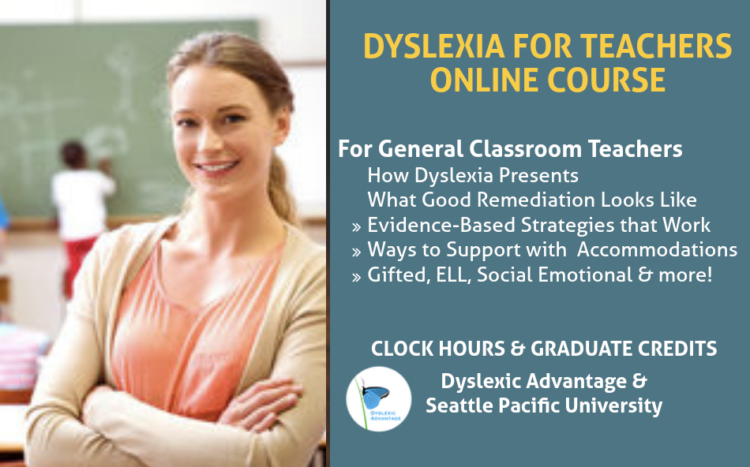
Dyslexia for Teachers Course

SPONSORS

    Discover Your Dyslexic MIND Strengths
                                    Free


Amazon Affiliate Notice

Dyslexic Advantage is an Amazon Affiliate. If you click on a link that takes you to the Amazon store, Dyslexic Advantage may earn money on qualifying purchases. Clicking HERE to enter Amazon and making a purchase may support Dyslexic Advantage. Thank you!