Resources For Reading Fluency [Premium]

Reading fluency is usually defined as an ability to read easily with little effort…with good accuracy, speed, expression, and comprehension. Reading fluency practice doesn’t take the place of decoding work, but it can be an important step that makes it likely that a person will become a lifelong reader. Strategies to improve reading fluency are many, including choral reading, echo reading, reading along with audiobooks, readers theater, sentence trees and more. As April Karl describes in the video below, reading books with repetitive text can also give student practice at reading words with a different tone.   The second video below is an example from McGraw Hill showing older students implementing practices like choral reading, Reader’s Theater, and paired reading in small groups. Some researchers […]

Bookmark

Please login to bookmark
Close
To access this post, you must be a Premium subscriber. log in

Bookmark
Please login to bookmark Close
read more

Bridging the Gap to Reading Long Words [Premium]

 In our last post, we wrote about the 3rd grade gap or wall. Dyslexic students typically get through the hard slog of phonemic awareness and then parents and teachers breathe a sigh of relief. Many times, the extra work fades away and students are integrated back into their usual classroom routine. All seems well, but a problem may remain. Reading remains effortful and the complexity of the text goes up. Students may not be able to keep up. With little extra help and too little time to complete assignments, the “guess and go” approach may dominate the reading strategy so that the gap between peers increases. A large part of the problem may be that students have not effective strategy to read long words. These problems can come […]

Bookmark

Please login to bookmark
Close
To access this post, you must be a Premium subscriber. log in

Bookmark
Please login to bookmark Close
read more

Dyslexia and the Third Grade Wall [Premium]

If you’re not aware if the ‘3rd Grade Wall’, you can get blind-sided. A recurring theme that we hear about when we interview accomplished dyslexic men and women is the trouble and failure (often grade retention) that happens in the 3rd grade. Why?  What’s the big deal about the 3rd grade? From Time Magazine, “Take a guess: What is the single most important year of an individual’s academic career? The answer isn’t junior year of high school, or senior year of college. It’s third grade. What makes success in third grade so significant? It’s the year that students move from learning to read — decoding words using their knowledge of the alphabet — to reading to learn. The books children are expected to master are no […]

Bookmark

Please login to bookmark
Close
To access this post, you must be a Premium subscriber. log in

Bookmark
Please login to bookmark Close
read more

How to Read to Kids with Dyslexia – Reading As a Conversation [Premium]

 There are many good ways to read to children with dyslexia. In this post, we wanted to talk share an approach that some have called “dialogic” or like a dialogue. A dialogue is a back and forth conversation, and that is exactly how this style of reading goes. Rather than having a parent or teacher read aloud with a child listening, in dialogic reading, the adult helps the child tell the story. The acronym for this method is PEER: 1. Prompt a child to say something about the book. 2. Evaluate her response. 3. Expand the response by rephrasing and adding more detail, and 4. Repeat the prompt to make sure the child learned. Except for the first reading of the book, PEER sequences should […]

Bookmark

Please login to bookmark
Close
To access this post, you must be a Premium subscriber. log in

Bookmark
Please login to bookmark Close
read more

[Premium] Q & A: Can People with Dyslexia Learn Speed Reading ?

  This question comes up frequently. Can older dyslexic students and adults learn ‘speed reading’ and if so, how? The short answer is YES, but it’s only usually a subset of people who can do this. Young children who are still struggling with decoding are not good candidates for speed reading, but some upper elementary and older folks may be able to do it – although when they do they will likely be skimming and not reading all the words. Recently a  member of our community volunteered to share her son’s experiences with speed reading. Rather than doing software or an app, she took the low-tech approach with a workbook and exercises that had her timing her son as he read books of their own […]

Bookmark

Please login to bookmark
Close
To access this post, you must be a Premium subscriber. log in

Bookmark
Please login to bookmark Close
read more

Speak

To listen, select text and click sound button

WATCH NOW

OSPI STEM Course – STEM for Diverse Learners

Dyslexia and Gifted: Course for Psychologists

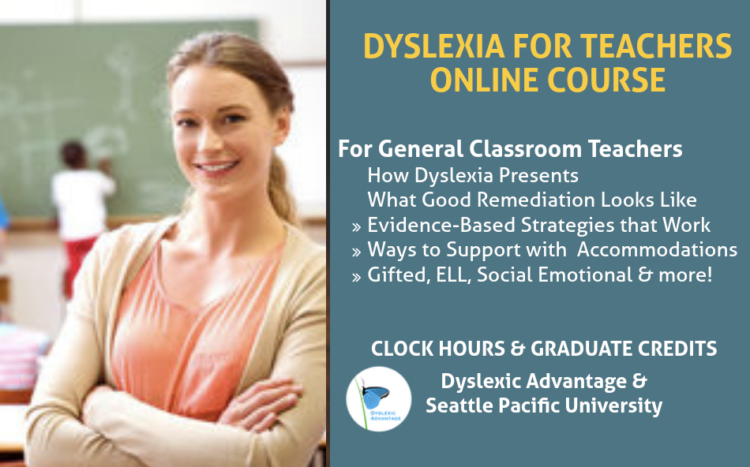
Dyslexia for Teachers Course

SPONSORS

    Discover Your Dyslexic MIND Strengths
                                    Free


Amazon Affiliate Notice

Dyslexic Advantage is an Amazon Affiliate. If you click on a link that takes you to the Amazon store, Dyslexic Advantage may earn money on qualifying purchases. Clicking HERE to enter Amazon and making a purchase may support Dyslexic Advantage. Thank you!