

If you have a 3rd grader trying to focus on reading, but he looks out the window and doesn’t make much progress – is it poor attention, working memory overload, distraction (attention to something besides a task that is assigned), lack of engagement or motivation, or something else?
And does weak attention or weak working memory matter all that much if a student seems to have strong knowledge and long term memory?
Researchers have tended to focus on one thing at a time – like attention or working memory or long term memory, or engagement, but in reality these things are all mixed together and it can be difficult sorting out where one thing is of greater importance than another.
WHAT IS ATTENTION?
Recently, researchers have become aware that attention and working memory are like two-sides of a coin. Attention refers to a spotlight that we shine on the outside world, while working memory is a spotlight directed at the contents of our minds.
When someone refers to a child or adult with attention problems, it’s as an “allor-none” difficulty that exists that interferes with learning and every day functioning. Dyslexia is not an attentional diagnosis and a student with attention or working memory limitations should not be assumed to have ADD/ADHD>
Failure to consider individual factors can inappropriately direct parents, teachers, and other professionals to thinking about disease and medication rather than addressing challenges and strengths on a granular level.
The failure to consider the relationship between outside attention and inside working memory – means that students having difficulty juggling new information will be shunted into the “attention” basket. Working memory can be addressed in instructional approaches with thought about how information is presented – like in smaller bits or with multiple reinforcing representations as can be found in many multisensory methods. In other words, it may look like a student is being inattentive, but they can actually be paying attention though overloading when too much information comes in at once and the manner of presentation doesn’t play to their strengths.
WORKING MEMORY IS MULTIMODAL
Simply Psychology has a nice review of working memory here. It includes how models of working memory have been updated to include the ideas of the brain’s central executive coordinating auditory, visual, and spatial information, but also an “episodic buffer” that can integrate various parts of working memory and long term memory into scenes or episodes.
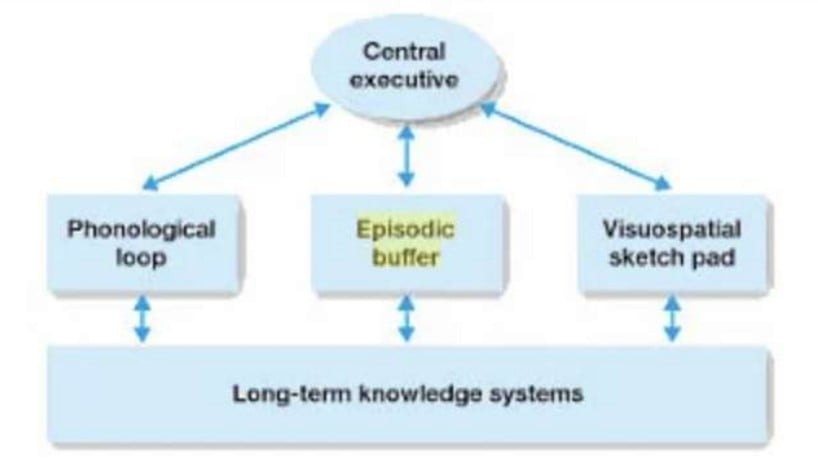
The idea about the episodic buffer is an important breakthrough in the model – because it helps explain how so many individuals with supposed “attention deficit disorder” actually have such strong knowledge abilities – and so long-term memory. If the problem were only an attention deficit, one would expect to see a weak vocabulary and smaller knowledge bases compared to peers – but not only is that not true, sometimes it’s just the opposite, when students diagnosed with ADD are also diagnosed as being gifted.
Now, it may be that a student who is not paying attention in class is inattentive because of lack of engagement or lack of challenge or working memory overload or distraction by outside phenomenon or inside thoughts – but if that is the case, then in the best case, solutions should be directed to these different reasons.
Most students will engage better in small groups or in one-on-one interactions – this may not always be possible – but it does highlight how we should all take care in how we may “diagnose” before carefully sorting out how a person learns, remembers, and works at their best.
Most theoretical models of attention don’t include engagement (interest and enthusiasm), motivation (drive to do something), and reward (something that is desirable or gives pleasure – like praise, money, or a piece of pie), but these factors may also be important for improving learning or persistence at difficult tasks in school or work settings.
ATTENTION, WORKING MEMORY, AND DYSLEXIA
Many of these different contributors to attention and school, home, or work performance may seem obvious or common sense, but where as parents and tutors may be oriented more toward a more holistic approach to parenting and teaching, science by its nature tries to understand by isolating and simplifying contributors so hypotheses can be made about what factor or factors are having effects.
Before considering what attention and working memory issues may be involved in the setting of dyslexia – it’s important to be aware of differences that accompany dyslexia that can contribute to both attentional and working memory overload.
For instance, there is substantial evidence that dyslexia affects an ability to filter sounds (auditory sensitivity or potentially increased distractibility), sensitivity to visual overload (crowding effects), and more difficulty automating motor movements that can make writing by hand more effortful.
But because that is so – is a dyslexic person’s challenges with attention or working memory really due to ADD or ADHD or rather that they have these extra things they have to deal with that puts more demands on everything – attention and working memory and episodic buffer and the central executive that is supposed to coordinate it all.
HELP ATTENTION AND WORKING MEMORY BY ALLOWING MORE TIME, SUPPORTS, AND BUILDING ON STRENGTHS
The truth is, many attention and working memory overload situations can be dealt with using practical accommodations and technology. Allowing students a copy of teachers notes and having students previewing information to be discussed in video format and increase the efficiency of learning and increase the likelihood of success.
Younger children learning to read, should have short multisensory lessons and plenty of opportunities to practice with hands-on multisensory materials like card sorts with colors and pictures. They can also engage in echo reading to minimize the demands on working memory when working on reading fluency.
Technology like speech to text and spell and grammar check can also get information down on a page to be worked on in subsequent drafts.
The topic of technology and leveraging strengths is a huge one. For more learning about this, consider becoming a Premium subscriber?